AI-Powered Compressed Air Systems Intelligence: The Invisible $40B Industrial Energy Optimization Opportunity
Every factory runs on compressed air — the "fourth utility" after electricity, water, and gas. Yet 30-50% of compressed air energy is wasted through leaks, poor maintenance, and suboptimal system design. An AI-first platform that monitors, predicts, and optimizes compressed air systems represents a massive B2B opportunity hiding in plain sight.
1.
Executive Summary
Compressed air powers 70% of all manufacturing processes — from automotive assembly lines to pharmaceutical packaging, food processing to electronics manufacturing. It's essential, expensive, and almost universally mismanaged.
The global compressed air systems market exceeds $40 billion annually, with the filter and dryer segment alone valued at $5.6 billion (growing at 5.8% CAGR). Yet the service and optimization layer remains fragmented among thousands of regional dealers, independent contractors, and manual processes.
The opportunity: An AI-powered platform that transforms reactive, phone-based compressed air service into predictive, autonomous optimization — capturing the 20-30% energy savings that most factories leave on the table.
2.
Problem Statement
Who Experiences This Pain?
Every manufacturing facility with compressed air systems — which is effectively every factory, warehouse, and production facility globally.
Plant Managers: Responsible for production uptime but lack visibility into compressed air system health until equipment fails.
Maintenance Teams: Spend 60%+ of time on reactive repairs rather than preventive maintenance. No predictive tools.
Energy Managers: Know compressed air consumes 20-30% of industrial electricity but lack granular data to optimize.
Procurement Teams: Navigate a fragmented supplier landscape with no standardized pricing or quality benchmarks.
The Core Problems
Invisible Energy Waste: Compressed air leaks are silent profit killers. The U.S. Department of Energy estimates 25-30% of compressor output is lost to leaks in a typical system.
Reactive Maintenance Culture: Equipment fails → production stops → emergency service call → expedited parts → premium pricing. This cycle repeats monthly.
Fragmented Service Ecosystem: Local dealers, OEM service arms, and independent contractors operate in silos. No data sharing, no benchmarking.
Compliance Blindness: ISO 8573 air quality standards require monitoring, but most facilities rely on periodic manual testing rather than continuous monitoring.
Phone/WhatsApp Operations: Service requests, quotes, and scheduling happen over phone calls and WhatsApp messages. Zero digital infrastructure.
Reactive model; no data infrastructure; regional only
Applying Zeroth Principles: Every existing solution assumes the OEM-dealer-factory relationship is fixed. What if we questioned whether equipment vendors should control the intelligence layer at all?
4.
Market Opportunity
Market Size
Global compressed air equipment market: $40+ billion
Industrial IoT for manufacturing: $107B (2026), 13.5% CAGR
Energy management services: $62B globally
The Energy Waste Opportunity
Compressed air systems typically account for 20-30% of industrial electricity costs. With 30-50% of generated air lost to leaks, pressure drops, and inefficient operation:
A mid-size auto parts plant: 500 HP compressor system = ~$400,000/year electricity
Conservative 25% optimization potential = $100,000/year savings per facility
India alone has 50,000+ such facilities
Why Now?
IoT sensor costs collapsed: Industrial-grade pressure, flow, and power sensors now cost <$100/unit
Edge AI matured: On-device anomaly detection runs on $35 Raspberry Pi
Energy prices volatile: Industrial electricity rates up 40%+ since 2022 in most markets
ESG pressure: Manufacturing companies face sustainability reporting requirements
Labor shortages: Skilled compressed air technicians retiring; no replacement pipeline
Applying Incentive Mapping: Who profits from the status quo? Equipment OEMs benefit from replacement cycles, not optimization. Dealers profit from emergency service calls, not prevention. Energy waste creates artificial demand for more compressors. The entire ecosystem has misaligned incentives.
5.
Gaps in the Market
Gap 1: Vendor-Agnostic Monitoring
No platform monitors Atlas Copco, Ingersoll Rand, Kaeser, and other brands simultaneously. Factories have mixed fleets.
Gap 2: Continuous Leak Detection
Ultrasonic leak surveys happen annually at best. AI-powered acoustic monitoring could detect leaks in real-time.
Gap 3: Predictive Maintenance for SME Factories
Enterprise solutions exist but cost $50,000+ to implement. The 50HP compressor at a small textile mill has zero digital infrastructure.
Gap 4: Service Marketplace
No platform connects factories to qualified service providers with transparent pricing, ratings, and scheduling.
Gap 5: Energy Optimization Intelligence
Load balancing, pressure optimization, and sequencing decisions are made manually based on experience, not data.
Gap 6: Air Quality Compliance Automation
ISO 8573 compliance requires documented monitoring. Most facilities use manual log sheets.
Applying Anomaly Hunting: What's surprising? Despite compressed air being critical infrastructure, there's no "Salesforce for compressed air" — no CRM, no ticketing system, no customer success platform. The industry operates like it's 1995.
6.
AI Disruption Angle
The Transformation
AI-Powered Compressed Air Transformation
How AI Agents Transform the Workflow
Today's Reality:
Compressor fails at 2 AM
Production stops
Maintenance calls local dealer
Dealer dispatches technician next business day
Technician diagnoses problem
Parts ordered (2-5 day lead time)
Repair completed
Factory loses $50,000-$500,000 in downtime
With AI Agents:
AI detects bearing vibration anomaly 3 weeks before failure
Agent schedules preventive maintenance during planned downtime
Parts pre-ordered based on predicted failure mode
Technician arrives with correct parts
30-minute replacement vs. 3-day emergency repair
Zero unplanned downtime
Specific AI Applications
Predictive Failure Detection: ML models trained on vibration, temperature, and power signatures predict failures 2-4 weeks in advance with 85%+ accuracy.
Acoustic Leak Localization: Ultrasonic microphone arrays + ML pinpoint leak locations to within 1 meter, reducing leak survey time from days to hours.
Dynamic Load Optimization: AI balances load across multiple compressors, optimizing for energy efficiency while maintaining required pressure and flow.
Conversational Service Interface: Factory managers chat with an AI agent via WhatsApp: "Why is compressor 3 using more power than usual?" Agent responds with diagnosis and recommended action.
Automated Compliance Reporting: Continuous air quality monitoring with auto-generated ISO 8573 compliance reports.
Applying Distant Domain Import: What field solved this? Fleet telematics. Companies like Samsara and Motive transformed truck maintenance from reactive to predictive. The same pattern — IoT sensors + AI analytics + service coordination — applies directly to industrial compressor fleets.
7.
Product Concept
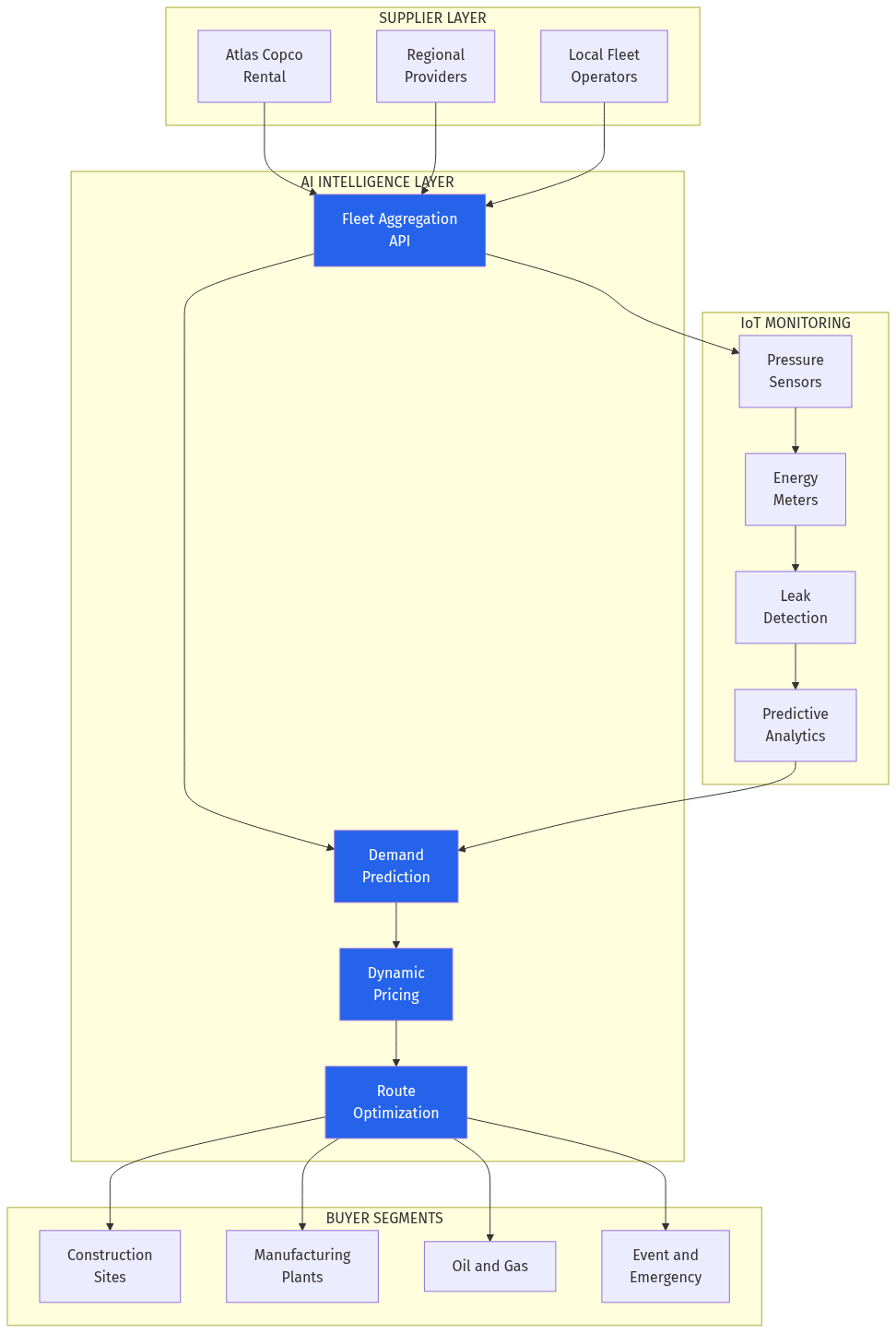
Platform Architecture
Platform Architecture
Core Features
For Factory Operators:
Real-time dashboard showing all compressors, dryers, and air treatment equipment
WhatsApp/mobile alerts for anomalies and maintenance needs
Energy consumption tracking with cost attribution
One-click service request with automatic dealer matching
For Service Providers:
Lead generation from monitored facilities
Work order management system
Parts inventory optimization recommendations
Performance benchmarking vs. peers
For Equipment OEMs:
Aggregate fleet performance data (anonymized)
Predictive warranty analytics
Customer success insights
The AI Agent Interface
Factory Manager: "Compressor 2 is making a weird noise"

AI Agent: "I've analyzed the acoustic signature. There's a 78%
probability of impeller bearing wear. Based on current degradation
rate, I estimate 2-3 weeks until recommended replacement.

I can:
1. Schedule preventive maintenance with your preferred dealer
2. Pre-order the bearing assembly (estimated ₹45,000)
3. Show you the acoustic analysis data

Which would you like?"
Insurance companies want monitoring data → new business model
12.
Why This Fits AIM Ecosystem
Market Structure Alignment
Market StructureAIM.in thesis: Structure beats scale. This market is:
✅ Highly fragmented (1000s of regional players)
✅ Offline-heavy (phone/WhatsApp transactions)
✅ High trust required (production-critical equipment)
✅ Repeat purchase model (service + consumables)
✅ Data-poor (no industry benchmarks)
Portfolio Synergies
Maintenance work order systems (existing coverage): Compressed air service integrates naturally
Industrial equipment procurement: Parts and consumables marketplace
Energy management: Cross-sell to same industrial buyer persona
Vertical Potential
This could become compressor.aim.in or industrialair.aim.in — a dedicated vertical within the AIM ecosystem serving the intersection of energy, maintenance, and industrial equipment.
## Mental Model Analysis
Falsification (Pre-Mortem)
Assume 5 well-funded startups failed here. Why?
Hardware complexity: IoT deployments in industrial environments are hard. Harsh conditions, legacy systems, IT/OT silos.
Long sales cycles: Manufacturing procurement is slow. 6-12 month decision cycles drain runway.
Service provider resistance: Dealers fear disintermediation. They may refuse to participate.
Data quality issues: Factory environments produce noisy sensor data. ML models underperform.
Limited willingness to pay: "We've always done it this way" — change management is the real competitor.
Mitigations:
Start with monitoring only (software-light entry)
Free tier eliminates procurement friction
Position as lead gen for dealers, not replacement
Industrial-grade sensors + edge filtering
Prove ROI through energy savings before upselling
Steelmanning (Best Case Against)
Why might incumbents win?
Atlas Copco and Ingersoll Rand have existing customer relationships and are building their own IoT platforms. They could bundle monitoring for free.
Equipment vendors control the install base. They can make their compressors difficult to monitor externally.
Industrial customers trust established brands for mission-critical infrastructure. A startup is a perceived risk.
Counter-argument: OEMs have vendor lock-in incentives. A neutral, multi-vendor platform serves factory interests better. The "Switzerland" positioning wins.
## Verdict
Opportunity Score: 8.5/10
Why High Score
Large, growing market with clear pain points
Technology tailwinds (IoT cost, AI maturity, energy prices)
Misaligned incumbent incentives create opening
Proven playbook (fleet telematics analogy)
Multiple revenue streams with strong unit economics
Why Not 9+
Hardware deployment complexity is non-trivial
Sales cycles in manufacturing are long
OEM response could be aggressive bundling
Recommendation
Build it. Start with energy monitoring (clear ROI), add predictive maintenance (retention driver), then layer marketplace (network effects). The fleet telematics playbook works — Samsara is a $20B company. Industrial compressed air is a larger, more fragmented market.
The "fourth utility" has been invisible for too long. AI makes it visible, measurable, and optimizable. First mover with vendor-agnostic platform wins.