ResearchThursday, February 19, 2026

AI-Powered Commercial Print & Signage Procurement Intelligence

Every business needs print—banners, packaging, signage, exhibition stalls, promotional materials. Yet procurement remains trapped in WhatsApp chaos: unclear specs, unreliable quality, missed deadlines, and zero price transparency. The $640B global print industry runs on phone calls and guesswork. AI agents can transform this into structured, predictable B2B commerce.

1.

Executive Summary

Commercial print and signage procurement is one of the last major B2B categories operating almost entirely offline. Businesses spend hours calling multiple vendors, explaining specs repeatedly, receiving wildly inconsistent quotes, and gambling on quality. The market is massive ($640B globally, $12B in India) but operates like it's 1995.

This represents a prime opportunity for an AI-powered procurement intelligence platform that:

  • Translates vague requirements into structured print specifications
  • Matches jobs to vendors based on verified capabilities, not claims
  • Predicts pricing and delivery timelines with accuracy
  • Builds quality accountability through transparent ratings
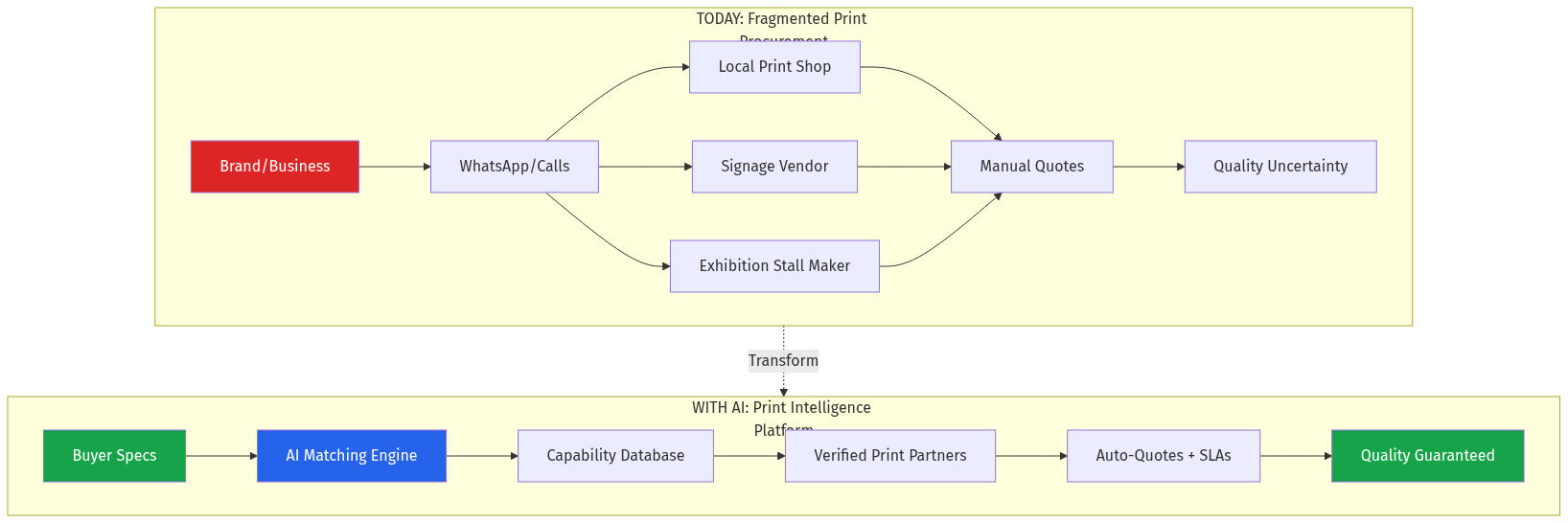
The key insight: print procurement is fundamentally a matching problem—complex specifications need to find the right production capabilities. This is exactly what AI excels at.


2.

Problem Statement

Who Experiences This Pain?

Marketing Teams & Brand Managers
  • Spend 4-6 hours per campaign sourcing print vendors
  • Receive quotes varying by 3-5x for identical specs
  • No way to verify vendor capabilities before committing
  • Quality failures discovered only after delivery
Procurement Departments
  • Cannot consolidate print spend across categories
  • No historical pricing data for negotiation
  • Compliance documentation (GST, quality certs) is manual
  • Vendor qualification is reputation-based guesswork
SME Business Owners
  • No purchasing expertise—don't know what to ask for
  • Overpay because they can't spec materials correctly
  • Burned by quality issues, afraid to try new vendors
  • Repeat purchases don't get better pricing
Event & Exhibition Managers
  • Tight deadlines with no buffer for vendor failures
  • Multiple vendors for signage, standees, backdrops, stalls
  • Coordination nightmare across 5-10 suppliers per event
  • No standardized quality benchmarks

The Core Problem

Zeroth Principles Analysis: The fundamental assumption everyone accepts is that "print procurement requires human judgment because every job is custom." But is this true?

In reality, 80% of commercial print jobs fall into predictable categories with standardized specifications. The "custom" nature is a symptom of poor information structure, not inherent complexity. A well-structured spec database could reduce most procurement decisions to matching algorithms.


3.

Current Solutions

CompanyWhat They DoWhy They're Not Solving It
IndiaMART/TradeIndiaList print vendors with basic profilesNo capability verification, no spec matching, just lead generation
Vistaprint/PrintStopTemplated commodity print (cards, flyers)Only simple products; no custom signage, exhibition, or large format
Local Print AggregatorsBroker jobs to nearby vendorsZero transparency, markup-based, no quality accountability
WhatsApp GroupsReferral-based vendor discoveryUnstructured, no specs, quality varies wildly
Alibaba/Made-in-ChinaImport-focused for bulk ordersMOQs too high, no local support, customs complexity

Incentive Mapping: Why Status Quo Persists

  • Print vendors profit from information asymmetry—they can charge wildly different prices because buyers can't compare
  • Aggregators/brokers earn margins by opacity—transparency would eliminate their role
  • Buyers lack expertise—they don't know what questions to ask, so they rely on relationships
  • Quality is subjective—no standardized benchmarks means disputes favor vendors

4.

Market Opportunity

  • Global Print Market: $640 billion (2025)
  • India Commercial Print: $12 billion
  • India Signage & Display: $3.2 billion
  • Exhibition/Event Materials (India): $800 million
  • Growth: 8-12% CAGR driven by retail expansion, events, packaging

Why Now?

  • Digital print costs dropping—more jobs economically viable
  • Retail expansion—every new store needs signage
  • Event economy recovering—exhibitions, conferences, activations surging
  • GST compliance pressure—buyers prefer organized vendors
  • WhatsApp Business limitations—can't scale coordination
  • AI capability maturity—LLMs can parse fuzzy specs into structured requirements
  • Distant Domain Import: What Can We Learn?

    From Freight Matching (Uber Freight, Convoy): They solved the "find available capacity for my load" problem by structuring truck capabilities and load requirements. Same pattern applies to print—structure vendor capabilities and job requirements. From AWS/Cloud Computing: Standardized "instance types" let customers self-select appropriate resources. Print could have standardized "job types" with clear specs and pricing. From MRO Procurement (Grainger, MSC): They built catalogs with precise specifications so buyers could compare across suppliers. Print needs the same—standardized material grades, finish types, size categories.
    5.

    Gaps in the Market

    Gap 1: No Capability Verification System

    Vendors claim capabilities they don't have. There's no way to verify machine types, material handling, finishing equipment, or maximum dimensions before placing an order.

    Gap 2: Spec Translation is Broken

    When a marketing manager says "I need a pull-up banner," they might not specify: material (vinyl vs. fabric), GSM, base type (retractable vs. X-stand), print resolution, lamination, wind resistance, or UV protection. Every undefined spec becomes a dispute vector.

    Gap 3: No Historical Pricing Intelligence

    Buyers can't answer: "What should a 10x8 ft flex banner cost?" No benchmark data exists. Every negotiation starts from zero.

    Gap 4: Zero Quality Prediction

    A vendor's past work quality is invisible. No portfolio verification, no delivery metrics, no color accuracy tracking.

    Gap 5: Multi-Vendor Coordination is Manual

    An exhibition needs 15+ print items from potentially 5+ vendors. Coordinating timelines, specs, and delivery is entirely manual.

    Anomaly Hunting: What's Strange Here?

    Strange: Repeat buyers don't get better service or pricing. Unlike other B2B categories, there's no loyalty benefit because data isn't captured. Strange: The best print vendors in any city are invisible online. They survive on referrals and don't need digital marketing. This creates discovery failure for new buyers. Strange: Print vendors don't specialize publicly. A shop that excels at packaging may also claim to do exhibition stalls—badly.
    6.

    AI Disruption Angle

    The Vision: Print Procurement Agents

    Architecture Diagram
    Architecture Diagram
    Phase 1: Intelligent Spec Builder AI agent interviews buyer conversationally:
    • "What's this for? Indoor or outdoor?"
    • "How long does it need to last?"
    • "Any specific brand guidelines?"
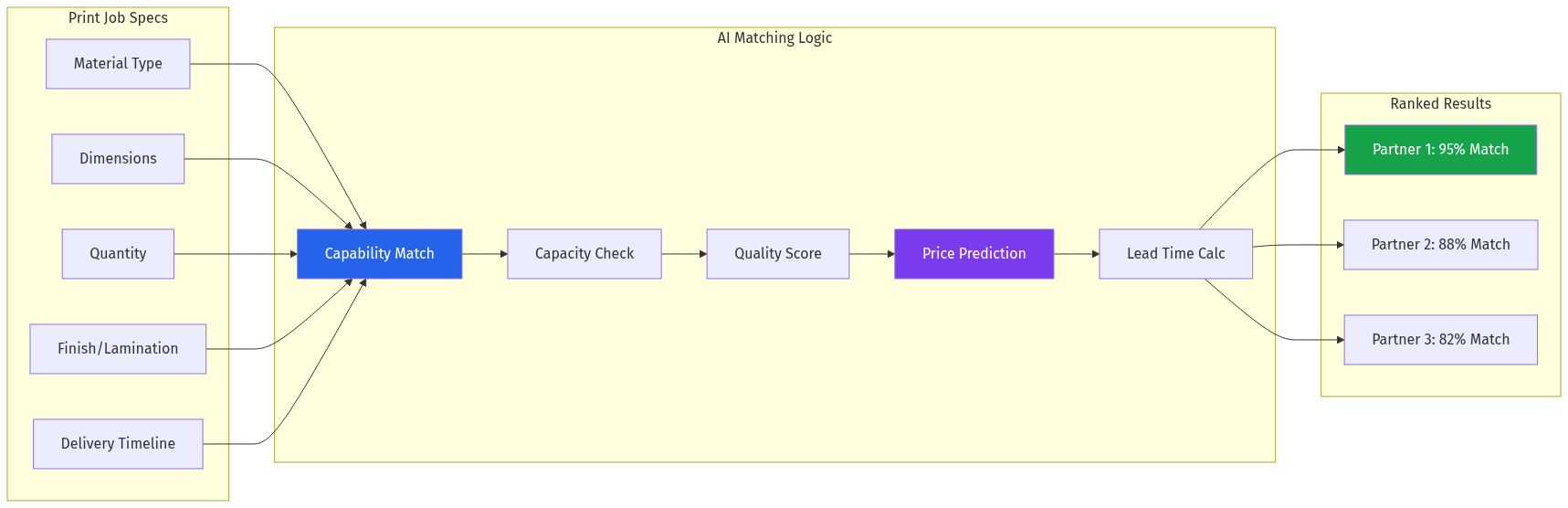
    Output: Structured specification document with material, dimensions, finish, quantity, and quality parameters. Phase 2: Capability Matching Engine
    Matching Logic
    Matching Logic

    Match structured specs against verified vendor capability database:

    • Machine types and max dimensions
    • Material inventory
    • Finishing equipment
    • Quality certifications
    • Historical delivery performance
    • Current capacity/lead time
    Phase 3: Price Intelligence ML model predicts fair pricing based on:
    • Historical transactions for similar specs
    • Material cost indices
    • Vendor capacity utilization
    • Urgency multipliers
    • Geographic factors
    Phase 4: Quality Assurance Loop
    • AI-powered visual inspection of delivered materials (photo upload)
    • Automatic comparison against spec requirements
    • Quality scoring feeds back into vendor rankings
    • Dispute resolution with evidence chain

    Second-Order Effects

    • Vendor specialization accelerates—transparent capability data rewards focus
    • Material innovation visible—new substrates can be marketed by specs, not relationships
    • Procurement becomes strategic—with data, print spend can be optimized like other categories
    ---

    7.

    Product Concept

    Core Platform: PrintBrain.in

    For Buyers:
    • AI-powered spec builder (conversational or form-based)
    • Instant vendor matching with capability scores
    • Price range prediction before requesting quotes
    • Multi-vendor project coordination dashboard
    • Quality inspection via photo upload + AI analysis
    • Historical order database with reorder capability
    For Vendors:
    • Capability profile with machine/material verification
    • Inbound RFQ matching to strengths
    • Capacity calendar for realistic lead times
    • Performance dashboard (delivery, quality, response metrics)
    • Material cost tracking integration
    For Procurement Teams:
    • Consolidated spend analytics across categories
    • Vendor qualification workflow
    • Compliance documentation (GST, certifications)
    • Budget vs. actual tracking
    • Preferred vendor lists with override controls

    Key Features

    FeatureDescription
    Spec TranslatorConvert vague requirements to structured specs using AI
    Capability GraphVisual map of vendor equipment, materials, certifications
    Price OracleML-predicted fair price range for any spec combination
    Deadline CalculatorRealistic lead time based on vendor capacity and job complexity
    Quality FingerprintPhoto-based verification against delivered specs
    Campaign ManagerMulti-item, multi-vendor project coordination
    ---
    8.

    Development Plan

    PhaseTimelineDeliverables
    MVP8 weeksSpec builder + basic matching for 3 categories (banners, signage, standees)
    V16 weeksPrice prediction, vendor onboarding flow, 5 cities, 100 vendors
    V28 weeksQuality inspection module, multi-vendor projects, mobile apps
    V310 weeksProcurement dashboard, API for enterprise, material marketplace

    Technical Architecture

    • Frontend: Next.js responsive web + React Native apps
    • Backend: Node.js + PostgreSQL + Redis
    • AI: Claude/GPT-4 for spec interpretation, custom ML for pricing
    • Search: Meilisearch for vendor capability matching
    • Storage: R2 for portfolios, order images
    • Integrations: WhatsApp Business API, GST verification, payment gateways

    9.

    Go-To-Market Strategy

    Phase 1: Supply-First in 3 Cities (Months 1-3)

  • Target: Delhi, Mumbai, Bangalore print clusters
  • Onboard 100 vendors with verified capability profiles
  • Build portfolio database from past work samples
  • Offer free leads in exchange for accurate capability data
  • Phase 2: Demand Activation (Months 3-6)

  • Content marketing: "Print Pricing Guide 2026" as lead magnet
  • Agency partnerships: Marketing and event agencies as channel
  • Exhibition presence: Set up booths at trade shows, source stalls via platform (dogfood)
  • LinkedIn targeting: Marketing managers, procurement heads
  • Phase 3: Enterprise Push (Months 6-12)

  • Retail chain pilots: Standardize signage across locations
  • Franchise networks: Centralized print procurement for consistency
  • Corporate procurement: Integrate with SAP/Oracle for large accounts
  • Falsification: Why This Might Fail

    Pre-Mortem Analysis:
  • Vendor resistance: Print vendors may refuse transparency, preferring information asymmetry
  • - Mitigation: Start with vendors hungry for leads, build value before requiring transparency
  • Spec complexity underestimated: Every job really is custom, AI can't handle edge cases
  • - Mitigation: Start with standardized categories (banners, standees), prove before expanding
  • Quality subjectivity: Buyers disagree with AI quality assessments, creating disputes
  • - Mitigation: Multi-photo verification, buyer-vendor alignment on specs upfront
  • Price sensitivity: Margins too thin for platform fees
  • - Mitigation: Volume-based pricing, premium features for enterprise, lead-gen model initially
  • Local relationships win: Buyers prefer trusted local vendors over platform efficiency
  • - Mitigation: Position as discovery + backup vendor, not replacement for existing relationships
    10.

    Revenue Model

    Primary Revenue Streams

    StreamModelPotential
    Transaction Fee3-5% on completed orders$2-5M ARR at scale
    Subscription (Vendors)₹2,000-10,000/month for premium placement$500K ARR
    Subscription (Enterprise)₹50,000-200,000/month for procurement suite$1M ARR
    Lead Generation₹50-200 per qualified RFQBridge revenue during growth
    FinancingPartner with NBFCs for vendor working capitalCommission-based

    Steelmanning: Why Incumbents Might Win

    Argument against this opportunity:
  • Network effects are local: Print is hyper-local; national platforms add little value
  • Relationship business: Large buyers already have preferred vendor relationships
  • Alibaba expansion: They could verticalize into Indian print market
  • Low-margin category: Tech economics don't work on thin print margins
  • IndiaMART dominance: They could add capability verification to existing platform
  • Counter-arguments:
  • Local networks don't help when you need specialized capabilities—platform bridges gaps
  • Relationships fail during scale-ups or vendor failures—backup discovery needed
  • Alibaba's India strategy has repeatedly failed on services/local fulfillment
  • Procurement software (not just marketplace) has better unit economics
  • IndiaMART's horizontal model prevents depth; vertical wins on quality

  • 11.

    Data Moat Potential

    Proprietary Data Assets

  • Spec-to-Price Database
  • Every transaction creates training data for price prediction. Over time, this becomes the definitive benchmark for print pricing.
  • Vendor Capability Graph
  • Verified machine types, materials, finishing options—not self-reported, but order-validated.
  • Quality Fingerprints
  • Photo database of delivered materials matched to specifications. Can detect quality degradation patterns by vendor.
  • Lead Time Intelligence
  • Actual delivery performance vs. promised timelines by vendor, category, complexity, season.
  • Buyer Preference Patterns
  • What specs correlate with which buyer types. Enables proactive suggestions.

    Compounding Effects

    Each transaction improves:
    • Price prediction accuracy
    • Vendor capability verification
    • Quality benchmarking
    • Lead time estimation
    • Spec recommendation quality
    This creates a flywheel: better data → better matching → more transactions → better data.
    12.

    Why This Fits AIM Ecosystem

    Vertical Synergy

    PrintBrain.in as an AIM.in vertical:
    • demo.aim.in → "Print & Signage" category
    • thefoundry.in → Print for manufacturing (labels, safety signage)
    • dhol.in → Event print coordination
    • masale.in → Packaging print for food

    Infrastructure Reuse

    • Same vendor verification workflow as other AIM verticals
    • Shared procurement dashboard for enterprises
    • Common quality inspection module
    • Unified payment and compliance layer

    Domain Asset

    Potential domains: printbrain.in, printmatch.in, signage.in, printiq.in

    AIM Philosophy Alignment

    • Structure over scale: Spec database is structured intelligence
    • Pre-create: Build vendor capability profiles before buyer demand
    • AI-first: Spec translation and matching are AI-native features
    • WhatsApp-driven: Meet market where it operates

    ## Verdict

    Opportunity Score: 8.5/10

    Strengths

    • Massive, fragmented market with clear pain points
    • AI application is natural (spec parsing, matching, pricing)
    • Low startup competition—no well-funded players attacking this
    • Data moat potential is strong
    • Fits AIM ecosystem strategy perfectly

    Risks

    • Vendor onboarding requires feet-on-street initially
    • Quality subjectivity creates dispute complexity
    • Local relationships may resist platform intermediation
    • Thin margins in commodity print categories

    Recommendation

    BUILD IT. Start with exhibition/event print vertical (higher margins, clear deadlines, multi-vendor coordination pain) in Delhi/Mumbai. The spec-to-vendor matching problem is solvable, the market is huge, and no one is building the intelligence layer.

    ## Sources

    • Grand View Research: Global Print Market Analysis
    • IBEF: India Printing Industry Report
    • Statista: Commercial Print Market Size
    • Industry interviews: Print cluster visits (Delhi Nehru Place, Mumbai Dadar)
    • Similar models: Uber Freight, Grainger, Xometry