ResearchThursday, February 19, 2026

AI Calibration Services Intelligence: The $8B Metrology Compliance Opportunity

Every manufacturing facility, pharmaceutical plant, and aerospace company relies on calibrated instruments — yet the process of finding accredited labs, scheduling calibrations, tracking certificates, and proving compliance remains shockingly manual. AI-powered calibration intelligence is the missing layer between enterprise asset management and regulatory compliance.

1.

Executive Summary

The calibration services market is projected to grow from $5.7 billion (2023) to $8.1 billion by 2030 at 5.3% CAGR. Yet the industry operates with 1990s-era workflows: spreadsheets for tracking, phone calls for scheduling, and filing cabinets for certificates.

This creates a massive opportunity for an AI-native calibration intelligence platform that:

  • Predicts when instruments need calibration before they drift out of spec
  • Matches manufacturers with accredited labs based on capability, turnaround, and cost
  • Maintains an immutable certificate blockchain for instant audit compliance
  • Eliminates the "audit panic" that plagues quality teams
The core insight: Calibration is not a one-time event — it's a continuous compliance obligation that generates recurring relationships and transactions. The business that owns the calibration schedule owns the customer relationship.


2.

Problem Statement

Who Feels the Pain?

Quality Managers at manufacturing facilities spend 15-20 hours monthly on:
  • Tracking calibration due dates across 500+ instruments
  • Researching which labs can calibrate specialized equipment
  • Chasing vendors for certificate delivery
  • Preparing audit documentation
Compliance Officers in regulated industries (pharma, aerospace, medical devices) face:
  • FDA/ISO audit failures due to missing or expired certificates
  • Production shutdowns when critical instruments lapse
  • Personal liability for compliance failures
Operations Leaders struggle with:
  • Equipment downtime during calibration cycles
  • Unpredictable costs from rush calibration requests
  • No visibility into total calibration spend across facilities

The Current Reality

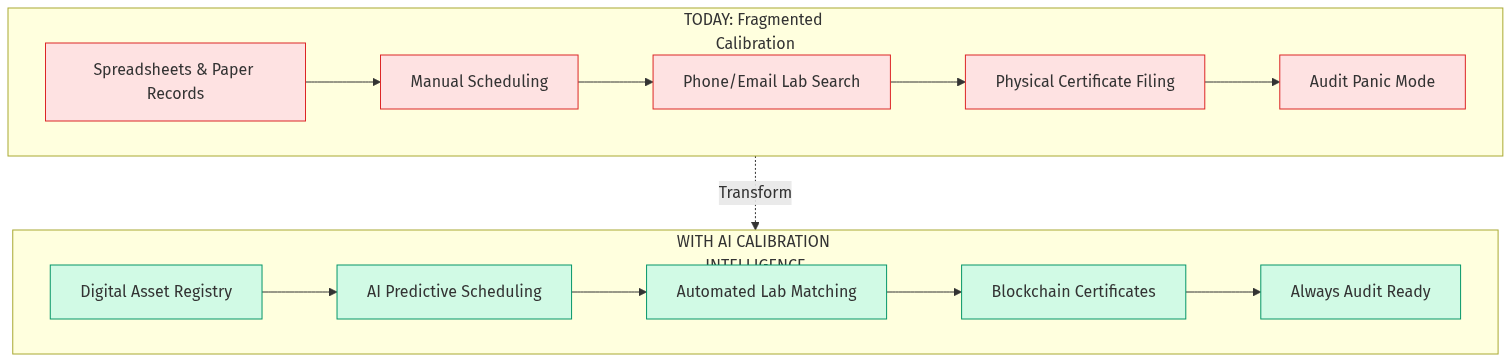
Current vs Future Calibration
ZEROTH PRINCIPLES Analysis: Why do we even calibrate instruments?

The fundamental axiom: All measurement devices drift over time. This isn't optional physics — it's thermodynamic reality. Temperature sensors shift. Pressure gauges lose accuracy. Scales drift.

But the current calibration workflow treats this continuous physical process as a discrete annual event. That's the foundational mismatch. We should be predicting drift, not reacting to calendar dates.


3.

Current Solutions

CompanyWhat They DoWhy They're Not Solving It
BeamexCalibration management software + hardwareEnterprise-only pricing, requires proprietary hardware, doesn't help find labs
Fluke CalibrationPremium calibration equipment + servicesOEM-centric, not a marketplace, extremely expensive
TrescalGlobal calibration services networkService provider, not a platform — limited to their own labs
IndySoftCalibration management databaseLegacy software, no AI, no lab marketplace, poor UX
Blue Mountain RAMAsset maintenance softwareGeneric maintenance system, not calibration-specific
Q-Ware CMMSGeneral calibration trackingBasic tracking only, no intelligence layer

INCENTIVE MAPPING: Who Profits from Status Quo?

  • Large calibration labs (Trescal, SGS, Bureau Veritas) benefit from opacity — customers can't easily compare prices or turnaround times
  • Enterprise software vendors sell expensive perpetual licenses to captive quality departments
  • Consultants thrive on audit preparation chaos
  • OEMs lock customers into proprietary calibration services
The entire ecosystem profits from friction. A transparent marketplace threatens every incumbent.
4.

Market Opportunity

Market Size

Segment2023 Value2030 ProjectionCAGR
Total Calibration Services$5.7B$8.1B5.3%
Electrical Calibration$2.1B$3.0B5.1%
Mechanical Calibration$1.4B$1.9B4.8%
Thermodynamic Calibration$1.1B$1.6B5.5%
Dimensional Calibration$1.1B$1.6B5.4%
Source: MarketsandMarkets Calibration Services Market Report (2023)

Why Now?

  • Regulatory Pressure Intensifying: FDA 21 CFR Part 11, ISO 17025:2017, and AS9100D requirements tightening
  • Digital Transformation Mandates: COVID accelerated paperless initiatives in manufacturing
  • Workforce Knowledge Loss: Experienced metrology professionals retiring without knowledge transfer
  • AI Maturation: Predictive models can now analyze drift patterns from historical calibration data
  • Blockchain Verification: Certificate authenticity is now cryptographically provable
  • SECOND-ORDER EFFECTS

    If calibration becomes predictive and automated:

    • Equipment failures decrease → insurance premiums drop
    • Audit prep time shrinks → quality teams can focus on improvement
    • Calibration data becomes valuable → new analytics products emerge
    • Lab utilization optimizes → costs decrease industry-wide
    ---

    5.

    Gaps in the Market

    ANOMALY HUNTING: What's Strange Here?

    Anomaly 1: Every other industrial procurement category has been marketplace-ified (packaging, chemicals, MRO) — except calibration services. Why?
    • Answer: Calibration is technically complex. You can't just match "buyer needs service" — you need to match specific instrument types, accuracy classes, accreditation scopes.
    Anomaly 2: Labs are universally under-utilized. Most operate at 40-60% capacity.
    • Answer: No demand aggregation exists. Each manufacturer calls labs individually, creating scheduling chaos.
    Anomaly 3: Certificate fraud is rampant but rarely discussed publicly.
    • Answer: Verification is manual. PDFs can be forged. No central registry exists.

    Specific Gaps

  • No Instrument-to-Lab Matching Engine
  • - Current process: Quality manager calls 3-5 labs, explains equipment specs, waits for quotes - Gap: AI should instantly match instruments with accredited labs capable of calibrating them
  • No Predictive Calibration Scheduling
  • - Current process: Calendar-based annual/semi-annual schedules regardless of actual drift - Gap: Machine learning on historical calibration data can predict when specific instruments will drift out of tolerance
  • No Certificate Verification System
  • - Current process: PDF certificates stored in SharePoint, authenticity unverifiable - Gap: Blockchain-anchored certificates with instant verification
  • No Calibration Cost Analytics
  • - Current process: Invoices scattered across AP systems - Gap: Total cost of ownership by instrument, by category, by facility
  • No On-Demand Mobile Calibration Marketplace
  • - Current process: Schedule mobile labs months in advance - Gap: Uber-like dispatch for mobile calibration units
    6.

    AI Disruption Angle

    DISTANT DOMAIN IMPORT: What Field Has Solved This?

    From Healthcare: Electronic Health Records (EHR) + Lab Information Systems (LIS)
    • Every medical test is tracked with chain of custody
    • Results flow automatically from analyzers to records
    • Regulatory compliance (HIPAA, CAP) is built into workflows
    • Import: Treat each instrument like a patient with a medical history
    From Supply Chain: Container Tracking + Blockchain Provenance
    • Every container has a unique ID tracked globally
    • Ownership transfers are recorded immutably
    • Import: Treat each calibration certificate like a shipping document with blockchain provenance
    From Insurance: Risk-Based Inspection Scheduling
    • Elevators, boilers, pressure vessels are inspected based on risk scores, not calendars
    • Import: High-drift, high-criticality instruments get more frequent calibration

    How AI Transforms Calibration

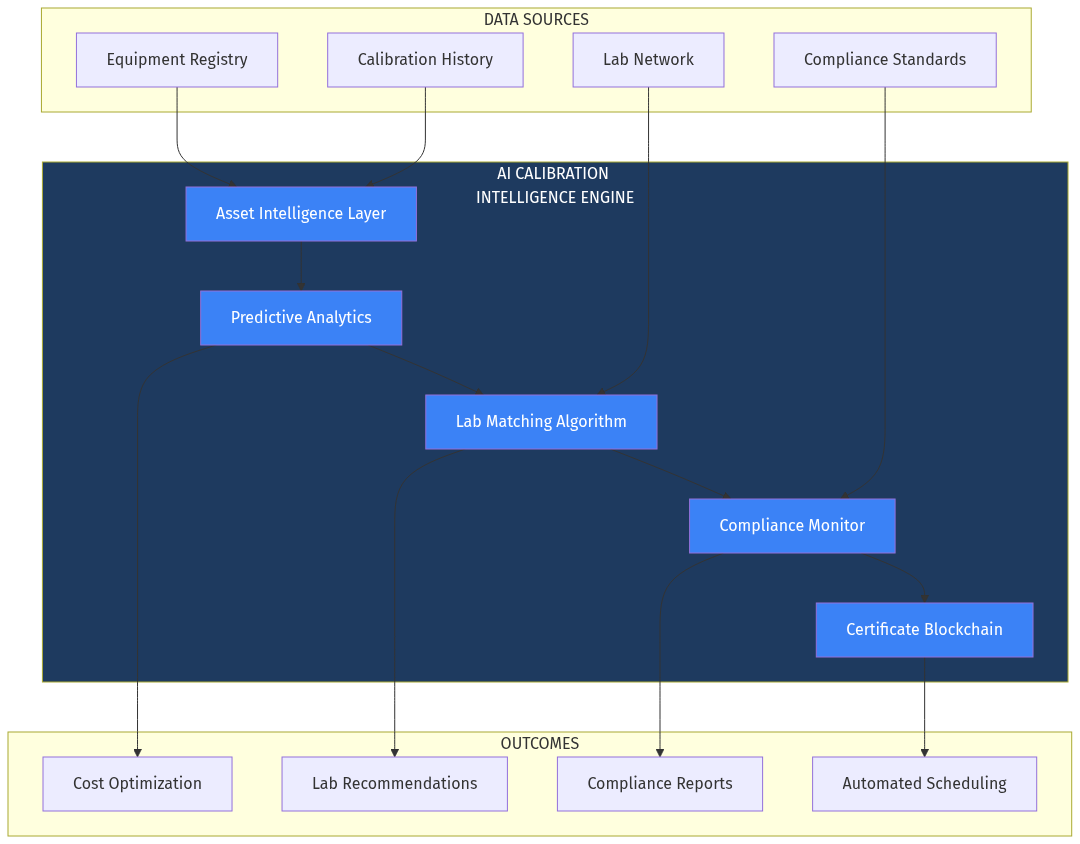
    AI Calibration Architecture
    AI Calibration Architecture
    1. Predictive Calibration Intelligence
    Historical calibration data → Drift pattern analysis → Time-to-OOT prediction
    AI analyzes thousands of calibration records to predict when specific instruments will drift out of tolerance (OOT). Instead of arbitrary annual schedules, calibrate precisely when needed. 2. Intelligent Lab Matching
    Instrument specs + Accreditation scopes + Location + Availability → Optimal lab match
    When an instrument needs calibration, AI instantly identifies labs with:
    • Proper accreditation (NABL/A2LA/NVLAP) for that instrument category
    • Current capacity to meet turnaround requirements
    • Competitive pricing based on historical quotes
    3. Compliance Copilot
    Regulation requirements + Equipment inventory + Certificate status → Compliance score + Actions
    AI maintains real-time compliance posture across all instruments, flagging gaps and generating audit-ready reports automatically. 4. Anomaly Detection
    Calibration results → Statistical process control → Drift alerts
    AI detects instruments showing abnormal drift patterns that might indicate equipment problems before failure.
    7.

    Product Concept

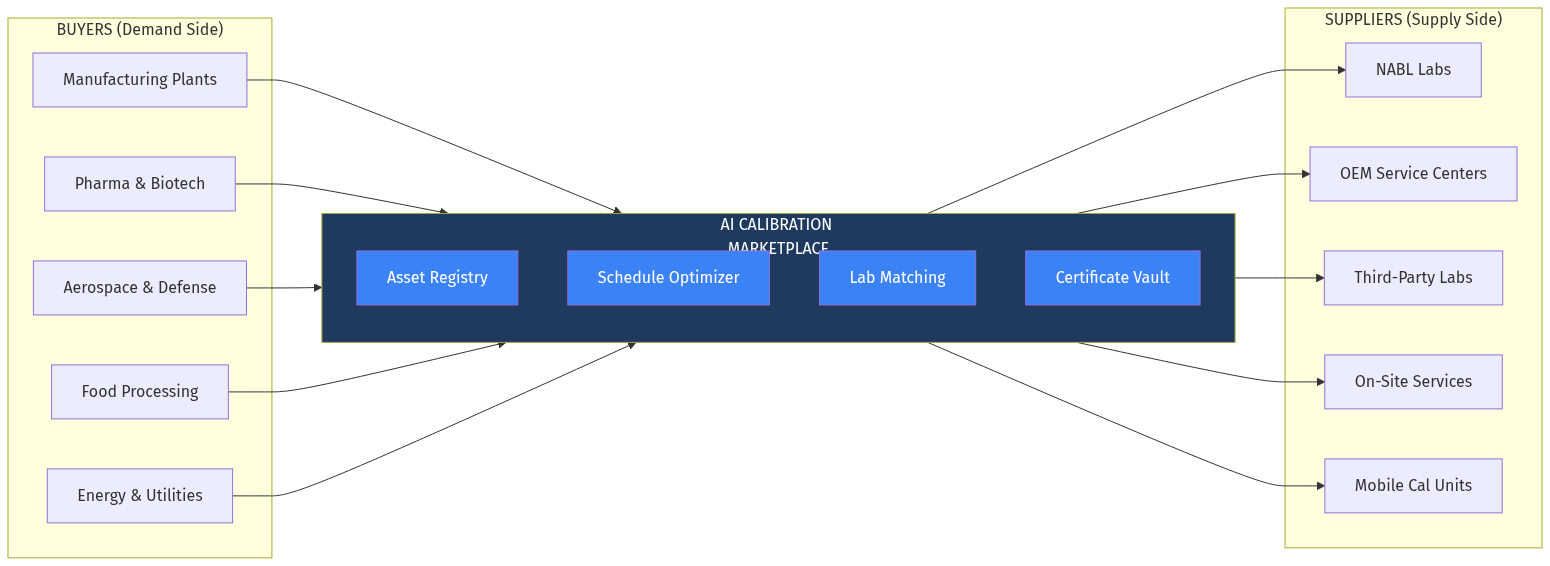
    Platform Architecture

    AI Calibration Marketplace
    AI Calibration Marketplace

    Core Features

    For Manufacturers (Demand Side)
    FeatureDescription
    Instrument RegistryDigital twin of every calibrated asset with specs, history, certificates
    Smart SchedulingAI-optimized calibration schedule based on drift prediction + criticality
    Lab FinderInstant matching to accredited labs with real-time availability
    Quote CompareSide-by-side pricing from multiple qualified labs
    Certificate VaultImmutable storage with blockchain verification
    Compliance DashboardReal-time ISO/FDA/AS compliance score with gap alerts
    For Calibration Labs (Supply Side)
    FeatureDescription
    Capability RegistrySearchable directory of accreditation scopes + equipment
    Lead GenerationQualified opportunities from matched manufacturers
    Capacity ManagementFill utilization gaps with on-demand work
    Digital CertificatesIssue blockchain-verified certificates directly on platform
    Payment ProcessingAutomatic invoicing and payment collection
    For Regulators/Auditors
    FeatureDescription
    Verification PortalInstant certificate authenticity checking
    Audit TrailsComplete history of calibration activities
    Statistical ReportsIndustry-wide calibration trend data

    User Journey: Quality Manager

  • Import assets → Upload equipment list (Excel, ERP export, or API)
  • AI enriches → Platform identifies manufacturer specs, calibration requirements
  • Schedule optimizes → AI builds optimal calibration schedule based on drift + criticality
  • Labs match → When due, qualified labs receive RFQ automatically
  • Compare + book → Quality manager reviews quotes, books with one click
  • Track pickup → Instrument checked out, tracked through calibration
  • Certificate received → Digital certificate issued to vault
  • Audit-ready → One-click compliance report generation

  • 8.

    Development Plan

    PhaseTimelineDeliverables
    MVP12 weeksInstrument registry, manual lab directory, certificate storage, basic scheduling
    V18 weeksAI lab matching, quote comparison, compliance dashboard
    V28 weeksPredictive scheduling, blockchain certificates, lab-side tools
    V38 weeksMobile app, API integrations (ERP, CMMS), analytics suite

    Technology Stack

    • Frontend: Next.js + React for web, React Native for mobile
    • Backend: Node.js + PostgreSQL + Redis
    • AI/ML: Python + scikit-learn for drift prediction, vector embeddings for instrument-lab matching
    • Blockchain: Polygon (low-cost, fast finality) for certificate anchoring
    • Integrations: SAP, Oracle, Maximo CMMS connectors

    9.

    Go-To-Market Strategy

    FALSIFICATION Pre-Mortem: Why Would This Fail?

  • Enterprise Sales Cycles: Large manufacturers take 12-18 months to adopt new compliance software
  • - Mitigation: Start with SMB manufacturers (<$100M revenue) with faster decisions
  • Lab Network Effects: Platform is useless without lab supply
  • - Mitigation: Pre-sign 50 NABL-accredited labs before manufacturer launch
  • Regulation Sensitivity: Quality departments resist change
  • - Mitigation: ISO 17025:2017 consultants as channel partners
  • Data Privacy: Calibration data is competitively sensitive
  • - Mitigation: Zero-knowledge architecture, customer-owned data
  • Certificate Fraud Blowback: Exposing fake certificates creates enemies
  • - Mitigation: Position as "verification" not "fraud detection"

    Launch Sequence

    Phase 1: Lab Network (Month 1-3)
    • Target: 100 NABL/A2LA accredited labs onboarded
    • Method: Direct outreach emphasizing lead generation value
    • Geography: Start with India (NABL), expand to US (A2LA)
    Phase 2: Anchor Customers (Month 4-6)
    • Target: 20 mid-market manufacturers (50-500 instruments)
    • Method: ISO consultants as referral partners
    • Offer: Free 90-day trial with migration assistance
    Phase 3: Scale (Month 7-12)
    • Target: 200 manufacturers, 500 labs
    • Method: Content marketing (calibration compliance guides), conference presence (Measurement Science Conference)
    • Expansion: Aerospace (AS9100), pharma (FDA), food (FSSC 22000)

    STEELMANNING: Why Incumbents Might Win

    Best argument against this opportunity: > "Beamex + Fluke have 40 years of metrology expertise, established relationships with every major manufacturer, and massive R&D budgets. A startup can't match their instrument hardware + software integration. Enterprise buyers trust established vendors for compliance-critical systems." Counter-argument: True, but incumbents are hardware companies with software as an afterthought. They profit from selling calibrators, not from optimizing calibration workflows. A software-first platform can aggregate the long tail of labs that no hardware company will serve, creating network effects that hardware can't replicate.
    10.

    Revenue Model

    Revenue Streams

    StreamModelExpected Contribution
    Lab Transaction Fee5-8% of calibration invoice45%
    Manufacturer Subscription$199-999/month based on instrument count35%
    Premium Lab Listing$299/month for enhanced visibility10%
    Certificate Verification API$0.10/verification for auditors5%
    Data & AnalyticsCustom reports, benchmarking5%

    Unit Economics (Target)

    MetricTarget
    CAC (Manufacturer)$1,500
    LTV (Manufacturer)$15,000
    LTV:CAC10:1
    Gross Margin75%
    Payback Period6 months

    Revenue Projections

    YearLabsManufacturersARR
    Y1200100$500K
    Y21,000500$3M
    Y35,0002,500$15M
    ---
    11.

    Data Moat Potential

    Proprietary Data Assets

  • Instrument-Lab Capability Graph
  • - Which labs can calibrate which instruments to which tolerances - Competitive advantage grows with every lab onboarded
  • Drift Pattern Database
  • - Historical calibration data reveals instrument-specific drift signatures - Enables increasingly accurate predictive scheduling
  • Lab Performance Metrics
  • - Turnaround time, accuracy, rejection rates by lab - Quality transparency creates switching costs
  • Pricing Intelligence
  • - Market rates for every calibration category - Enables cost optimization recommendations
  • Compliance Requirement Graph
  • - Which regulations require which calibrations at which intervals - Regulatory knowledge base becomes reference standard

    Network Effects

    • Same-side (Labs): More labs → better coverage → more manufacturer demand → more labs join
    • Cross-side: More manufacturers → more calibration volume → labs see ROI → more labs → better manufacturer experience
    • Data: More calibrations → better drift models → better scheduling → more value → more customers → more data

    12.

    Why This Fits AIM Ecosystem

    AIM's Mission: Help B2B buyers DECIDE, not just discover.

    Calibration services fit perfectly:

    • Structured decision criteria: Accreditation scope, turnaround, price, location
    • Repeat transactions: Same instruments need recurring calibration
    • Trust-dependent: Certificate authenticity is critical
    • Fragmented suppliers: 10,000+ calibration labs in India alone
    Cross-portfolio synergies:
    • thefoundry.in customers (industrial procurement) likely need calibration services
    • challan.in (compliance) shares regulatory DNA
    • niyukti.in (recruitment) could source metrology technicians for labs
    Domain alignment:
    • calibration.in, metrology.in, nabl.in would be strong category-defining domains
    ---

    ## Verdict

    Opportunity Score: 8.5/10

    Scoring Breakdown

    CriterionScoreNotes
    Market Size9/10$8.1B by 2030, growing steadily
    Problem Severity8/10Compliance failures = production shutdowns
    Competition Gap8/10No AI-native marketplace exists
    AI Leverage9/10Predictive scheduling + matching = clear value
    Network Effects8/10Lab-manufacturer cross-side effects
    Execution Complexity7/10Enterprise sales + lab onboarding = hard
    Data Moat9/10Drift patterns + pricing = defensible
    AIM Fit9/10Perfect B2B decision support use case

    Final Assessment

    This is a high-conviction opportunity. Calibration services represents a $8B market stuck in spreadsheet-and-phone-call workflows while AI capabilities have matured to enable predictive, automated, marketplace-driven transformation. Key success factors:
  • Build lab supply before chasing demand — network effects require critical mass
  • Start with SMB manufacturers who can adopt without 18-month procurement cycles
  • Position as "compliance insurance" not "cost reduction" — quality teams spend on risk mitigation
  • Blockchain certificates are differentiator — immutable verification solves real audit pain
  • Primary risk: Enterprise sales velocity. Mitigate by proving value with mid-market first. Recommendation: Proceed to MVP development with focus on India (NABL ecosystem) as initial market.

    ## Sources