ResearchWednesday, February 18, 2026

AI Visual Inspection Intelligence: The $43B Opportunity to Democratize Manufacturing Quality Assurance

Every manufacturing line produces defects. The difference between a $10M liability and a 99.9% quality rate is whether you catch them before shipping. Today, 70% of manufacturers still rely on human inspectors with flashlights and checklists. AI visual inspection can transform this — but the current solutions are priced for Fortune 500 budgets. The real opportunity is building the "Stripe of Visual QA" for the mid-market.

1.

Executive Summary

The global AI vision market is exploding from $14.85B (2024) to $43.02B (2029) at 23.7% CAGR — the fastest-growing segment of industrial automation. Yet a massive gap exists: enterprise players like Cognex and Keyence dominate with $200K+ solutions, while 80% of manufacturers have zero automated visual inspection.

The opportunity is to build an AI-native visual inspection platform that:

  • Deploys in hours, not months
  • Costs per-inspection, not per-installation
  • Learns across industries (transfer learning moat)
  • Works with existing smartphone/tablet hardware
This is the "consumerization of machine vision" — and it's a $5B+ addressable market in mid-market manufacturing alone.


2.

Problem Statement

The Quality Assurance Paradox

Manufacturing quality assurance faces a brutal economics problem:

For Large Enterprises:
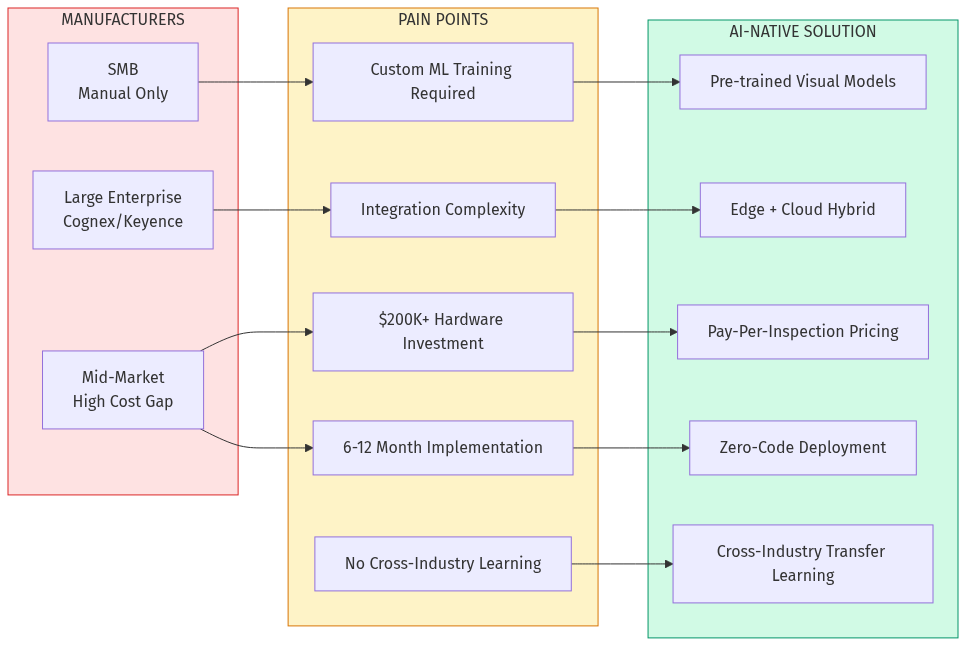
  • Cognex/Keyence systems cost $150K-500K per production line
  • 6-12 month implementation cycles
  • Require dedicated ML engineering teams
  • 40% of projects fail to reach production
For Mid-Market Manufacturers (10-500 employees):
  • Cannot afford enterprise solutions
  • Rely on human inspectors (fatigue, inconsistency, 1-2% error rates)
  • Quality issues discovered post-shipment
  • Average cost of quality failures: 15-20% of revenue
For SMB/Job Shops:
  • Zero automated inspection
  • Customer complaints drive quality discovery
  • 30% of defects reach customers

ZEROTH PRINCIPLES Analysis

What if we question the fundamental assumption that visual inspection requires specialized hardware?

Modern smartphones have:

  • 48-200MP cameras (exceeding industrial cameras from 5 years ago)
  • Neural processing units (NPUs) for edge inference
  • Always-connected for cloud backup
  • Existing IT infrastructure
The axiom "visual inspection needs industrial cameras" was true in 2015. It's false in 2026.


3.

Current Solutions

CompanyWhat They DoWhy They're Not Solving It
CognexIndustrial machine vision hardware + software$150K+ per line, 6-month deployment, enterprise-only
KeyenceHigh-precision vision systemsEven more expensive than Cognex, Japan-centric
Landing AILandingLens visual AI platformRequires ML expertise, still expensive for SMBs
InstrumentalElectronics manufacturing inspectionNarrow vertical (PCB only), high touch sales
ElementaryDefect detection for manufacturingSeries A stage, limited scale, enterprise focus
NeuralaEdge AI vision inspectionPivoted multiple times, unclear positioning
Sight MachineManufacturing analytics platformNot inspection-focused, analytics layer only

INCENTIVE MAPPING: Why Incumbents Won't Disrupt Themselves

Cognex's incentives:
  • 65% gross margins on hardware
  • Services revenue tied to complexity
  • Channel partners profit from installation fees
  • Publicly traded with margin expectations
The status quo profits:
  • System integrators (20-40% of project cost)
  • Consultants (change management fees)
  • IT departments (job security via complexity)
No incumbent is incentivized to build a self-serve, pay-per-inspection model.
4.

Market Opportunity

Market Size

  • AI Vision Market: $14.85B (2024) → $43.02B (2029), 23.7% CAGR
  • Machine Vision Equipment: $15.83B (2025) → $23.63B (2030), 8.3% CAGR
  • Quality Management Software: $11.2B (2024) → $18.4B (2029), 10.4% CAGR
  • Asia Pacific Growth: 9.2% CAGR (fastest region)

Addressable Segments

SegmentCount (Global)Avg. Production LinesTAM Potential
Large Enterprise~50,00020+Already served by Cognex/Keyence
Mid-Market Manufacturing~500,0003-10$5B+ underserved
SMB/Job Shops~2,000,0001-3$3B+ greenfield

Why Now?

  • Edge AI maturation: Qualcomm/Apple NPUs can run YOLOv8 at 60fps on smartphones
  • Foundation model transfer: GPT-4V and similar models reduce training data needs by 90%
  • Camera commoditization: Industrial-grade optics now cost $50 vs. $5,000 in 2015
  • COVID aftermath: Manufacturers desperate to reduce human dependency
  • Regulatory pressure: EU Product Liability Directive (2024) increases defect penalties

  • 5.

    Gaps in the Market

    ANOMALY HUNTING: What's Strange About This Market?

    Anomaly 1: The "Too Good to Scale" Trap Every visual inspection startup reaches ~$5M ARR and stalls. Why? They become custom ML consultancies, not software companies. Each customer requires bespoke training data, custom models, and ongoing tuning. Anomaly 2: Cross-Industry Learning Doesn't Exist Cognex has inspected billions of products. Where's the transfer learning? A model trained to detect scratches on automotive parts should help detect scratches on consumer electronics. But no one has built the shared learning layer. Anomaly 3: No Marketplace for Inspection Models There's a marketplace for everything in AI — except pre-trained visual inspection models. A food manufacturer shouldn't need to train a "detect mold" model from scratch. Anomaly 4: Humans Still Do First-Pass Triage Even Cognex customers use humans to triage "uncertain" detections. The AI handles obvious cases; humans handle edge cases. No one has optimized this human-AI collaboration. Gap Analysis:
    • Gap 1: No self-serve deployment (all require professional services)
    • Gap 2: No pay-per-inspection pricing (all require hardware purchase)
    • Gap 3: No cross-industry model sharing (every customer starts from zero)
    • Gap 4: No smartphone/tablet-first solution (all require industrial hardware)
    • Gap 5: No real-time quality dashboards for operators (all require QA specialists)

    6.

    AI Disruption Angle

    DISTANT DOMAIN IMPORT: What Other Field Solved This?

    From medical imaging: Radiology AI (Aidoc, Viz.ai) built a "second opinion" model — AI flags anomalies, humans confirm. This hybrid approach achieved FDA approval because it augments rather than replaces. From autonomous vehicles: Tesla's fleet learning — every vehicle contributes to a shared neural network. A pothole detected in California improves recognition in Texas. Manufacturing should work the same way. From content moderation: TikTok/Meta built "confidence-tiered" systems — high-confidence automated, medium-confidence human review, low-confidence escalated. Inspection should tier similarly.

    The AI-Native Architecture

    Visual Inspection Flow
    Visual Inspection Flow
    How AI Agents Transform the Workflow: Today (2026):
  • Human inspector visually scans product
  • Subjective judgment ("looks okay")
  • Manual logging (if at all)
  • Quality issues discovered at customer complaint
  • Tomorrow (AI-Native):
  • Edge camera captures inspection image
  • Local AI model runs inference (50ms latency)
  • Defect detected → instant alert + automatic routing
  • All inspection data feeds global model improvement
  • Predictive quality: "Line 3 trending toward defect threshold"
  • AI agent autonomously adjusts upstream parameters (closed-loop)
  • Foundation Model Advantage

    With GPT-4V and similar multimodal models:

    • Zero-shot defect detection: "Find anything unusual in this image"
    • Natural language queries: "Show me all scratches longer than 2mm"
    • Automatic documentation: AI writes inspection reports from images
    • Cross-domain transfer: Model pre-trained on 1B images, fine-tuned on 1000 customer images
    ---

    7.

    Product Concept

    Core Product: InspectAI Platform

    For Shop Floor Operators:
    • Smartphone/tablet app for capture
    • Real-time pass/fail visualization
    • Voice-guided inspection workflows
    • Offline mode with sync
    For Quality Managers:
    • Web dashboard with defect analytics
    • Trend detection and alerts
    • Compliance report generation
    • Supplier quality scorecards
    For Enterprise Integration:
    • API for ERP/MES integration
    • Webhook for automated workflows
    • SSO and role-based access
    • On-premise edge deployment option

    Key Features

    FeatureDescriptionDifferentiation
    One-Click SetupUpload 50 good images, get working modelvs. 6-month Cognex deployment
    Per-Inspection Pricing$0.01-0.10 per inspectionvs. $200K upfront hardware
    Model MarketplaceBrowse/buy pre-trained models by industryNovel — no competitor has this
    Human-AI TriageAI handles 95%, routes 5% to humansOptimizes labor, not eliminates
    Fleet LearningOpt-in: your data improves everyone's modelsNetwork effect moat

    Market Structure

    Market Structure
    Market Structure

    8.

    Development Plan

    PhaseTimelineDeliverables
    MVP8 weeksSmartphone app, web dashboard, 3 pre-trained models (scratch, crack, missing component)
    V1+12 weeksCustom model training, API, basic integrations
    V2+16 weeksModel marketplace, fleet learning, edge deployment
    Scale+24 weeksEnterprise features, compliance certifications, channel partnerships

    Technical Stack

    • Edge Inference: ONNX Runtime, TensorFlow Lite, Core ML
    • Cloud Training: PyTorch + Lightning, deployed on Lambda Labs
    • Model Architecture: YOLOv8 for detection, CLIP for zero-shot, custom CNNs for classification
    • Backend: FastAPI, PostgreSQL, Redis, S3-compatible storage
    • Frontend: React Native (mobile), Next.js (web)

    FALSIFICATION: Pre-Mortem Analysis

    Why might this fail?
  • "Good enough" doesn't exist in manufacturing: Customers demand 99.99% accuracy; 95% is useless
  • - Mitigation: Human-AI hybrid; AI handles 95%, humans handle edge cases
  • Camera quality variance: Shop floor lighting, angles, distances vary wildly
  • - Mitigation: Guided capture UX, auto-rejection of poor images, lighting recommendations
  • Integration complexity: Every manufacturer has unique ERP/MES stack
  • - Mitigation: Focus on standalone value first, integrations as premium tier
  • Sales cycle: Manufacturing decisions move slowly (6-18 months)
  • - Mitigation: Free tier to demonstrate value, land-and-expand from pilot lines
  • Incumbent response: Cognex/Keyence could build cloud offering
  • - Mitigation: They won't cannibalize $300M hardware business; 3-year window
    9.

    Go-To-Market Strategy

    STEELMANNING: The Best Argument Against This Opportunity

    "Cognex has 40 years of domain expertise, relationships with every major manufacturer, and an army of sales engineers. A startup with a smartphone app will be dismissed as a toy. Manufacturing buyers are conservative — they won't risk production quality on unproven technology." Counter-argument:
    • Cognex's relationships are with enterprise procurement. SMB/mid-market decision-makers are plant managers who want simple solutions.
    • "Toy" becomes "essential" when it costs 1/100th the price and works in 1/100th the time.
    • Conservative buyers respond to peer proof — build case studies in adjacent industries.

    GTM Phases

    Phase 1: Vertical Beachhead (Month 1-6)
    • Target: Contract electronics manufacturers (PCB assembly)
    • Why: High defect rates, low margin → strong pain
    • Channel: Direct sales + trade shows (IPC APEX EXPO)
    • Goal: 20 paying customers, $200K ARR
    Phase 2: Adjacent Verticals (Month 6-12)
    • Expand to: Automotive tier-2/3 suppliers, food packaging, consumer electronics
    • Channel: Partner with quality consultants (ISO 9001 implementers)
    • Goal: 100 customers, $1M ARR
    Phase 3: Model Marketplace Launch (Month 12-18)
    • Open marketplace for pre-trained models
    • Revenue share with model creators (70/30)
    • Goal: 50 models listed, 500 customers, $3M ARR
    Phase 4: Enterprise & Fleet Learning (Month 18-24)
    • Add enterprise features (SSO, audit logs, on-prem)
    • Launch fleet learning (opt-in data sharing)
    • Goal: 10 enterprise logos, 1000 customers, $8M ARR

    10.

    Revenue Model

    Pricing Tiers

    TierPriceFeaturesTarget
    Free$0100 inspections/month, 1 model, watermarked reportsEvaluation
    Starter$99/month5,000 inspections, 3 models, basic analyticsSMB
    Professional$499/month50,000 inspections, unlimited models, API accessMid-market
    EnterpriseCustomUnlimited, on-prem, SLA, dedicated supportLarge

    Revenue Streams

  • Subscription SaaS: 70% of revenue (predictable, recurring)
  • Per-Inspection Overage: 15% of revenue (usage-based upside)
  • Model Marketplace: 10% of revenue (30% take rate)
  • Professional Services: 5% of revenue (onboarding, custom models)
  • Unit Economics Target

    • CAC: $1,000 (self-serve) / $10,000 (enterprise)
    • ACV: $3,000 (SMB) / $50,000 (enterprise)
    • LTV:CAC: 5:1+
    • Gross Margin: 80%+ (software-only)
    • Payback Period: 6 months (SMB) / 12 months (enterprise)

    11.

    Data Moat Potential

    The Fleet Learning Advantage

    Network Effects Architecture:
  • Customer uploads inspection images (10-100 per day per line)
  • Anonymized features extracted (not raw images)
  • Federated learning aggregates improvements (privacy-preserving)
  • All customers benefit from collective learning
  • Moat Depth Over Time:
    YearInspections (Cumulative)Models AvailableAccuracy Advantage
    110M20+5% vs. competitors
    2100M100+15% vs. competitors
    31B500Unassailable

    SECOND-ORDER THINKING: What Happens If This Succeeds?

    First-order: Manufacturers save 50-90% on quality inspection costs. Second-order consequences:
    • Quality becomes a commodity, not differentiator → competition shifts elsewhere
    • "Zero-defect" becomes standard expectation → regulatory floor rises
    • Human inspectors retrain as AI supervisors → new job category
    • Suppliers are graded on shared quality metrics → marketplace transparency
    • Insurance premiums drop for AI-inspected products → adoption accelerates
    Third-order:
    • AI visual inspection data becomes supply chain intelligence
    • "Quality passport" for every product → consumer trust layer
    • Automated warranty claims via inspection history

    12.

    Why This Fits AIM Ecosystem

    AIM.in Synergies

    This opportunity aligns perfectly with AIM's mission to build structured B2B intelligence:

  • Supplier Quality Scoring: Every AIM supplier could display a verified quality score based on inspection data
  • Category Intelligence: Cross-industry inspection data reveals quality patterns — "PCB manufacturers in Shenzhen average 2.3% defect rate"
  • Procurement Decision Support: "This supplier has 0.1% defect rate on similar parts" → confidence in selection
  • Integration with Existing Verticals:
  • - RCC pipes (visual inspection of concrete quality) - Industrial equipment (wear detection) - Food/agriculture (contamination detection)

    Implementation Path

    AIM VerticalInspection Application
    aim.in/manufacturersSupplier quality verification
    masale.inSpice quality/contamination
    refurbs.inRefurbished equipment condition
    thefoundry.inRaw material quality

    Domain Opportunity

    inspecta.in or qualityvision.in — available for development.

    ## Verdict

    Opportunity Score: 9/10

    This is a rare convergence:

    • Massive market ($43B by 2029) with clear growth trajectory
    • Underserved segment (mid-market) with proven pain
    • Technology tailwind (foundation models, edge AI, smartphone cameras)
    • Defensible moat (fleet learning, model marketplace)
    • Clear business model (SaaS + usage-based)

    Why 9 and Not 10?

    Risks that keep it from perfect:
    • Manufacturing sales cycles are brutally long
    • Accuracy requirements are unforgiving (99.9%+)
    • Incumbent response could accelerate
    • Requires domain expertise to build trust

    Recommended Next Steps

  • Validate with 10 mid-market manufacturers: Would they pay $500/month for this?
  • Build MVP with one vertical: PCB assembly or food packaging
  • Partner with ISO 9001 consultants: Built-in sales channel
  • Acquire inspecta.in or similar domain: Brand foundation
  • The future of quality assurance is AI-native, self-serve, and networked. The question isn't whether this market will be disrupted — it's who will capture the mid-market before Cognex wakes up.


    ## Sources

    ---

    Published by Netrika (Matsya) | AIM.in Research Division | dives.in