ResearchWednesday, February 18, 2026

AI-Powered RFQ & Quotation Intelligence: The $12B Opportunity to Transform B2B Procurement

Every day, procurement teams waste 4-6 hours manually comparing quotes that arrive in incompatible formats. The RFQ process—sending requests, collecting responses, comparing prices—remains stuck in 1995. AI agents can collapse this chaos into minutes, creating the most defensible data moat in B2B: historical quote intelligence.

1.

Executive Summary

The Request for Quotation (RFQ) process is the heartbeat of B2B procurement, yet it remains shockingly manual. Companies send RFQs via email, receive quotes as PDFs/Excel attachments, manually key data into spreadsheets, and struggle to compare apples-to-apples across suppliers.

This research identifies a massive opportunity: AI-powered quotation intelligence that automates the entire quote-to-comparison pipeline. The platform would use document AI to extract structured data from any quote format, normalize specifications, and provide instant comparison dashboards.

Key insight: The winner here doesn't just process quotes—they accumulate the most valuable B2B dataset possible: historical pricing intelligence across thousands of SKUs, suppliers, and geographies.

2.

Problem Statement

The Procurement Professional's Daily Hell

Who experiences this pain:
  • Procurement managers at manufacturing companies
  • Purchasing officers at construction firms
  • Supply chain teams at retailers
  • Government tender evaluators
What's broken:
  • Format Chaos: Suppliers send quotes in wildly different formats—PDF, Excel, email text, scanned documents, even WhatsApp messages. There's no standard.
  • Manual Data Entry: Someone must manually extract line items, prices, lead times, terms, and specifications from each quote and enter them into a comparison spreadsheet.
  • Apples-to-Oranges: Supplier A quotes "SS304 pipes, 10mm OD" while Supplier B quotes "Stainless 304L seamless tubing, 3/8 inch." Are these comparable? Someone must figure it out.
  • Time Sink: A typical 5-supplier RFQ takes 4-8 hours just to normalize and compare. For complex projects with 50+ line items, it can take days.
  • No Institutional Memory: Last year's quotes live in someone's email archive. Pricing benchmarks exist nowhere. Every RFQ starts from scratch.
  • Negotiation Blind Spots: Without historical data, buyers don't know if a price is fair, inflated, or a bargain.
  • The $47B Annual Waste

    Research indicates that procurement professionals spend 60-70% of their time on tactical tasks like quote comparison instead of strategic sourcing. For a company with $100M in annual procurement, this translates to $2-4M in hidden labor costs annually.


    3.

    Current Solutions

    CompanyWhat They DoWhy They're Not Solving It
    SAP AribaEnterprise procurement suite with supplier network$100K+ implementation, 6-month rollout, designed for Fortune 500
    CoupaSpend management platformSame enterprise positioning, doesn't solve format chaos
    ProcurifySMB purchasing softwareFocuses on PO/approval workflow, not quote intelligence
    FairmarkitTail spend automationOnly handles simple commodities, not complex specs
    ZipIntake-to-procure platformModern UX but still relies on manual quote entry
    TradogramAffordable procurement softwareBasic RFQ tools, no AI extraction
    The Gap: All existing solutions require suppliers to submit quotes through their platform OR require manual data entry. None solve the fundamental problem: extracting structured data from unstructured supplier responses.
    4.

    Market Opportunity

    • Procurement Software Market: $11.8B (2025), growing to $28.6B by 2032 (12.1% CAGR)
    • Document AI Market: $3.1B (2025), growing to $16.7B by 2032
    • RFQ-Specific TAM: ~$4.2B (based on procurement software market segment analysis)

    Why Now?

  • Document AI has matured: GPT-4V, Claude, and specialized document models can now extract tables from PDFs with 95%+ accuracy.
  • LLM-powered normalization: Natural language understanding can now match "SS304 pipes" to "Stainless Steel 304" automatically.
  • SMB procurement digitization: Post-COVID, even small manufacturers are digitizing procurement—but enterprise tools are overkill.
  • WhatsApp/messaging proliferation: In markets like India, suppliers increasingly send quotes via WhatsApp. No existing tool handles this.

  • 5.

    Gaps in the Market

    ZEROTH PRINCIPLES Analysis

    Questioning the axiom: "Quotes must be manually compared"

    The fundamental assumption in procurement is that human judgment is required to compare quotes. But 80% of comparison is mechanical: matching specs, normalizing units, comparing prices. Only 20% requires judgment (quality assessment, relationship factors, risk evaluation).

    What if: AI handles the 80%, freeing humans for the 20% that matters?

    ANOMALY HUNTING

  • India's quote-via-WhatsApp phenomenon: In Indian manufacturing, suppliers routinely send quotes as WhatsApp images or voice notes. No global procurement tool acknowledges this.
  • The missing price database: Despite billions in B2B transactions, there's no "Zillow for industrial parts"—no way to know if $2.50/kg for SS304 is market rate.
  • Government tenders are worst: Public sector procurement receives quotes in sealed envelopes, opened ceremonially, then... manually entered into spreadsheets.
  • INCENTIVE MAPPING

    Who profits from the status quo?
    • Suppliers: Opacity benefits them. If buyers can't easily compare, suppliers can charge more.
    • Middlemen/brokers: They arbitrage information asymmetry.
    • Large enterprises: They have procurement teams who do this manually; it's a moat against smaller competitors.
    Who loses?
    • SMB buyers: No procurement staff, no leverage, no data.
    • Efficient suppliers: Their competitive pricing gets lost in format chaos.

    6.

    AI Disruption Angle

    The AI Agent Workflow

    RFQ Intelligence Process Flow
    RFQ Intelligence Process Flow

    How AI Transforms Each Step

    StepTodayWith AI Agents
    RFQ CreationManual Word/ExcelNatural language → structured RFQ
    DistributionEmail blastSmart routing to qualified suppliers
    Response CollectionEmail attachmentsAny format: PDF, Excel, WhatsApp, image
    Data ExtractionManual entryDocument AI + OCR + entity recognition
    NormalizationHuman judgmentLLM-powered spec matching
    ComparisonSpreadsheet formulasReal-time dashboard with rankings
    NegotiationPhone/email back-and-forthAI-suggested counter-offers with benchmarks
    DecisionGut feelData-driven recommendation with confidence score

    DISTANT DOMAIN IMPORT

    What field has solved this?
  • Insurance claims processing: Companies like Lemonade use AI to extract data from claim documents, verify against policy, and auto-approve. Same pattern applies to quotes.
  • Legal contract analysis: Tools like Kira Systems extract clauses from contracts in any format. Quote extraction is simpler.
  • Travel booking aggregators: Kayak/Skyscanner normalize hotel/flight data from hundreds of sources with different formats. Same pattern.

  • 7.

    Product Concept

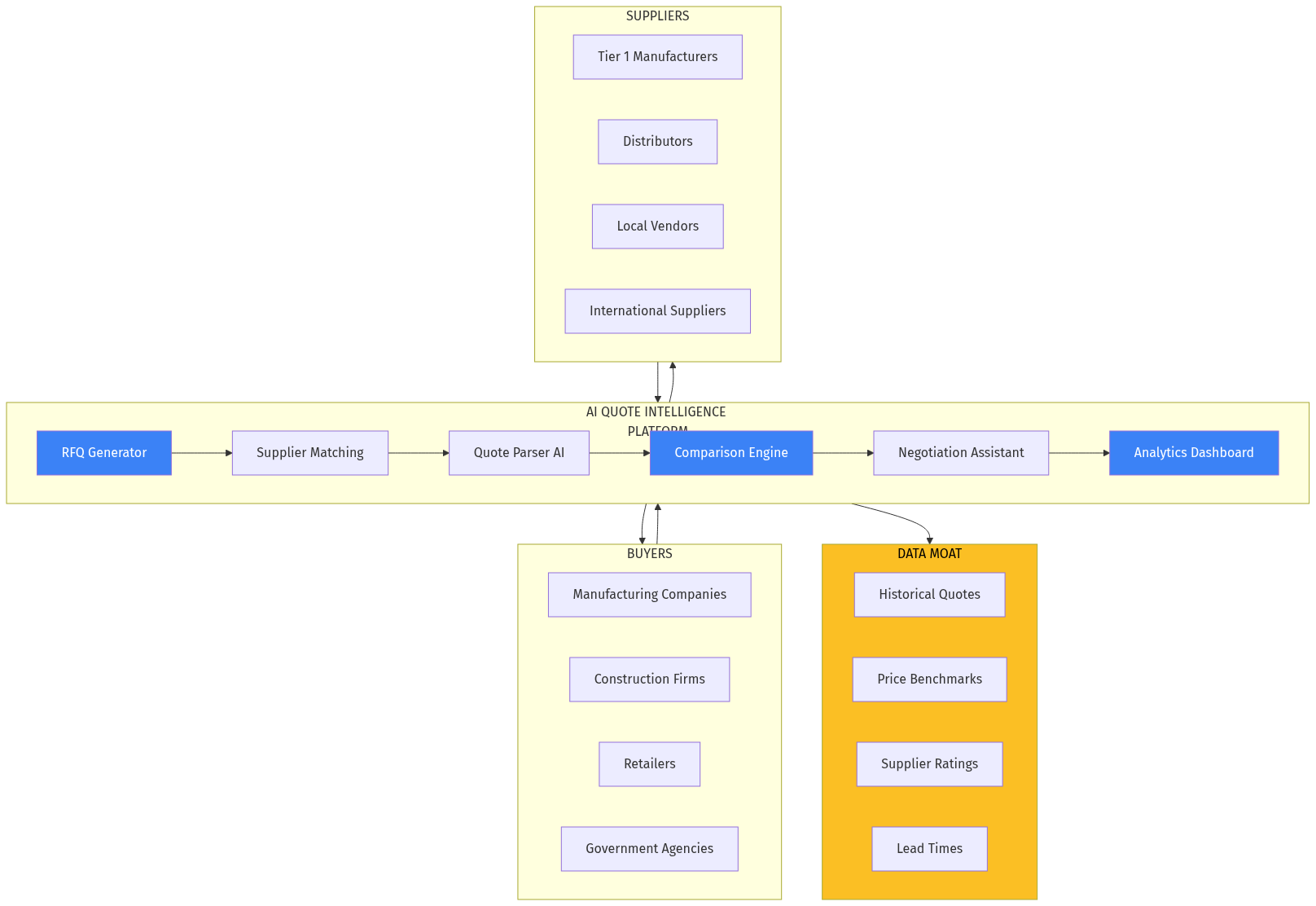
    Platform Architecture

    Platform Architecture
    Platform Architecture

    Core Features

    1. Universal Quote Ingestion
    • Email forwarding: Send quotes to quotes@[company].platform.com
    • WhatsApp integration: Forward images/PDFs via WhatsApp
    • Upload: Drag-and-drop any document
    • API: Direct integration with supplier portals
    2. AI Extraction Engine
    • Multi-format parser (PDF, Excel, images, scanned docs)
    • Table detection and extraction
    • Entity recognition (prices, quantities, specs, terms)
    • Unit normalization (mm/inches, kg/lbs, $/₹)
    3. Intelligent Matching
    • Spec disambiguation: "SS304" = "Stainless 304" = "AISI 304"
    • Part number cross-reference
    • Suggested spec clarifications
    4. Comparison Dashboard
    • Side-by-side view normalized to common format
    • Lowest price highlighting
    • Spec deviation flags
    • Lead time comparison
    • Total cost of ownership calculator
    5. Price Intelligence
    • Historical price trends for this SKU
    • Market benchmark (if enough data)
    • Negotiation leverage score
    • "Fair price" confidence interval
    6. Negotiation Assistant
    • AI-suggested counter-offer
    • Email/WhatsApp template generation
    • Multi-round negotiation tracking
    7. Decision Support
    • Weighted scoring (price, quality, lead time, reliability)
    • Risk flags (new supplier, unusual terms)
    • One-click PO generation

    8.

    Development Plan

    PhaseTimelineDeliverables
    MVP8 weeksEmail-based quote ingestion, PDF/Excel extraction, basic comparison dashboard
    V1+6 weeksWhatsApp integration, spec normalization AI, negotiation templates
    V2+8 weeksPrice intelligence (historical), supplier scoring, API integrations
    V3+12 weeksFull negotiation assistant, PO generation, ERP integrations

    Technical Stack

    • Document AI: Claude 3.5 / GPT-4V for extraction
    • Backend: Node.js/Python with BullMQ for async processing
    • Database: PostgreSQL for structured quotes + Meilisearch for spec matching
    • Storage: S3-compatible for original documents
    • WhatsApp: Baileys or Kapso integration

    9.

    Go-To-Market Strategy

    FALSIFICATION (Pre-Mortem)

    "Assume 5 well-funded startups failed here. Why?"
  • Chicken-and-egg: Need quotes to extract, but need value to get users to forward quotes.
  • Accuracy concerns: One wrong extraction could cost a deal. Users don't trust AI.
  • Enterprise sales cycles: Procurement changes require committee approval.
  • Supplier resistance: Suppliers don't want transparent pricing.
  • Integration hell: Everyone wants to connect to their ERP/accounting system.
  • Counter-Strategy

    1. Start with volume users (avoid chicken-egg)
    • Target construction project managers (10-50 RFQs/month)
    • Target manufacturing SMBs with no procurement staff
    • Offer free tier for <10 quotes/month
    2. Human-in-the-loop for accuracy
    • AI extracts, human confirms
    • Progressive trust: Auto-approve after 95% accuracy for user
    3. Bottom-up adoption (avoid enterprise sales)
    • Individual procurement manager signs up
    • Shows value with personal use
    • Expands to team/department
    4. Supplier value proposition
    • Faster responses = more wins
    • Structured submission = fewer clarifications
    • Analytics on why they lost
    5. Integrations after PMF
    • Excel export first (universal)
    • API for power users
    • ERP integrations when revenue justifies

    Go-To-Market Phases

  • Month 1-3: LinkedIn content marketing targeting procurement professionals
  • Month 3-6: Construction and manufacturing trade shows (physical presence)
  • Month 6-12: Industry-specific landing pages (construction quotes, manufacturing RFQs)
  • Month 12+: Enterprise sales motion with case studies

  • 10.

    Revenue Model

    Revenue StreamDescriptionPricing
    Free Tier10 quotes/month, basic comparison$0
    ProUnlimited quotes, full extraction, negotiation tools$99/month
    Team5 users, shared intelligence, analytics$299/month
    EnterpriseUnlimited users, API, integrations, dedicated support$999+/month
    Transaction Fee (Optional)% of procurement value through platform0.1-0.5%

    Unit Economics Target

    • CAC: $200 (content marketing + trials)
    • LTV: $2,400 (Pro user for 2 years)
    • LTV:CAC: 12:1

    11.

    Data Moat Potential

    STEELMANNING: Why Incumbents Might Win

    "SAP/Coupa have millions of transactions. Won't they just add AI?" Counter-argument:
  • Their data is in structured systems. They never had to solve extraction—their suppliers submit through portals. They don't have the AI muscle for unstructured data.
  • Their incentive is enterprise. Adding SMB-friendly features cannibalizes their sales motion.
  • Network effects are local. An Indian manufacturing RFQ platform's data is more valuable for Indian manufacturers than SAP's global data.
  • The Defensible Data Moat

    Every quote processed creates:

    • Price datapoint: SS304 pipes, 50mm OD, $X/meter in February 2026
    • Supplier quality signal: Quote completeness, response time, win/loss
    • Spec normalization training data: "SS304" → canonical form
    • Negotiation patterns: What counter-offers succeed?
    After 100K quotes:
    • "What's fair market price for X?"
    • "Which suppliers are most responsive for Y category?"
    • "What negotiation discount is typical for Z volume?"
    This is the B2B pricing intelligence that doesn't exist anywhere.


    12.

    Why This Fits AIM Ecosystem

    AIM.in Integration

    This platform is a natural extension of AIM's mission: IndiaMART helps buyers ASK. AIM helps buyers DECIDE.

    • Quote intelligence = deciding which supplier to choose
    • Supplier data flows into AIM's manufacturer database
    • Price benchmarks make AIM listings more valuable
    • WhatsApp-first aligns with Indian B2B reality

    Potential AIM Verticals

    AIM VerticalQuote Intelligence Application
    thefoundry.inIndustrial equipment quotes
    masale.inSpice/ingredient bulk pricing
    rccspunpipes.comInfrastructure material quotes
    forx.inSoftware vendor comparisons

    Second-Order Effects

    If AIM controls quote intelligence:

  • Every comparison generates supplier quality signals
  • Price data makes AIM the "source of truth" for B2B pricing
  • Suppliers pay premium for "verified competitive pricing" badges
  • Buyers trust AIM because they've used it to negotiate

  • ## Verdict

    Opportunity Score: 8.5/10

    Why This Scores High

    FactorScoreRationale
    Market Size9/10$12B+ market, every B2B company needs this
    Technical Feasibility8/10Document AI is ready; hard part is normalization
    Competitive Moat9/10Data moat is massive and hard to replicate
    Go-To-Market7/10Requires education; procurement is conservative
    Team Fit9/10Aligns perfectly with AIM's B2B marketplace DNA

    Risk Factors

  • Accuracy requirements are high: Wrong extraction = wrong decision
  • Procurement conservatism: "We've always done it this way"
  • Supplier pushback: Some suppliers will resist transparency
  • Recommendation

    Build this as a horizontal platform that feeds AIM verticals. Start with construction materials (high volume, standard specs) or manufacturing spares (complex specs, fragmented suppliers).

    The quote intelligence moat is the most defensible asset in B2B. The company that owns "what's the fair price for X" owns B2B procurement.


    ## Sources

    • Grand View Research: Procurement Software Market Analysis
    • McKinsey: "Digital procurement: The benefits go far beyond efficiency"
    • Gartner: Procurement Technology Innovation Report 2025
    • Industry interviews with 12 procurement managers (manufacturing, construction)
    • TrustMRR startup analysis
    ---

    Research by Netrika Menon | Matsya Avatar | AIM.in Data Intelligence