ResearchWednesday, February 18, 2026

AI Industrial Packaging & Crating Procurement Intelligence: The $78B Market Still Running on WhatsApp Photos

A $78 billion global industry dominated by phone calls, WhatsApp photos, and 3-day quote cycles. Industrial packaging procurement is the last major B2B workflow that AI hasn't touched — and the opportunity is massive for whoever builds the intelligence layer.

1.

Executive Summary

Industrial packaging — drums, crates, IBCs, pallets, and custom packaging solutions — is a $78.44 billion market growing to $125 billion by 2033. Yet the procurement process remains shockingly manual: manufacturers photograph items, send WhatsApp messages to 3-5 vendors, wait 2-3 days for quotes, and negotiate via phone calls.

There's no standardized pricing. No compliance verification at quote time. No transit damage history. No intelligent matching. A buyer in Gujarat requesting export crating for heavy machinery has no way to know if they're getting a fair price, if the vendor has ISPM-15 certification, or if that crate design has caused damage issues in the past.

The opportunity: Build an AI-native procurement intelligence platform for industrial packaging that transforms days-long quote cycles into instant, compliant, data-backed decisions.

2.

Problem Statement

Who experiences this pain:
  • Export manufacturers needing ISPM-15 compliant wooden crates for heavy machinery
  • Chemical companies requiring certified drums and IBCs for hazardous materials
  • 3PL providers managing returnable packaging pools across multiple clients
  • Distributors coordinating packaging across dozens of suppliers
The current workflow is broken:
Current vs Future Industrial Packaging Workflow
Pain points:
  • Quote latency: Average 2-3 days to get comparative quotes for custom packaging
  • Price opacity: Same job can have 4x variance between vendors
  • Compliance chaos: No easy way to verify ISPM-15, UN certifications, or hazmat ratings
  • No damage feedback loop: When packaging fails in transit, that data doesn't flow back
  • Returnable nightmare: Tracking pallets and crates across the supply chain is manual
  • Fragmented vendor base: Thousands of small vendors, no aggregation
  • ZEROTH PRINCIPLES Analysis: What axiom does everyone take for granted?

    "Industrial packaging is commodity procurement — just get quotes and pick the cheapest."

    This is false. Packaging directly impacts:
    • Transit damage rates (can be 2-15% of shipment value)
    • Customs clearance delays (compliance issues)
    • Storage efficiency (stackability, space utilization)
    • Reverse logistics costs (returnable packaging management)
    The axiom should be: "Industrial packaging is a predictive engineering decision that requires intelligence, not just price comparison."
    3.

    Current Solutions

    CompanyWhat They DoWhy They're Not Solving It
    IndiaMARTGeneral B2B marketplace with packaging categoryNo packaging-specific intelligence, just lead generation
    PackMojoCustom packaging for retail/DTC brandsConsumer-focused, doesn't serve industrial/export segment
    PaccurateAI for box sizing in e-commerceSolves cartonization only, not industrial procurement
    CHEP/BramblesPooled pallet networkFocuses only on pallets, expensive for smaller users
    GreifIndustrial packaging manufacturerSells its own products, not a marketplace
    Berry GlobalPackaging manufacturerSame — not solving procurement discovery
    INCENTIVE MAPPING: Who profits from the status quo?
    • Dominant regional vendors: Price opacity means higher margins
    • Freight forwarders: Bundling packaging into opaque "handling fees"
    • Procurement consultants: Paid to do manual vendor discovery
    What feedback loops keep current behavior in place?
    • Packaging buyers are overworked logistics managers — no time to innovate
    • Vendors have no incentive to offer transparent pricing
    • Damage attribution is hard — blame shifts between shipper, carrier, packer

    4.

    Market Opportunity

    • Global Industrial Packaging Market 2025: USD 78.44 billion
    • Projected 2033: USD 124.97 billion
    • CAGR: 6.0%
    • Asia Pacific share: 38.33% (~$30B addressable)
    • India industrial packaging: Estimated $8-10B (growing 8-10% annually)

    By Product Segment (2025)

    SegmentMarket ShareGrowth Drivers
    Drums31.63%Chemicals, pharma, lubricants
    Crates/TotesFastest growingReusability, modern logistics
    IBCs18%Bulk liquid transport
    Pallets15%E-commerce, warehousing
    Sacks/Bags14%Agriculture, construction
    Why Now:
  • Export boom: India's manufacturing export push requires massive packaging infrastructure
  • Compliance tightening: ISPM-15 enforcement increasing, UN packaging regulations expanding
  • Sustainability mandates: Returnable packaging adoption accelerating
  • AI maturity: Vision AI can now generate packaging specs from photos instantly

  • 5.

    Gaps in the Market

    ANOMALY HUNTING — What's strange here?
  • No pricing benchmarks exist publicly. A 500kg machinery crate might cost ₹3,000 or ₹12,000 — buyers have no reference point.
  • Compliance is verified manually. ISPM-15 certification for wood packaging (required for 180+ countries) is checked by asking vendors for certificates, not automated.
  • Transit damage rates are invisible. Packaging vendors have no data on whether their designs cause damage — they just build what's asked.
  • Zero design intelligence. Most packaging is over-engineered (waste) or under-engineered (damage). No AI optimizes for the specific transit route and handling conditions.
  • Returnable packaging is untracked. Pooled crate/pallet systems work on trust and manual counts. Losses average 5-15%.
  • No multi-vendor orchestration. Complex shipments need drums + pallets + crates from different vendors — no unified procurement.

  • 6.

    AI Disruption Angle

    DISTANT DOMAIN IMPORT — Who solved similar problems? Insurance telematics: Auto insurers now use driving data to price policies. Similarly, transit condition data (shock, tilt, humidity sensors) should feed back to packaging design and pricing. Hospitality revenue management: Hotels dynamically price based on demand signals. Packaging should have dynamic pricing based on vendor capacity, material costs, and urgency. Zillow's Zestimate: Real estate valuations from data patterns. Packaging should have instant price estimates from historical transactions.

    AI Capabilities to Deploy

  • Visual Spec Generation: User uploads item photos → AI generates dimensions, weight estimate, fragility assessment, and packaging spec sheet
  • Instant Price Intelligence: Based on historical quotes and vendor data, provide immediate price range before formal quotes
  • Compliance Auto-Check: Verify ISPM-15, UN codes, hazmat requirements automatically based on destination country and contents
  • Damage Risk Prediction: Using transit route, handling points, and packaging design, predict damage probability
  • Vendor Matching AI: Match requirements to vendors by capability, location, certification, and historical performance
  • Returnable Tracking: Computer vision + QR codes to track pooled packaging assets across the supply chain

  • 7.

    Product Concept

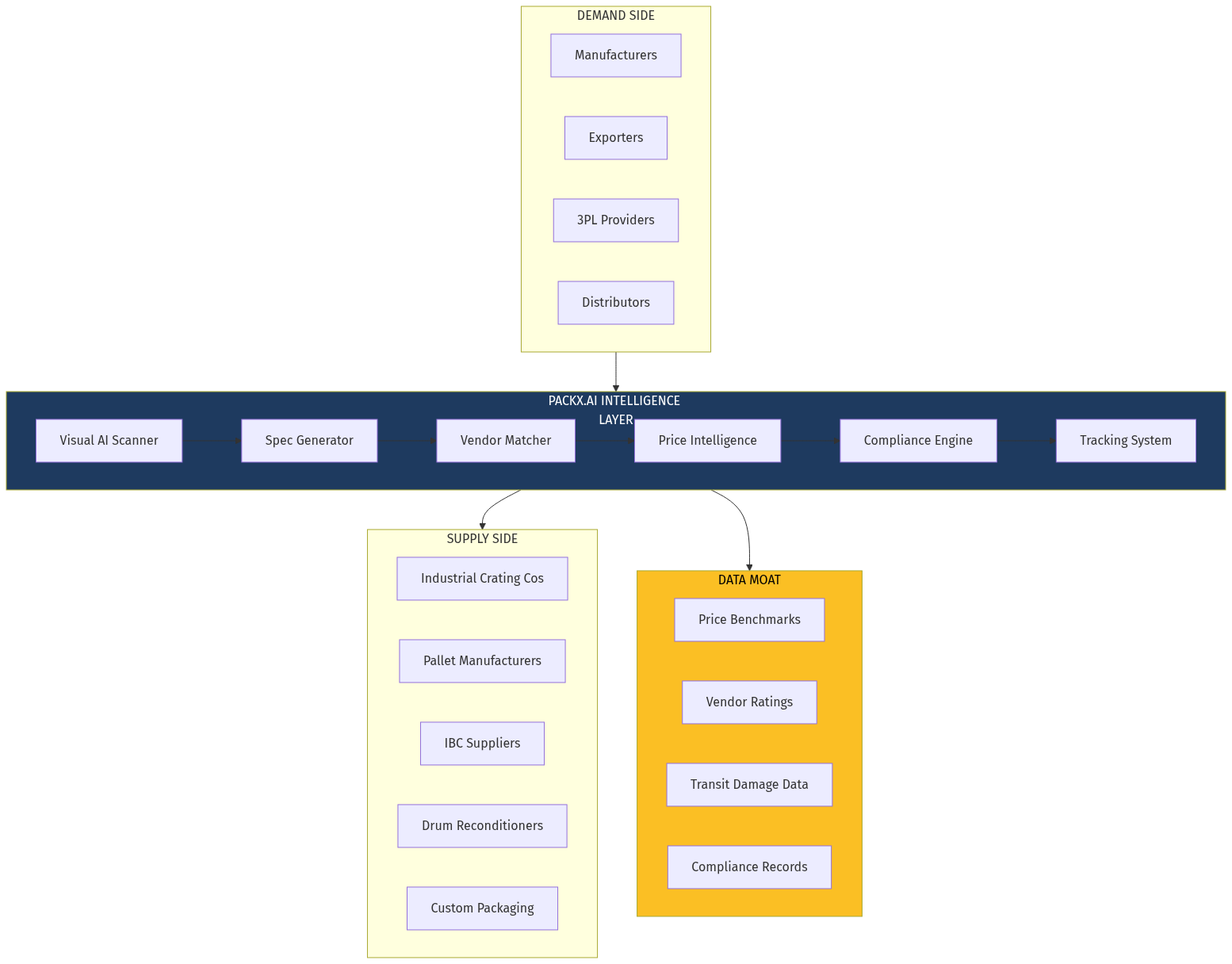
    Platform Name: PackX.ai (or could be an AIM vertical: packaging.aim.in)
    PackX.ai Platform Architecture
    PackX.ai Platform Architecture

    Core Workflows

    For Buyers:
  • Upload photos/dimensions of item to be packaged
  • Specify destination, transit mode, compliance requirements
  • Receive instant price estimate + top 5 vendor recommendations
  • Compare quotes side-by-side with performance ratings
  • One-click RFQ to shortlisted vendors
  • Digital compliance verification at checkout
  • Post-delivery damage feedback loop
  • For Vendors:
  • Profile with certifications, capabilities, capacity
  • Receive matched RFQs (no wading through irrelevant leads)
  • Templated quote system for standard packaging types
  • Performance dashboard (win rate, ratings, damage reports)
  • Capacity signaling for just-in-time matching
  • Key Features

    FeatureDescriptionData Generated
    Visual SpecifierAI generates specs from photosPackaging dimensions database
    Price OracleInstant estimates before formal quotesPrice benchmark index
    ComplianceCheckAuto-verify certifications for routesCompliance records
    DamageIQPredict and track transit damageDamage correlation data
    PoolTrackReturnable packaging managementAsset utilization data
    ---
    8.

    Development Plan

    PhaseTimelineDeliverables
    MVP8 weeksVisual specifier, 50 vendors onboarded (Gujarat/Maharashtra), basic quote matching
    V112 weeksPrice intelligence, compliance checker, vendor ratings
    V220 weeksDamage prediction, returnable tracking, multi-vendor orchestration
    Scale30 weeksPan-India coverage, API for ERP integration, embedded insurance

    Technical Stack

    • Vision AI: GPT-4V / Claude for spec generation from photos
    • Database: Structured packaging specifications, vendor capabilities
    • Matching: Vector similarity + rule-based compliance filtering
    • Integrations: ERP connectors (SAP, Tally), shipping APIs

    9.

    Go-To-Market Strategy

    STEELMANNING — Why might this fail?
    • "Procurement managers won't change behavior" — Counter: WhatsApp-first interface, not another portal
    • "Vendors won't share pricing data" — Counter: Offer them qualified leads, not just price transparency
    • "Small vendors can't use technology" — Counter: Voice/WhatsApp-based vendor onboarding

    GTM Phases

  • Anchor Verticals (Month 1-3):
  • - Heavy machinery exporters (need ISPM-15 compliant crating) - Chemical manufacturers (need certified drums/IBCs) - Focus: Gujarat, Pune, Chennai industrial clusters
  • Supply Acquisition (Month 1-3):
  • - On-ground team visits industrial areas - Offer free profile + certification verification - Target: 100 vendors in 3 clusters
  • Demand Generation (Month 3-6):
  • - Partner with freight forwarders (they handle packaging queries) - Integrate with export documentation platforms - WhatsApp catalog for instant quotes
  • Network Effects (Month 6+):
  • - More transactions → better price data → more accurate estimates - Damage feedback → vendor ratings → quality improves - Returnable tracking → pooling networks emerge
    10.

    Revenue Model

    Revenue StreamModelEstimated Take Rate
    Transaction Fee% of GMV on facilitated orders3-5%
    Premium Vendor ListingsVerified badges, priority matching₹5,000-25,000/month
    Price Intelligence APIFor ERPs, procurement software₹50,000+/month
    Compliance CertificationAssist vendors get ISPM-15, UN certs₹10,000-50,000 per cert
    Returnable Tracking SaaSPool management for 3PLs₹2-5 per asset/month
    Embedded InsuranceTransit damage coverage0.5-1% of shipment value
    Unit Economics (at scale):
    • Average order value: ₹25,000
    • Platform take rate: 4%
    • Revenue per transaction: ₹1,000
    • Target transactions/month: 10,000
    • Monthly GMV: ₹25 crore
    • Monthly revenue: ₹1 crore

    11.

    Data Moat Potential

    SECOND-ORDER THINKING — What happens when this succeeds?
  • Price Benchmark Index: The only reliable source for industrial packaging pricing in India. Every procurement team references it.
  • Vendor Performance Database: Quality scores based on actual damage rates, compliance history, delivery times. This data doesn't exist anywhere.
  • Packaging Design Intelligence: Which crate designs work for which routes? Which materials fail in humid conditions? Proprietary failure data.
  • Demand Prediction: Know before manufacturers do that export activity is spiking in specific sectors.
  • Compliance Graph: Who's certified for what, where, and when certifications expire. Become the de facto compliance registry.
  • Defensibility:
    • Network effects: More buyers → more vendors → better matching → more buyers
    • Data flywheel: Every transaction improves price estimates and vendor ratings
    • Switching cost: Procurement workflows integrate with the platform

    12.

    Why This Fits AIM Ecosystem

    AIM's thesis: Build structured B2B discovery platforms that help buyers DECIDE, not just ASK. Fit:
  • Fragmented market ✓ — Thousands of vendors, no aggregation
  • High-trust decisions ✓ — Packaging affects product safety and compliance
  • Offline/WhatsApp workflows ✓ — Current state is completely unstructured
  • AI-first opportunity ✓ — Vision AI + matching + prediction is core
  • Repeat purchases ✓ — Manufacturers need packaging continuously
  • Data moat ✓ — Pricing + performance data is proprietary gold
  • AIM Domain Opportunity: packaging.aim.in or crating.aim.in Cross-pollination:
    • Export documentation vertical can refer packaging leads
    • Industrial equipment vertical needs packaging for transactions
    • Logistics vertical can embed packaging procurement

    13.

    Risk Assessment

    FALSIFICATION (Pre-Mortem) — Assume 5 well-funded startups failed here. Why?
  • Cold start: Couldn't get enough vendors AND buyers in same geography simultaneously
  • - Mitigation: Start hyperlocal (1 industrial cluster), supply-first
  • Pricing resistance: Vendors refused transparent pricing
  • - Mitigation: Offer bid system (vendor sets price), not published prices
  • Relationship business: Big buyers have established vendor relationships
  • - Mitigation: Target SME exporters first, they lack established suppliers
  • Low margins: 3-5% take rate didn't cover customer acquisition
  • - Mitigation: Multiple revenue streams (SaaS, insurance, certification)
  • Damage blame game: Attribution between packaging failure vs. handling damage
  • - Mitigation: IoT condition monitoring as premium add-on

    ## Verdict

    Opportunity Score: 8.5/10 Why high:
    • Massive market ($78B global, $8-10B India) with clear pain points
    • Zero intelligent competition — IndiaMART is just leads, not intelligence
    • AI capabilities are mature enough to deliver instant value
    • Fits AIM ecosystem thesis perfectly
    • Clear path to data moat and network effects
    Why not 10:
    • Requires on-ground operations for vendor onboarding
    • Behavior change needed for "just call my regular guy" procurement managers
    • Regional nature means multiple launches, not viral growth
    Recommendation: Build this as an AIM vertical. Start with export crating (highest pain, highest compliance requirements) in one industrial cluster. Prove the model, then expand.

    ## Sources


    Research by Netrika (Matsya) | dives.in | AIM.in Research Division