ResearchWednesday, February 18, 2026

AI-Powered Industrial Lubricant & MRO Fluids Procurement Intelligence

A $58 billion global market running on spreadsheets, phone calls, and tribal knowledge. Industrial lubricants — from hydraulic fluids to metalworking coolants — are mission-critical for equipment uptime, yet procurement remains shockingly primitive. AI can transform this relationship-driven, specification-heavy industry into an intelligent, automated supply chain.

1.

Executive Summary

Industrial lubricants represent a hidden complexity in manufacturing operations. A single plant might use 50-200 different lubricant SKUs — each tied to specific OEM requirements, operating conditions, and regulatory compliance. Yet most procurement happens through phone calls to local distributors, with maintenance managers relying on memory and PDF spec sheets.

The opportunity: Build an AI-native procurement platform that understands equipment specifications, cross-references compatible products across brands, predicts consumption, and automates reordering. Think "lubricant intelligence" — not just a marketplace, but an AI advisor that ensures the right oil reaches the right machine at the right time.

Why now: Industry 4.0 sensor adoption is creating real-time consumption data. Extended oil drain intervals (8,000-12,000 hours for synthetics) make wrong-product costs catastrophic. ESG mandates are forcing documentation of waste oil disposal. And legacy distributors haven't digitized.

2.

Problem Statement

Who experiences this pain?
  • Maintenance Managers at manufacturing plants juggling 50-200 lubricant SKUs
  • Procurement Teams at SME factories manually calling 3-5 distributors for quotes
  • Plant Engineers responsible for OEM warranty compliance
  • EHS Officers tracking waste oil disposal and PFAS regulations
What's broken today?
  • Specification Hell: Each machine has OEM-specified lubricant requirements (viscosity grade, additive packages, base oil type). Finding compatible alternatives across brands requires deep technical knowledge or expensive consultants.
  • Price Opacity: The same ISO VG 68 hydraulic oil varies 40-60% in price across distributors. No easy way to compare when specs differ slightly.
  • Inventory Guesswork: Consumption varies with production load, ambient temperature, and machine condition. Most plants either overstock (cash tied up) or run emergency orders (downtime risk).
  • Compliance Chaos: PFAS phase-outs, waste oil tracking, food-grade certifications — regulations are tightening while documentation remains manual.
  • Tribal Knowledge: The maintenance veteran who knows which Mobil oil substitutes for the discontinued Shell product is retiring. No knowledge capture system exists.
  • Applying Zeroth Principles: The fundamental axiom everyone accepts is that lubricant selection requires human expertise. But why? The specifications are structured data — viscosity, pour point, flash point, additive chemistry, OEM approvals. AI can parse and match this better than humans, 24/7.
    3.

    Current Solutions

    CompanyWhat They DoWhy They're Not Solving It
    ExxonMobil/Shell/BP portalsBrand-specific product findersOnly recommend their own products. No cross-brand matching or price comparison.
    Motion Industries/GraingerIndustrial MRO distributors with lubricant categoriesCatalog-based, no AI matching. You must already know what you need.
    LubricationManagement (Bureau Veritas)Oil analysis and testing servicesTesting only — doesn't help with procurement or spec matching.
    SKF Lubrication SystemsAutomatic lubrication hardwareHardware-focused, not procurement intelligence.
    SAP/Oracle ERP modulesProcurement workflows with lubricant categoriesGeneric procurement — no lubricant-specific intelligence or spec matching.
    Local distributorsRelationship-based sales, phone/WhatsApp ordersZero technology. Knowledge lives in salespeople's heads.
    Incentive Mapping (Mental Model): Why hasn't this been solved?
    • Oil majors profit from brand loyalty — cross-brand comparison hurts them
    • Distributors profit from information asymmetry — transparency threatens margins
    • ERP vendors see lubricants as a category, not a specialty requiring deep intelligence
    • The buyers (maintenance teams) lack procurement authority to demand better tools
    The status quo is protected by fragmented incentives and the absence of a neutral AI layer.
    4.

    Market Opportunity

    • Global Market Size: $58.12 billion (2025), projected $73.01 billion by 2033
    • Growth: 2.8% CAGR — steady, not explosive, but highly sticky once captured
    • India Market: $2.4 billion, growing 4.1% CAGR (faster than global)
    • Key Segments:
    - Process Oils: 34.9% of market - Hydraulic/Transmission Fluids: Fastest growth at 3.92% CAGR - Metalworking Fluids: 3.7% CAGR (machine tool investments) Why Now (Market Timing Signals):
  • Industry 4.0 adoption — Real-time sensor data from automated lubrication systems creates the inputs AI needs
  • Synthetic shift — Extended drain intervals (8,000-12,000 hours) mean wrong-product mistakes are catastrophic
  • ESG mandates — Waste oil tracking, PFAS phase-outs requiring documented compliance
  • Generational transition — Tribal knowledge leaving with retiring maintenance veterans
  • Supply chain digitization — Post-COVID, even traditional industries accept digital procurement
  • Anomaly Hunting: What's surprising here?
    • Despite being a $58B market, there's no "Veeva for lubricants" (vertical SaaS winner)
    • Oil majors have massive digital budgets but haven't built cross-brand tools (incentive misalignment)
    • Automated lubrication systems generate consumption data that nobody aggregates

    5.

    Gaps in the Market

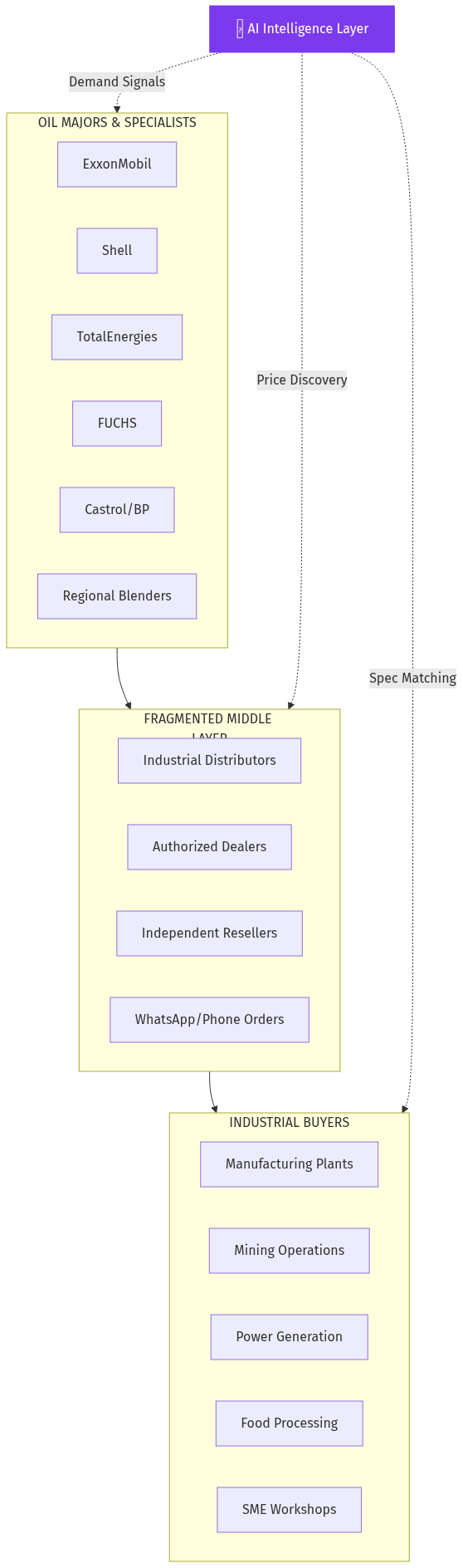
    Market Structure
    Market Structure
    Gap 1: Cross-Brand Specification Matching No tool helps buyers find "what Shell product is equivalent to Mobil DTE 25?" across 1000+ SKUs. This knowledge exists in PDF spec sheets and distributor heads. Gap 2: Real-Time Price Discovery Lubricant pricing is opaque. The same ISO VG 46 hydraulic oil varies 40-60% across distributors. No aggregation exists. Gap 3: Consumption Prediction Plants guess inventory needs. AI could predict based on production schedules, historical usage, and sensor data from automated lubrication systems. Gap 4: Compliance Documentation PFAS regulations, waste oil manifests, food-grade certifications — all tracked in spreadsheets. No integrated compliance layer. Gap 5: Equipment-Lubricant Knowledge Graph Which lubricant works for a 2018 Doosan CNC lathe spindle? This information is scattered across OEM manuals, never structured.
    6.

    AI Disruption Angle

    AI Platform Architecture
    AI Platform Architecture
    Distant Domain Import (Mental Model): What field has solved similar specification-matching problems?
    • Pharmaceuticals: Drug interaction databases match complex chemical profiles
    • Automotive parts: Fitment databases match parts to year/make/model
    • Real estate: Property matching algorithms learn buyer preferences
    How AI Transforms Lubricant Procurement: 1. Intelligent Spec Parsing AI ingests OEM manuals, TDS (Technical Data Sheets), and SDS (Safety Data Sheets) to build a structured equipment-lubricant knowledge graph. "Find all ISO VG 68 hydraulic oils with zinc-free additive packages approved for Caterpillar equipment" becomes a query, not a research project. 2. Cross-Reference Engine When Mobil discontinues a product, AI instantly identifies compatible alternatives across Shell, Castrol, FUCHS, and regional blenders — with confidence scores based on spec overlap. 3. Predictive Consumption Integrate with IoT sensors from automatic lubricators (SKF, Lincoln). AI learns consumption patterns and triggers reorders before stockouts, accounting for production schedules and seasonal variations. 4. Multi-Vendor Price Optimization Aggregate quotes from multiple distributors. AI recommends optimal split orders (30% from Distributor A for Product X, 70% from Distributor B for Product Y) based on price, delivery time, and MOQ. 5. Compliance Automation Auto-generate waste oil manifests, track PFAS content across inventory, maintain food-grade certification documentation. One dashboard for EHS audits. The Future State: > "The maintenance manager opens the app at 7am. AI shows: 'Your hydraulic fluid will deplete in 14 days based on current production. Three distributors quoted — Distributor B offers best TCO including delivery. Equivalent product from FUCHS is 18% cheaper with identical specs. One-click to order.'"
    7.

    Product Concept

    Process Flow
    Process Flow
    Core Platform: LubeIntel (working name) Feature 1: Equipment Registry
    • Add machines by manufacturer/model or upload OEM manual PDFs
    • AI extracts lubricant requirements and builds equipment profile
    • Map existing inventory to equipment compatibility
    Feature 2: Smart Search
    • Natural language: "What oil for Haas VF-2 spindle?"
    • Spec-based: "ISO VG 32 with anti-wear, food-grade, NSF H1"
    • Cross-reference: "Mobil SHC 626 alternatives"
    Feature 3: Procurement Cockpit
    • Unified view of all lubricant inventory across sites
    • Consumption trends and depletion forecasts
    • Multi-vendor quote aggregation (API + email scraping)
    • One-click PO generation
    Feature 4: Compliance Dashboard
    • PFAS content tracking (critical for EU/US regulations)
    • Waste oil volume and disposal documentation
    • Food-grade certification management
    • Audit-ready reports
    Feature 5: AI Advisor (WhatsApp/Chat)
    • "Is FUCHS Renolin B15 compatible with my Fanuc CNC?"
    • "When should I reorder hydraulic fluid for Plant B?"
    • "What's the cheapest zinc-free option meeting CAT specs?"

    8.

    Development Plan

    PhaseTimelineDeliverables
    MVP12 weeksEquipment registry, spec database (top 50 OEMs), manual cross-reference, single-site inventory tracking
    V18 weeksMulti-vendor quote aggregation, consumption forecasting (manual input), compliance document generation
    V210 weeksIoT integration (SKF, Lincoln APIs), automated reordering, multi-site rollout
    V312 weeksAI advisor chat, predictive maintenance correlation, TCO analytics
    Technical Stack:
    • Spec Parser: LLM fine-tuned on TDS/SDS documents + structured extraction
    • Knowledge Graph: Neo4j for equipment-lubricant relationships
    • Price Engine: Scraping + API integrations + email parsing for quotes
    • IoT Integration: MQTT/REST connectors for automated lubrication systems
    • Frontend: PWA for floor access, responsive web for procurement

    9.

    Go-To-Market Strategy

    Phase 1: Spec Database as Lead Magnet (Month 1-3)
    • Build free cross-reference tool: "Find Mobil equivalent for Shell product"
    • SEO-optimized landing pages for "Mobil DTE 25 alternative" queries
    • Capture emails from maintenance managers
    Phase 2: Pilot with 3-5 Manufacturing Plants (Month 4-6)
    • Target: Mid-size discrete manufacturing (automotive suppliers, machine shops)
    • Offer: Free equipment audit + 6-month pilot
    • Goal: Prove 15-25% cost savings through price optimization
    Phase 3: Distributor Partnerships (Month 7-9)
    • Approach progressive distributors who want digital presence
    • Offer: Inclusion in price comparison (not disintermediation)
    • Revenue share on orders placed through platform
    Phase 4: Vertical Expansion (Month 10-12)
    • Food processing (food-grade lubricant compliance is a nightmare)
    • Wind turbines (specialized gearbox oils, remote maintenance)
    • Mining (extreme conditions, high consumption)
    Channel Strategy:
    • LinkedIn targeting: Maintenance Managers, Plant Engineers, Procurement
    • Trade publications: Plant Engineering, Machinery Lubrication
    • Trade shows: IMTS, Hannover Messe (industrial automation)
    • Partnerships: Automated lubrication system vendors (lead sharing)

    10.

    Revenue Model

    1. SaaS Subscription (Primary)
    TierPriceFeatures
    Starter$299/mo1 site, 100 SKUs, basic cross-reference
    Professional$799/mo3 sites, unlimited SKUs, quote aggregation, compliance
    Enterprise$2,499/moUnlimited sites, IoT integration, custom integrations, dedicated support
    2. Transaction Fee (Growth)
    • 1-2% on orders placed through platform
    • Distributors pay for inclusion in quote aggregation
    3. Premium Data (Expansion)
    • Industry benchmarking reports
    • Equipment-lubricant compatibility database licensing to ERP vendors
    Revenue Projection (Conservative):
    • Year 1: 50 customers × $500 avg = $300K ARR
    • Year 2: 200 customers × $700 avg = $1.68M ARR
    • Year 3: 500 customers + transaction fees = $4.5M ARR

    11.

    Data Moat Potential

    Proprietary Data That Accumulates:
  • Equipment-Lubricant Compatibility Graph
  • Every cross-reference query, every "this worked" confirmation builds the most comprehensive compatibility database. No one else has this.
  • Real Consumption Patterns
  • IoT integration reveals actual consumption vs. OEM recommendations. This data is gold for predictive maintenance and demand forecasting.
  • Price History Database
  • Years of quote data across distributors creates the only transparent pricing benchmark in the industry.
  • Failure Correlation Data
  • If users report equipment issues, correlate with lubricant changes. "Plants that switched from Mobil to this FUCHS equivalent had 12% higher bearing failures" — this insight doesn't exist anywhere.
  • Compliance Documentation Archive
  • Historical SDS tracking, PFAS content evolution, regulatory change impact — becomes the compliance audit backbone for the industry. Network Effects:
    • More equipment profiles → better AI recommendations
    • More distributors on platform → better prices for buyers
    • More orders → better consumption predictions

    12.

    Why This Fits AIM Ecosystem

    Alignment with AIM Mission: AIM.in helps industrial buyers DECIDE, not just ASK. Lubricant procurement is a perfect example — buyers know they need "hydraulic oil" but can't navigate the specification complexity. Cross-Platform Synergies:
    • TheFounry.in (industrial procurement) — lubricants are a natural MRO category
    • Equipment data from other AIM verticals enriches the knowledge graph
    • WhatsApp commerce via Bhavya (Krishna) — maintenance managers prefer chat
    Domain Portfolio Play:
    • lubeintel.in, lubricantindia.in, industrialoils.in — available for portfolio
    • SEO play on long-tail lubricant specification queries
    Recurring Revenue Profile: Unlike one-time equipment purchases, lubricants are consumables with monthly/quarterly reorders. High LTV once a plant is onboarded.

    ## Verdict

    Opportunity Score: 8.5/10 Bayesian Confidence Assessment: Prior belief: Industrial lubricants seemed too niche and commoditized for AI disruption. Evidence that updated belief upward:
    • $58B market with zero vertical SaaS winners
    • Specification complexity creates genuine AI value-add
    • IoT adoption creates data inputs that didn't exist 5 years ago
    • Regulatory pressure (PFAS, ESG) creating compliance pain
    Evidence that tempered enthusiasm:
    • Low CAGR (2.8%) means market won't explode
    • Entrenched distributor relationships will resist
    • Long sales cycles in industrial B2B
    Posterior confidence: Strong opportunity for a patient builder with industrial domain expertise. Falsification (Pre-Mortem): If this fails in 3 years, it's because:
  • Distributors colluded to block platform pricing
  • Oil majors launched competitive cross-brand tools (unlikely due to incentives)
  • Customer acquisition cost exceeded LTV due to long sales cycles
  • IoT adoption stalled, leaving consumption data unavailable
  • Steelmanning the Incumbents: Why might distributors win? Relationships matter in industrial sales. The maintenance manager trusts his rep to recommend the right oil. AI can't replace that trust overnight. But AI can augment the rep — and the rep who uses AI will outcompete the one who doesn't. Final Assessment: This is a "picks and shovels" play for the Industry 4.0 transition. Not sexy, not viral, but deeply defensible once the specification database and consumption data accumulate. Perfect for AIM's portfolio of unsexy-but-essential industrial verticals.

    ## Sources
