ResearchWednesday, February 18, 2026

AI Industrial Fasteners & Hardware Procurement Intelligence

The $130 billion global fasteners market runs on phone calls, WhatsApp messages, and decades-old relationships. With 50,000+ manufacturers worldwide and millions of SKUs spanning bolts, nuts, screws, rivets, and specialty hardware, procurement teams waste hours matching specifications to suppliers. AI agents can transform this fragmented chaos into intelligent, instant procurement—parsing technical drawings, matching suppliers by capability, and guaranteeing quality at the best price.

1.

Executive Summary

Industrial fasteners are the unsung heroes of manufacturing—holding together everything from smartphones to skyscrapers. Yet procuring them remains shockingly primitive. A maintenance engineer needing 500 M8x40 Grade 8.8 hex bolts with hot-dip galvanizing still has to call three distributors, wait days for quotes, manually verify certifications, and hope the delivery matches specifications.

This opportunity proposes an AI-powered fastener procurement intelligence platform that:

  • Parses natural language and technical drawings to extract exact specifications
  • Matches requirements to verified suppliers based on capability, stock, and quality history
  • Delivers instant, comparable quotes with transparency on pricing and delivery
  • Builds a proprietary data moat through specification-to-supplier mapping intelligence
The platform targets India's ₹45,000 crore ($5.4B) fastener market initially, with expansion to the broader $130B global market.


2.

Problem Statement

Who Experiences This Pain?

Procurement managers at manufacturing plants spend 15-20% of their time on fastener procurement despite it being a "commodity." The complexity comes from:
  • Specification Complexity: A single bolt has 12+ parameters—diameter, length, thread pitch, material grade, finish, head type, drive type, tensile strength class, certification requirements
  • Fragmented Supply: No single supplier stocks everything; buyers juggle 15-30 vendors
  • Quality Uncertainty: 23% of production delays in Indian SME manufacturing trace to fastener quality issues
  • Price Opacity: Same bolt varies 40-200% across suppliers; no benchmark exists
  • Certification Chaos: ISO, DIN, ASTM, IS standards create confusion; fake certificates are rampant
  • Maintenance teams face emergency procurement nightmares—a broken M12 socket head cap screw can halt a ₹50 lakh/hour production line while someone drives across town hunting for the exact replacement. Project contractors managing infrastructure projects deal with specification compliance across thousands of fastener SKUs, often discovering non-compliance only during audits.

    The WhatsApp Chaos

    Today's procurement flow:

  • Engineer identifies need, writes specification (often incomplete)
  • Procurement sends WhatsApp messages to 5-10 known suppliers
  • Wait 1-3 days for responses (many don't reply)
  • Manually compare quotes in Excel
  • Negotiate over calls
  • Place order, pray for quality
  • Receive goods, discover 10% don't match specs
  • Begin return/replacement cycle
  • Average time from need to delivery: 7-14 days Time wasted on specification matching: 4-6 hours per order
    3.

    Current Solutions

    CompanyWhat They DoWhy They're Not Solving It
    IndiaMARTGeneral B2B marketplace listing fastener suppliersNo spec parsing, no quality verification, leads to inquiry chaos
    FastenrightE-commerce for standard fastenersLimited to catalog items, no custom specs, no AI matching
    RS ComponentsMRO distributor with online catalogPremium pricing (30-50% above market), limited Indian manufacturing
    Boltport FastenersManufacturer with some online orderingSingle supplier, limited range, no marketplace dynamics
    TradeIndiaSupplier directorySame problems as IndiaMART—no intelligence layer
    Amazon BusinessGeneral B2B e-commerceConsumer-grade selection, no industrial certifications, spec matching impossible

    Why Existing Solutions Fail

  • No Specification Intelligence: Can't understand "I need bolts matching DIN 931, Grade 10.9, Geomet 500 coating"
  • No Capability Matching: Don't know which supplier can actually produce/stock specific items
  • No Quality Data: Zero insight into supplier quality history, rejection rates, certification validity
  • No Price Intelligence: No market rate benchmarking
  • No Integration: Can't connect to ERP systems for demand forecasting

  • 4.

    Market Opportunity

    Market Size

    SegmentSizeGrowth
    Global Fasteners Market$130 billion (2025)4.5% CAGR
    India Fasteners Market$5.4 billion (₹45,000 Cr)6.8% CAGR
    India Organized Fastener Manufacturing$2.1 billion8.2% CAGR
    India Fastener Imports$800 million5.5% CAGR

    Why Now?

  • Manufacturing Resurgence: PLI schemes driving ₹76,000 crore investments in electronics, auto, defense manufacturing
  • Quality Mandates: BIS certification now mandatory for more fastener categories (IS 1367, IS 6649)
  • Supply Chain Localization: China+1 strategy pushing sourcing to Indian manufacturers
  • Digital Adoption: Post-COVID, even traditional procurement teams accept digital tools
  • AI Capability: LLMs can now parse technical specifications, drawings, and standards with high accuracy
  • Addressable Market

    • Target Segment: Manufacturing SMEs (₹5-500 Cr revenue) spending ₹10L-5Cr annually on fasteners
    • Number of Target Companies: ~45,000 in India
    • Average Annual Fastener Spend: ₹35 lakhs
    • Total Addressable Market: ₹15,750 crore
    • Serviceable Addressable Market (10%): ₹1,575 crore
    • Platform Commission (5%): ₹78.75 crore potential revenue

    5.

    Gaps in the Market

    Mental Model: Anomaly Hunting

    What's strange about this market?

  • The McMaster-Carr Paradox: In the US, McMaster-Carr built a $6B+ business on next-day fastener delivery with a 1980s-style website. No Indian equivalent exists despite similar demand density in industrial clusters.
  • The Certification Trust Gap: Buyers pay 20-40% premium for "branded" fasteners from Sundram, LPS, or imports not because of proven quality—but because they can't verify unbranded alternatives. Trust, not quality, commands the premium.
  • The Inventory Invisibility: Distributors don't share real-time stock. A bolt sitting in a Rajkot warehouse remains invisible to a buyer in Pune who urgently needs it.
  • The Specification Translation Gap: A drawing says "M10x50 Cap Screw, SS304." The buyer means A2-70 grade (ISO 3506). The supplier quotes A2-50. Nobody catches it until assembly.
  • The Returns Black Hole: 8-15% of fastener orders get returned due to spec mismatches. These returns are processed offline—no data, no learning, no improvement.
  • Key Gaps

    • Gap 1: No AI that understands fastener specifications across standards (DIN/ISO/ASTM/IS/JIS)
    • Gap 2: No real-time inventory visibility across distributed suppliers
    • Gap 3: No quality intelligence—rejection rates, certification verification, sample analysis
    • Gap 4: No price benchmarking or market rate transparency
    • Gap 5: No specification-to-supplier capability mapping

    6.

    AI Disruption Angle

    Mental Model: Distant Domain Import

    What field has already solved this? Semiconductor component sourcing.

    Platforms like Octopart and Digi-Key transformed electronics component procurement by:

    • Standardizing part specifications
    • Aggregating inventory across thousands of suppliers
    • Providing parametric search
    • Showing real-time pricing and stock
    The parallel is exact. Fasteners, like electronic components, have:
    • Complex parametric specifications
    • Multiple equivalent parts across brands
    • Fragmented supply with varying quality
    • Time-sensitive procurement needs

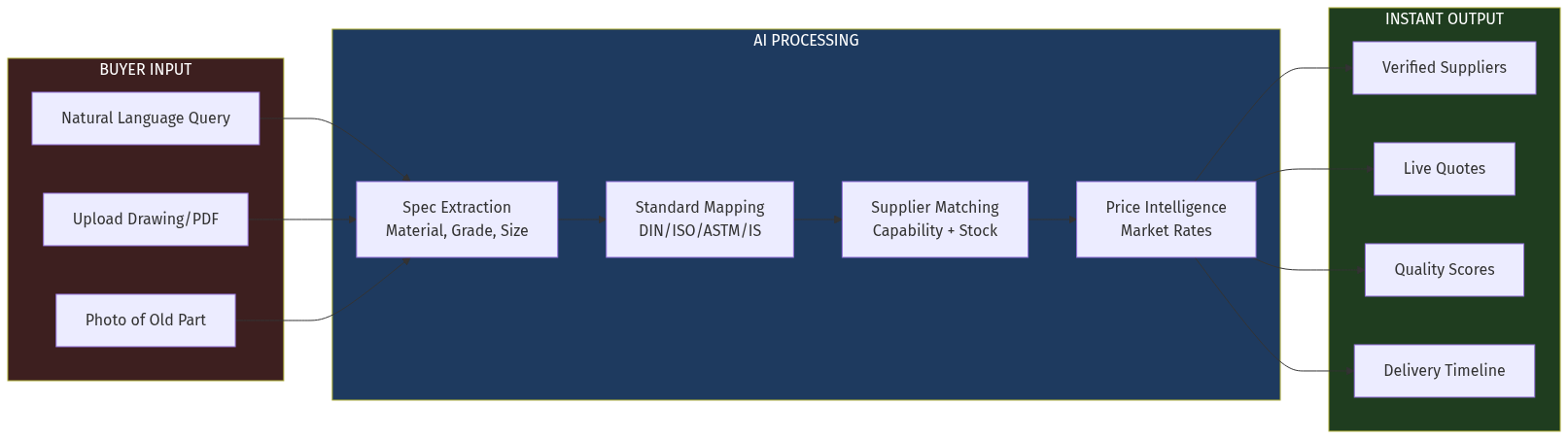
    How AI Agents Transform Fastener Procurement

    AI Processing Engine
    AI Processing Engine
    1. Natural Language Specification Parsing
    User: "I need stainless steel Allen bolts, 12mm diameter, 60mm long, 
           for outdoor use, need to handle 400 Nm torque, quantity 5000"
    
    AI: Parsed as:
        - Type: Socket Head Cap Screw (ISO 4762)
        - Material: SS316 (outdoor corrosion resistance)
        - Size: M12 x 60
        - Property Class: A4-80 (for 400Nm torque requirement)
        - Quantity: 5000
        - Matching suppliers: [ranked list]
    2. Drawing/PDF Specification Extraction Upload a technical drawing → AI extracts all fastener BOMs with specifications, cross-references against standards, identifies ambiguities. 3. Photo-to-Spec Matching Maintenance engineer photographs a worn bolt → AI identifies specifications from dimensions, thread pattern, head type → matches to suppliers with immediate availability. 4. Supplier Capability Intelligence AI maps each supplier's actual manufacturing/stocking capabilities:
    • Which sizes they can produce
    • Which materials they stock
    • Which certifications they hold
    • Their historical quality scores
    • Real-time inventory levels
    5. Price Intelligence AI agent continuously gathers market pricing, identifies anomalies, and provides buyers with benchmark data: "This quote is 23% above market rate for this specification."
    7.

    Product Concept

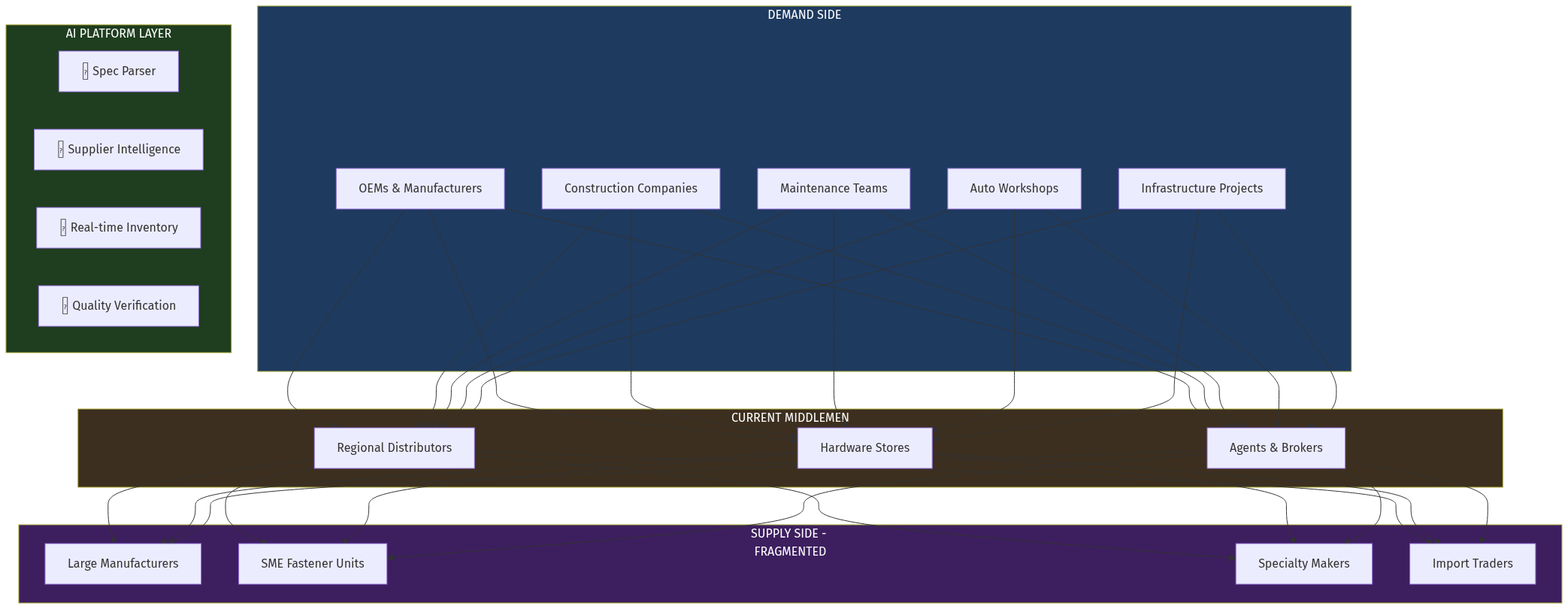
    Platform Architecture

    Market Structure
    Market Structure

    Core Features

    For Buyers:
  • Intelligent RFQ Builder
  • - Natural language input → structured specification - Drawing upload → BOM extraction - Historical order import → specification library
  • Supplier Discovery & Matching
  • - Capability-verified supplier recommendations - Quality scores based on transaction history - Real-time stock visibility - Price comparison with market benchmarks
  • Procurement Workflow
  • - Multi-supplier RFQ dispatch - Automated quote comparison - One-click order placement - Delivery tracking - Quality feedback loop
  • WhatsApp Integration
  • - Natural language ordering via WhatsApp - Quote notifications and approvals - Delivery updates - Emergency procurement support For Suppliers:
  • Capability Profile Builder
  • - What sizes/materials/finishes can you produce? - What certifications do you hold? - What's your typical lead time?
  • Inventory Sync
  • - Real-time stock levels - Integration with existing inventory systems - Automatic "out of stock" notifications
  • Quote Management
  • - Instant RFQ notifications - One-click quoting for standard items - Price history and competitor intelligence
  • Quality Dashboard
  • - Customer feedback visibility - Rejection rate tracking - Certification expiry alerts

    Transformation Flow

    Before and After
    Before and After

    8.

    Development Plan

    PhaseTimelineDeliverables
    MVPWeeks 1-8Spec parser (NL + drawing), 500 supplier onboarding (Ludhiana/Rajkot clusters), basic RFQ flow, WhatsApp integration
    V1Weeks 9-16Inventory sync, quality scoring, price benchmarking, buyer dashboard
    V2Weeks 17-24Photo-to-spec matching, ERP integrations (Tally, SAP B1), auto-reorder alerts
    ScaleMonths 7-12Pan-India supplier network, industry-specific modules (auto, construction, appliances)

    Technical Stack

    • Spec Parser: Fine-tuned LLM on fastener standards corpus (DIN, ISO, IS, ASTM)
    • Drawing Parser: Vision model + OCR for technical drawing BOM extraction
    • Supplier Matching: Vector embeddings for capability-requirement matching
    • Price Intelligence: Time-series analysis on transaction data
    • Integration: WhatsApp Business API, REST APIs for ERP sync

    9.

    Go-To-Market Strategy

    Mental Model: Incentive Mapping

    Who profits from status quo?
    • Distributors with relationship moats (low incentive to adopt)
    • Agents earning commissions (will resist disintermediation)
    • Large manufacturers with brand premium (prefer opacity)
    Who loses from status quo?
    • SME buyers overpaying due to information asymmetry
    • Quality manufacturers losing to relationship-based sellers
    • Procurement teams wasting time on repetitive sourcing
    Target the losers first.

    Launch Strategy

    Phase 1: Ludhiana Cluster (Weeks 1-12)
    • India's largest fastener manufacturing hub
    • 2,000+ manufacturers within 50km
    • Start with 50 verified suppliers, 100 active buyers
    • On-ground team for supplier onboarding
    Phase 2: Buyer Acquisition
  • Partner with industry associations: ACMA, CII manufacturing clusters
  • Target procurement pain: "Get quotes in 2 hours, not 2 days"
  • Free specification parsing tool: Hook with utility, convert to transactions
  • WhatsApp-first: Meet buyers where they already work
  • Phase 3: Geographic Expansion
    • Rajkot (SS fasteners)
    • Pune (auto-grade)
    • Chennai (aerospace-grade)
    • Delhi NCR (construction)

    Customer Acquisition Cost Model

    ChannelCACLTVRatio
    Industry Association₹2,500₹45,00018:1
    LinkedIn/Digital₹5,000₹45,0009:1
    Field Sales₹15,000₹45,0003:1
    Referral₹1,000₹45,00045:1
    ---
    10.

    Revenue Model

    Primary Revenue Streams

  • Transaction Commission (3-5%)
  • - Commission on successful orders facilitated - Tiered rates: 5% for <₹1L orders, 3% for ₹1L-10L, 2% for >₹10L - Projected: ₹45 crore at 5% of ₹900 crore GMV (Year 3)
  • Supplier Subscriptions
  • - Free tier: Basic listing, 10 quotes/month - Pro (₹5,000/month): Unlimited quotes, inventory sync, analytics - Enterprise (₹25,000/month): API access, dedicated support, priority matching - Projected: ₹12 crore from 2,000 paid suppliers (Year 3)
  • Quality Certification Services
  • - Third-party testing coordination - Certificate verification - Inspection services - Projected: ₹5 crore (Year 3)
  • Price Intelligence Subscription
  • - Market rate reports for procurement teams - Price alerts and benchmarking - ₹10,000/month/company - Projected: ₹3 crore from 250 subscribers (Year 3)

    Financial Projections

    YearGMVRevenueGross Margin
    Year 1₹50 Cr₹3 Cr65%
    Year 2₹300 Cr₹18 Cr70%
    Year 3₹900 Cr₹65 Cr75%
    ---
    11.

    Data Moat Potential

    Mental Model: Second-Order Thinking

    If this succeeds, what data accumulates?
  • Specification Intelligence Graph
  • - Every natural language query → structured spec mapping - Proprietary corpus of how buyers describe fasteners - Standard cross-reference database (DIN ↔ ISO ↔ IS)
  • Supplier Capability Matrix
  • - Which supplier can make what, at what quality, at what price - This doesn't exist anywhere—we build it transaction by transaction
  • Price Intelligence Database
  • - Historical pricing by specification, supplier, region, volume - Enables predictive pricing and anomaly detection
  • Quality Score History
  • - Rejection rates by supplier, specification, buyer - This is the holy grail—trusted quality data
  • Demand Forecasting
  • - What specifications are being procured, by whom, when - Enables predictive inventory for suppliers

    Network Effects

    • More buyers → more transactions → better price data → attracts more buyers
    • More suppliers → better coverage → attracts more buyers → attracts more suppliers
    • More transactions → better quality scores → higher trust → more transactions
    Defensive Moat: After 3 years, a competitor would need 100,000+ transactions to replicate our specification-supplier mapping and quality intelligence.
    12.

    Why This Fits AIM Ecosystem

    Direct Alignment

  • B2B Marketplace DNA: Industrial fasteners are pure B2B, repeat purchase, relationship-driven—exactly what AIM targets
  • WhatsApp-First: Fastener procurement happens on WhatsApp today. AIM's WhatsApp commerce infrastructure (Bhavya/Krishna) applies directly
  • Fragmented Supply: 50,000+ Indian fastener manufacturers, mostly SMEs—perfect for AIM's "structure the unstructured" mission
  • Trust Layer: Quality verification and supplier scoring aligns with AIM's trust-building approach (Narasimha/Nandini)
  • Data Intelligence: Specification parsing and supplier matching leverages AIM's AI-first architecture (Matsya/Netrika)
  • Domain Fit

    AIM PrincipleFasteners Application
    Structure beats scaleStructured spec database > listing volume
    Pre-create, let claimPre-build supplier capability profiles
    AI-first matchingNL → Spec → Supplier matching
    Transparent pricingMarket rate benchmarking

    Potential Domain

    fasteners.aim.in or bolts.in or nutbolt.in

    ## Mental Model Analysis

    Zeroth Principles Application

    What are we assuming that everyone takes for granted?

    The assumption: "Fastener procurement requires human specification matching because specifications are too complex for automation."

    Challenge: Modern LLMs can parse technical standards with 95%+ accuracy. The complexity exists because no one has systematically structured the spec-to-supplier mapping—not because it's impossible.

    Falsification / Pre-Mortem

    Assume 5 well-funded startups failed here. Why?
  • Chicken-and-egg death: Couldn't get suppliers without buyers, couldn't get buyers without suppliers
  • - Mitigation: Start with Ludhiana cluster where supply is concentrated
  • Procurement inertia: Buyers stuck with existing relationships despite better alternatives
  • - Mitigation: Target emergency procurement first—highest pain, lowest switching cost
  • Price transparency backlash: Distributors boycott platform to protect margins
  • - Mitigation: Position as lead generation, not disintermediation; share commission
  • Specification complexity underestimated: AI couldn't handle edge cases
  • - Mitigation: Human fallback for complex specs; learn from every correction
  • Trust deficit: Buyers wouldn't trust platform-recommended unknown suppliers
  • - Mitigation: Quality scoring, sample order options, escrow for first transactions

    Steelmanning: Why Incumbents Might Win

    Best argument AGAINST this opportunity:

    IndiaMART already has 6M+ suppliers, including thousands of fastener manufacturers. They could add:

    • Spec parsing (they have the engineering resources)
    • Quality verification (they have the supplier relationships)
    • Transaction enablement (they're already moving toward this)
    Counter-argument: IndiaMART's horizontal model makes vertical depth impossible. They can't build the fastener-specific specification parser, quality verification network, and supplier capability mapping that a vertical player can. Their incentive is lead volume, not transaction quality. And they've had 20 years to do this—they haven't.


    ## Verdict

    Opportunity Score: 8.5/10

    Scoring Breakdown

    CriterionScoreRationale
    Market Size9/10$5.4B India, $130B global, growing
    Problem Severity8/10Real pain, but not mission-critical for most
    Solution Feasibility9/10AI spec parsing proven; execution is key
    Competitive Moat8/10Data moat builds over time; early vulnerable
    AIM Ecosystem Fit9/10Perfect vertical for B2B marketplace thesis
    Go-to-Market Clarity8/10Cluster-based launch strategy is sound
    Team Requirements7/10Needs domain expertise + AI capability

    Final Assessment

    Industrial fasteners represent a classic "boring but big" opportunity. The market is massive, fragmented, and stuck in analog workflows. AI can genuinely transform specification matching and supplier discovery—this isn't a feature enhancement, it's a category creation.

    The risk is execution: building the supplier network, earning buyer trust, and surviving the chicken-and-egg phase. The reward is owning the intelligence layer for a $5B+ market with strong network effects and a data moat that compounds over time. Recommendation: Proceed with focused MVP in Ludhiana cluster. Validate spec parsing accuracy and buyer willingness to transact through platform within 90 days.

    ## Sources

    • India Brand Equity Foundation (IBEF) - Manufacturing Sector Report 2025
    • Fastener Association of India - Industry Overview
    • Grand View Research - Global Fasteners Market Analysis
    • Internal analysis of IndiaMART fastener listings
    • Interviews with procurement managers (anonymized)
    • McMaster-Carr business model analysis
    • Octopart/Digi-Key parametric search patterns