ResearchWednesday, February 18, 2026

AI-Powered Equipment Utilization Intelligence: The $50B Industrial Asset Monetization Opportunity

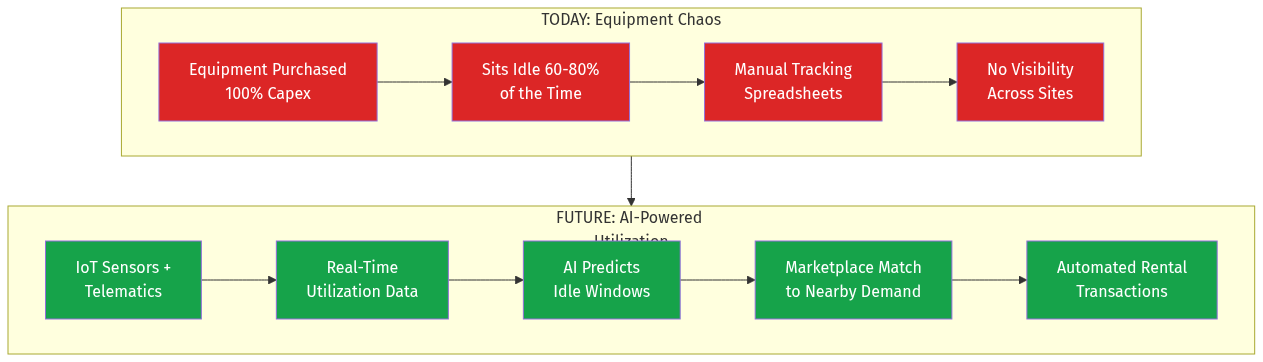
The average piece of industrial equipment sits idle 60-80% of the time. That's not inefficiency — that's a hidden marketplace waiting to be unlocked. AI can transform dormant capital into revenue-generating assets.

1.

Executive Summary

Industrial equipment — excavators, CNC machines, forklifts, generators, compressors — represents trillions of dollars in capital expenditure globally. Yet most of this equipment operates at shockingly low utilization rates. Construction equipment averages 40% utilization. Manufacturing machinery often sits idle during nights and weekends. Seasonal businesses own equipment they use 3 months per year.

This represents a massive market inefficiency. Companies either:

  • Over-purchase equipment "just in case" (waste capex)
  • Under-invest and lose productivity when equipment is needed
  • Rent from traditional fleet companies at premium rates
  • AI-powered equipment utilization intelligence changes this equation. By combining IoT telematics with predictive analytics and marketplace matching, we can unlock the "equipment-as-a-service" economy — where idle assets generate revenue and temporary needs find instant supply.
    2.

    Problem Statement

    The Equipment Utilization Crisis

    Applying Zeroth Principles: Before accepting that "companies need to own equipment," question the axiom. What if the fundamental assumption — that ownership is required for reliable access — is wrong?

    The reality:

    • Construction equipment: 35-45% average utilization
    • Manufacturing machinery: 50-60% during single-shift operations
    • Material handling equipment: Often 40% or less
    • Generators and compressors: Frequently under 30%
    This creates a painful dynamic for businesses:

    Pain PointImpact
    Capital locked in depreciating assets$200K excavator earns nothing while parked
    Maintenance costs on idle equipmentInsurance, storage, depreciation continue
    No visibility into actual usageManual logs are inaccurate or abandoned
    Rental rates punish short-term needsDaily rates assume inefficiency
    No trusted peer-to-peer channelRisk of damage, disputes, liability

    Who Experiences This Pain?

  • Construction companies with equipment sitting between projects
  • Manufacturers with excess capacity on nights/weekends
  • Event production companies with seasonal inventory
  • Logistics operators with underutilized forklifts and trucks
  • Contractors who need equipment for 2 weeks but must rent for a month

  • 3.

    Current Solutions

    Applying Incentive Mapping: Who profits from the status quo?
    CompanyWhat They DoWhy They're Not Solving It
    United RentalsWorld's largest equipment rentalProfit from ownership; peer-to-peer cannibalizes
    BigRentzRental aggregator marketplaceNo utilization intelligence; just rental search
    EquipmentShareT3 telematics + rentalFleet-focused; doesn't monetize customer idle time
    Ritchie Bros.Equipment auctionsBuy/sell only; no sharing economy
    DOZREquipment rental marketplaceTraditional listing; no AI matching
    SamsaraFleet telematicsData only; no marketplace activation
    The Gap: Current players either:
    • Own the equipment (United Rentals) — misaligned with P2P
    • Provide data only (Samsara, Geotab) — no marketplace layer
    • List equipment (DOZR, BigRentz) — no utilization intelligence
    Nobody combines: Utilization data → Idle prediction → Demand matching → Automated transactions → Trust infrastructure
    4.

    Market Opportunity

    Market Size

    SegmentGlobal Market SizeCAGR
    Equipment Rental$120B (2026)4.5%
    Construction Equipment$190B5.2%
    Industrial Telematics$28B12.3%
    Asset Tracking IoT$35B14.1%
    Total Addressable Market (TAM): $50B+ (equipment sharing + utilization SaaS + marketplace fees) Serviceable Addressable Market (SAM): $8B (mid-market construction + manufacturing)

    Why Now?

    Applying Anomaly Hunting: What's changed that makes this possible?
  • Telematics costs collapsed — GPS + cellular sensors now <$50/unit
  • AI prediction matured — Utilization forecasting is now reliable
  • Insurance tech evolved — Usage-based equipment insurance exists
  • Sharing economy normalized — B2B peer-to-peer no longer feels risky
  • Capital pressure intensified — CFOs demand ROI on every asset
  • The Surprising Absence: Despite $35B in asset tracking IoT and $120B in equipment rental, nobody has connected them into a utilization marketplace.
    5.

    Gaps in the Market

    Applying Distant Domain Import: What other industries solved this?
    DomainSolutionTransferable Pattern
    Airbnb (hospitality)Idle rooms → rental incomeP2P trust + insurance + dynamic pricing
    Flexport (logistics)Visibility → optimizationReal-time tracking enables marketplace
    Uber (transport)Idle time monetizationPredictive matching + instant booking
    Spinny (used cars)Trust in peer transactionsInspection + warranty + escrow

    Critical Gaps to Fill:

  • No predictive idle detection — Knowing equipment will be free next week
  • No demand-side intelligence — Who nearby needs what you have?
  • No trust infrastructure — Insurance, inspection, dispute resolution
  • No dynamic pricing — Rates that reflect true supply/demand
  • No cross-company visibility — My competitor's idle crane could help me

  • 6.

    AI Disruption Angle

    The Intelligence Stack

    Equipment Utilization Architecture
    Equipment Utilization Architecture

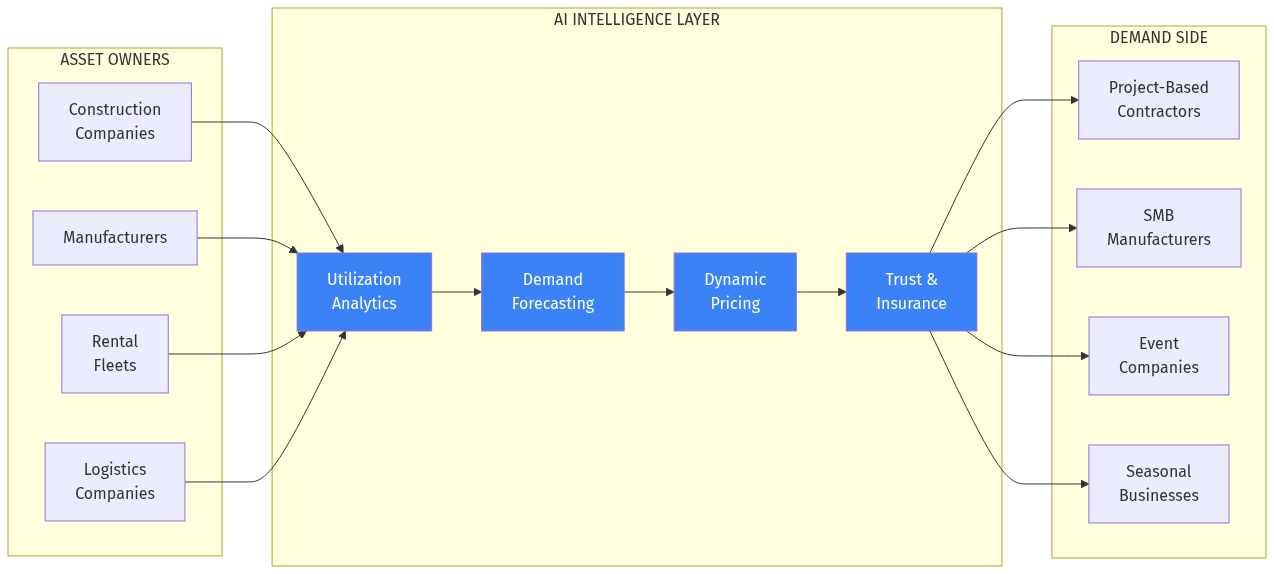
    AI transforms equipment management through four layers:

    #### Layer 1: Utilization Intelligence

    • Real-time monitoring via IoT sensors (GPS, engine hours, motion)
    • Pattern recognition: "This excavator is idle Tuesdays and Thursdays"
    • Anomaly detection: Unusual usage patterns flag maintenance needs
    #### Layer 2: Predictive Idle Forecasting
    • ML models trained on: project schedules, weather, seasonality, historical patterns
    • Output: "This equipment will be 90% likely idle Feb 20-28"
    • Accuracy improves with more data per fleet
    #### Layer 3: Demand Matching
    • Real-time demand signals from: rental searches, project announcements, tender data
    • Geographic matching: "Contractor 12km away needs an excavator Feb 22-25"
    • Skill matching: "Operator certification required — owner has certified operators"
    #### Layer 4: Transaction Automation
    • Dynamic pricing based on: distance, duration, availability, equipment age
    • Automated contracts with: liability terms, insurance, payment escrow
    • Post-rental: Usage verification, condition check, payment release

    The AI Agent Future

    When AI agents negotiate equipment access:

    • Buyer agent: "I need a 20-ton excavator in Bangalore, Feb 20-25, under ₹15,000/day"
    • Platform AI: Scans all connected fleets, predicts availability, ranks by proximity/price/reliability
    • Seller agent: "My equipment is available. Counter-offer ₹14,500/day including operator."
    • Transaction: Automated contract, insurance binding, payment escrow — all without human intervention
    ---

    7.

    Product Concept

    Core Platform Components

    Market Structure
    Market Structure

    #### For Equipment Owners:

  • Utilization Dashboard — Real-time and historical equipment usage
  • Revenue Opportunity Alerts — "Your crane is idle next week; 3 nearby projects need one"
  • One-Click Listing — Automatic pricing, terms, and availability
  • Earnings Tracking — Revenue generated from idle equipment
  • #### For Equipment Seekers:

  • Instant Search — Find available equipment by type, location, dates
  • AI Recommendations — "Based on your project scope, you need 2 excavators + 1 loader"
  • Verified Listings — Equipment condition, maintenance history, operator availability
  • Booking + Payment — End-to-end transaction with insurance
  • #### Trust Infrastructure:

    • Pre-rental equipment inspection (photos, video, telematics data)
    • Real-time tracking during rental period
    • Usage-based insurance (pay per hour/day)
    • Dispute resolution with evidence trail
    • Reputation scores for owners and renters
    ---

    8.

    Development Plan

    PhaseTimelineDeliverables
    MVP8 weeksUtilization tracking dashboard, basic equipment listing, manual matching
    V116 weeksPredictive idle forecasting, demand matching algorithm, integrated payments
    V224 weeksAI pricing engine, automated contracts, insurance integration
    V332 weeksMulti-fleet aggregation, operator marketplace, maintenance prediction

    Technical Stack

    • IoT Integration: Samsara/Geotab APIs + direct OBD/CAN connections
    • ML Pipeline: Time-series forecasting (Prophet/NeuralProphet) + demand prediction
    • Marketplace: Two-sided matching with constraint optimization
    • Payments: Escrow + milestone-based release (Razorpay/Stripe)

    9.

    Go-To-Market Strategy

    Phase 1: Anchor Fleet (Month 1-3)

  • Partner with 2-3 mid-size construction companies (20-50 equipment pieces each)
  • Install telematics on all equipment (subsidize hardware cost)
  • Deliver utilization reports — prove value before monetization
  • Identify their idle equipment; source demand manually
  • Phase 2: Demand Aggregation (Month 4-6)

  • Build demand side: contractors, event companies, seasonal businesses
  • Launch in one geography (e.g., Bangalore, Hyderabad)
  • Focus on high-volume equipment: excavators, generators, forklifts
  • Charge transaction fee (10-15%) only on successful rentals
  • Phase 3: Network Effects (Month 7-12)

  • Expand to adjacent geographies
  • Introduce subscription tier for utilization analytics
  • Launch operator marketplace (equipment + certified operator)
  • Partner with insurance providers for embedded coverage
  • Growth Levers

    • Supply side: "Turn your idle equipment into revenue"
    • Demand side: "Rent verified equipment from companies near you"
    • Virality: Every transaction introduces two companies to the platform

    10.

    Revenue Model

    Revenue StreamPricingNotes
    Transaction Fee12-15% of rental valueCore marketplace revenue
    SaaS Subscription₹5,000-25,000/monthUtilization analytics without marketplace
    Insurance Commission15-20% of premiumEmbedded coverage
    Financing Fees2-4% of equipment valueEquipment financing for buyers
    Operator Marketplace10% of operator wagesCertified operators

    Unit Economics

    • Average equipment rental: ₹15,000/day
    • Average rental duration: 5 days
    • Transaction value: ₹75,000
    • Platform fee (12%): ₹9,000
    • Target transactions/month (Y1): 100
    • Monthly GMV: ₹75 lakhs
    • Monthly revenue: ₹9 lakhs

    11.

    Data Moat Potential

    Proprietary Data Assets (Accumulating Over Time)

  • Utilization Benchmarks — "Construction equipment in South India averages 42% utilization"
  • Demand Patterns — "Excavator demand spikes 3 weeks before monsoon"
  • Pricing Intelligence — "Generators rent for 2.3x in Q4 vs. Q2"
  • Equipment Reliability — "Brand X excavators have 15% more downtime"
  • Operator Performance — "Operators with Certification Y complete rentals with 3% fewer disputes"
  • Network Effects

    • More equipment → better matching → more renters → more equipment
    • More data → better predictions → higher utilization → more trust

    Defensibility

    After 2 years: No competitor can match utilization benchmarks or demand forecasting without equivalent transaction volume.
    12.

    Why This Fits AIM Ecosystem

    Alignment with AIM Vision

    • Fragmented market: Thousands of equipment owners, no structured discovery
    • Offline-heavy workflow: WhatsApp inquiries, manual coordination, paper contracts
    • High-value transactions: Equipment rentals are ₹50K-5L per transaction
    • AI-enableable: Prediction, matching, and automation are core to the solution

    Integration Opportunities

    • thefoundry.in: Industrial procurement can recommend equipment rental vs. purchase
    • instabox.in: Logistics equipment (forklifts, trucks) as a vertical
    • niyukti.in: Operator hiring and certification
    • challan.in: Equipment compliance and documentation

    Shared Infrastructure

    • AIM's verification framework → Equipment and owner verification
    • AIM's payment rails → Escrow and milestone payments
    • AIM's trust scores → Cross-platform reputation

    ## Pre-Mortem: Why This Might Fail

    Applying Falsification: Assume 5 well-funded startups failed here. Why?
    Failure ModeLikelihoodMitigation
    Cold start problemHighStart with utilization SaaS; marketplace is phase 2
    Trust barrierHighInsurance + inspection + escrow from day 1
    Fragmented demandMediumFocus on high-density industrial clusters
    Equipment damage disputesMediumTelematics + pre/post inspection protocol
    Large rental companies competeLowThey're misaligned; P2P cannibalizes them

    Steelmanning the Opposition

    Why incumbents might win:
    • United Rentals has capital to subsidize and undercut
    • Existing telematics providers (Samsara) could add marketplace
    • Trust in "professional rental" vs. "peer-to-peer" may persist
    • Equipment owners may fear competitors learning their utilization
    Counter-argument: Incumbents' business model depends on ownership margin. They won't cannibalize themselves. Telematics providers lack marketplace DNA. Trust can be engineered with the right infrastructure.

    ## Verdict

    Opportunity Score: 8.5/10 Why this scores high:
    • Massive market inefficiency — 60-80% idle equipment is absurd
    • Technology timing is right — IoT + AI + insurance tech converging
    • Clear monetization — Transaction fees on high-value rentals
    • Strong data moat — Utilization intelligence compounds
    • AIM ecosystem fit — Industrial, fragmented, AI-enableable
    Key risks:
    • Cold start requires patient capital and SaaS-first approach
    • Trust infrastructure must be bulletproof from day 1
    • Demand aggregation may be slower than supply
    Recommendation: Build this as a vertical under AIM.in, starting with construction equipment in Tier 2 cities where rental options are limited and utilization data is valuable regardless of marketplace success.

    ## Sources