ResearchWednesday, February 18, 2026

AI-Powered Chemical SDS Intelligence: The $12B Hazard Communication Compliance Gap

Every manufacturer with chemicals maintains Safety Data Sheets. Most still use paper binders and decade-old PDFs. AI can transform this liability nightmare into proactive hazard intelligence.

1.

Executive Summary

Safety Data Sheets (SDS) are the backbone of chemical hazard communication. OSHA's Hazard Communication Standard requires every employer to maintain accessible SDS for every hazardous chemical on-site. Yet the average manufacturing facility manages 500-2,000+ chemicals with SDS scattered across paper binders, shared drives, and supplier websites.

This is a $12B+ problem hiding in plain sight. EHS software vendors focus on incident reporting and permit management — the SDS management module is always an afterthought. Meanwhile, AI has matured to the point where it can parse any SDS format, extract GHS classifications, cross-reference regulatory databases, and proactively alert on hazard incompatibilities.

The opportunity: Build an AI-native platform that transforms passive SDS filing into active chemical intelligence — from compliance checkbox to competitive advantage.
2.

Problem Statement

The Hidden Compliance Nightmare

Who experiences this pain:
  • EHS managers at manufacturing facilities (300,000+ sites in the US alone)
  • Safety coordinators managing chemical inventories
  • Procurement teams onboarding new chemical suppliers
  • Operations managers ensuring worker safety
What's broken:
  • SDS Decay: Average SDS is 3-5 years old. Suppliers update their SDS, but customers rarely receive notifications. A 2019 study found 40% of on-site SDS were outdated.
  • Format Chaos: Every supplier formats SDS differently. Some are 16-page technical documents; others are scanned faxes. No standardized machine-readable format exists.
  • Access Friction: OSHA requires SDS to be "readily accessible" within seconds. In reality, workers dig through binders or click through poorly organized folders.
  • Hazard Blindness: Section 10 (Stability/Reactivity) contains critical incompatibility data, but it's buried in text. Facilities routinely store incompatible chemicals together because nobody reads 2,000 SDS documents.
  • Training Gap: New employees need chemical-specific training. Most facilities do generic "chemical safety" training because customizing for 1,000+ chemicals is impractical.
  • Applying Zeroth Principles

    What axioms are we assuming?

    The industry assumes SDS management is fundamentally a filing problem — collect documents, organize them, provide access. This is wrong.

    SDS management is actually a knowledge extraction problem. The documents contain structured hazard data, but current systems treat them as opaque PDFs. The shift: from document management to chemical intelligence.


    3.

    Current Solutions

    CompanyWhat They DoWhy They're Not Solving It
    VelocityEHSFull EHS platform with SDS moduleSDS is a feature, not the focus. Basic search, no AI parsing
    3E CompanyChemical data servicesEnterprise-only, expensive ($50K+/year), consultancy model
    SafeTecSDS authoring for manufacturersSupplier-side, not buyer-side. Doesn't solve customer access
    MSDSonline (VelocityEHS)Cloud SDS database10M+ SDS library but no intelligent extraction. Search-only
    ChemwatchSDS management + trainingLegacy interface, no AI, manual hazard mapping
    SpheraEnterprise EHS + chemical management$100K+ implementations, 12+ month deployments

    Incentive Mapping

    Who profits from the status quo?
  • EHS Consultants: Charge $200-500/hour for compliance audits. Complex = billable.
  • Legacy EHS Vendors: Sell seats, not outcomes. User confusion = more support contracts.
  • Chemical Suppliers: No incentive to proactively update customer SDS. Liability shifts to buyer.
  • The feedback loop: Complexity → consultant dependence → vendor lock-in → no pressure to innovate.


    4.

    Market Opportunity

    • EHS Software Market: $12.1B (2025) → $21.2B (2030), 11.9% CAGR
    • Workplace Safety Market: $19.6B (2025) → $38.5B (2030), 14.4% CAGR
    • Chemical Management Software: $2.4B (2025) → $4.1B (2030)
    Addressable segment:
    • ~300,000 manufacturing facilities in the US manage chemicals
    • Average 500-2,000 SDS per facility
    • SMBs (50-500 employees) are drastically underserved
    Why Now:
  • AI Document Understanding: GPT-4V, Claude 3, Gemini can parse complex multi-page SDS with high accuracy. This wasn't possible 3 years ago.
  • GHS Adoption Complete: The Global Harmonized System standardized hazard classifications worldwide. Unified taxonomy = trainable AI.
  • Regulatory Pressure: OSHA inspections increased 15% in 2024. Fines for HazCom violations average $15,953 per violation (up to $156,259 for willful).
  • Labor Shortage: EHS managers are stretched thin. 43% report understaffing. They need automation, not more software.

  • 5.

    Architecture Overview

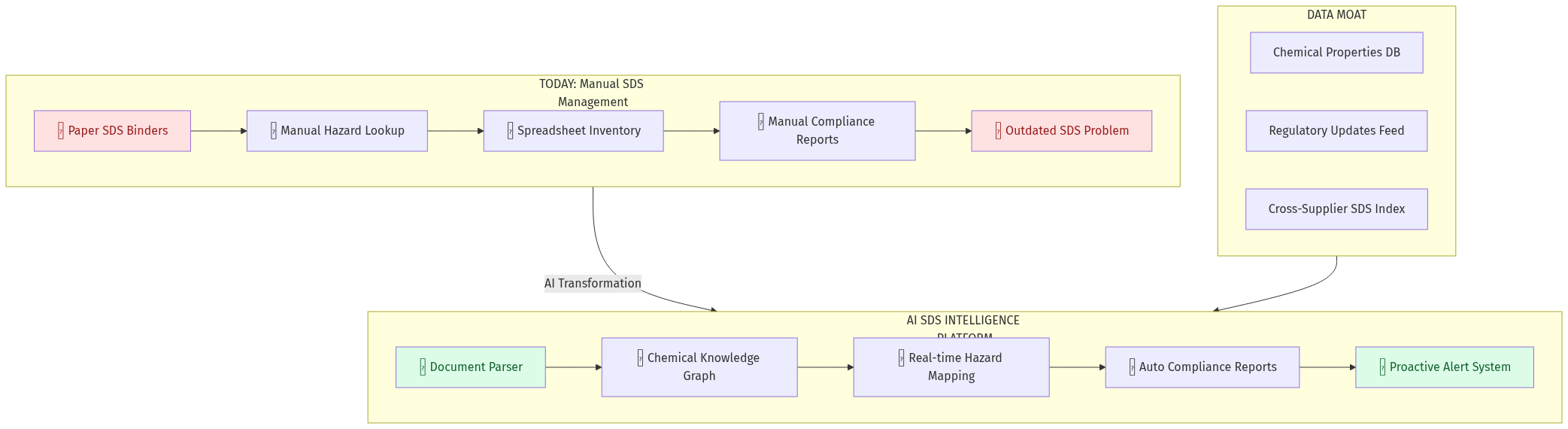
    AI SDS Intelligence Platform Architecture
    AI SDS Intelligence Platform Architecture

    The platform transforms passive SDS filing into proactive chemical intelligence through AI-powered document understanding and continuous regulatory monitoring.


    6.

    Gaps in the Market

    Applying Anomaly Hunting

    What's surprising about this market?
  • No AI-native player exists. Every competitor is a legacy vendor bolting AI onto 20-year-old architecture. The market leader (VelocityEHS) acquired MSDSonline in 2017 and hasn't fundamentally innovated since.
  • SMB desert. Solutions start at $5,000/year minimum. A 100-person machine shop with 300 chemicals has no affordable option beyond paper binders.
  • Supplier disconnect. Manufacturers maintain SDS for products they MAKE, but rarely push updates to customers. There's no supply-chain SDS sync.
  • Training is separate. SDS systems don't generate training content. Companies buy separate LMS and manually create chemical training. Obvious integration is missing.
  • Mobile is an afterthought. Workers need SDS on the floor, not at a desktop. Most systems have poor mobile UX.
  • Gap Summary

    GapIncumbent ApproachAI-Native Opportunity
    Document parsingManual data entryAutomatic extraction from any format
    Hazard mappingStatic lookup tablesDynamic incompatibility graphs
    CurrencyAnnual auditsReal-time supplier sync
    TrainingSeparate systemAuto-generated from SDS content
    AccessDesktop portalsMobile-first with QR integration
    ---
    7.

    AI Disruption Angle

    Distant Domain Import

    What field has solved structurally similar problems? Healthcare: Drug Interaction Databases

    Epocrates and Lexicomp built massive drug interaction databases. Doctors don't read every drug's full prescribing information — the system surfaces conflicts automatically.

    The parallel: EHS managers shouldn't read 2,000 SDS. The system should surface conflicts, flag outdated documents, and auto-generate training. Financial Services: Know Your Customer (KYC)

    KYC platforms automatically parse ID documents, extract data, and verify against regulatory databases. Humans review exceptions, not every document.

    The parallel: SDS intake should be automatic. Parse PDF → extract hazards → validate GHS codes → flag anomalies. Human reviews exceptions only.

    AI Capabilities

    CapabilityApplication
    Document Vision (GPT-4V/Claude)Parse any SDS format including scanned documents
    Named Entity RecognitionExtract chemical names, CAS numbers, GHS codes
    Knowledge GraphsBuild chemical interaction networks
    RAG + EmbeddingsInstant hazard search across all SDS
    Auto-generationCreate facility-specific training from SDS content

    The AI-Powered Future

    Today: Worker encounters unknown chemical → searches binder → finds 8-year-old SDS → reads 16 pages → maybe finds PPE requirements. Tomorrow: Worker scans QR code on container → sees PPE icon overlay → taps for 30-second video on handling → incompatibility warning shows nearby chemicals.
    8.

    Platform Data Flow

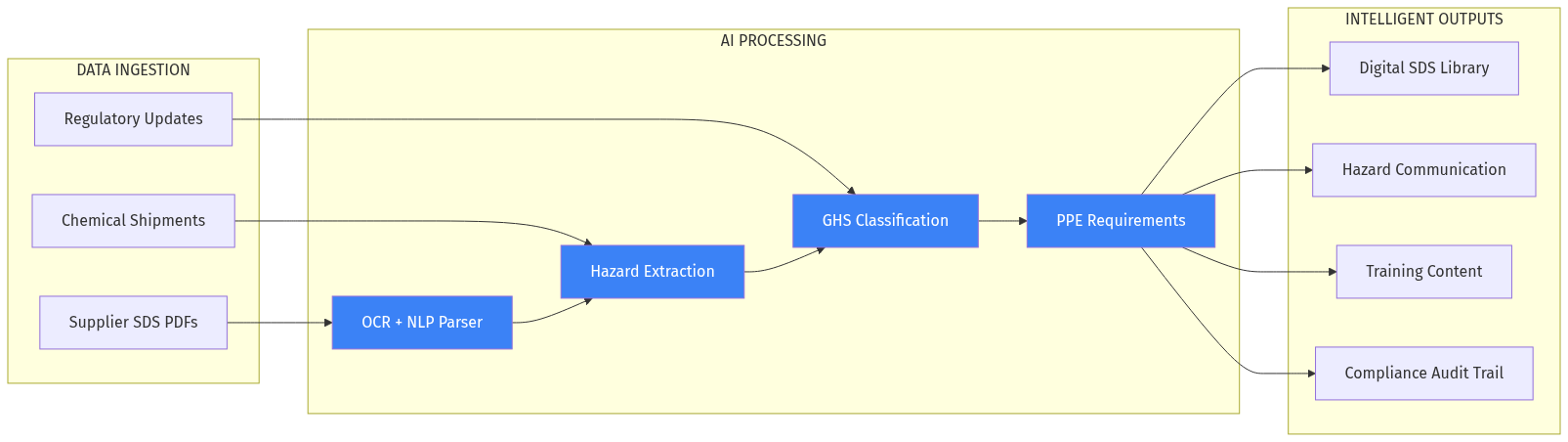
    SDS Intelligence Data Flow
    SDS Intelligence Data Flow

    The platform ingests SDS from any source, extracts structured hazard data, and generates intelligent outputs for training, compliance, and operations.


    9.

    Product Concept

    Core Features

    1. Universal SDS Ingestion
    • Drag-drop any PDF, image, or URL
    • AI extracts all 16 GHS sections automatically
    • Handles multi-language SDS (critical for imports)
    • Bulk upload for supplier catalogs
    2. Chemical Knowledge Graph
    • Every chemical linked by CAS number, synonyms
    • Automatic incompatibility mapping (Section 10 extraction)
    • Storage class recommendations
    • Regulatory cross-reference (OSHA PEL, ACGIH TLV, EPA)
    3. Living SDS Library
    • Automatic supplier SDS monitoring
    • Push notifications when SDS updates
    • Version history with change highlighting
    • Regulatory deadline tracking (REACH, TSCA)
    4. Smart Hazard Communication
    • QR codes for every container linking to digital SDS
    • Mobile app with offline access
    • AR overlay for PPE requirements (future)
    • Emergency responder data export (CHEMTREC format)
    5. Auto-Generated Training
    • Create chemical-specific training modules from SDS content
    • Quiz generation with regulatory citation
    • Training completion tracking per chemical
    • New hire onboarding packets auto-compiled
    6. Compliance Dashboard
    • Audit-ready reports (OSHA 300 format)
    • Missing/outdated SDS alerts
    • Storage incompatibility warnings
    • Exposure assessment support

    10.

    Development Plan

    PhaseTimelineDeliverables
    MVP8 weeksSDS upload → AI extraction → searchable library. Target: 95% extraction accuracy on standard SDS formats
    V1+6 weeksIncompatibility mapping, QR code generation, basic mobile app, OSHA report export
    V2+8 weeksSupplier SDS monitoring, auto-training generation, multi-facility support, enterprise SSO
    V3+12 weeksKnowledge graph API, AR mobile features, industry-specific compliance packs (pharma, food, construction)

    MVP Validation Criteria

    • Extract 95%+ of Section 2 (Hazard Identification) accurately
    • Parse both digitally-native and scanned SDS
    • Demonstrate time savings: 10 min/SDS (manual) → 30 sec (AI)
    • Get 3 paid pilots from manufacturing SMBs

    11.

    Go-To-Market Strategy

    Falsification (Pre-Mortem)

    Assume 5 well-funded startups failed here. Why?
  • Sold to EHS managers who don't have budget authority. Must sell to CFO (compliance risk) or COO (operational efficiency).
  • Underestimated data quality challenges. Scanned SDS from the 1990s don't parse cleanly.
  • Tried to replace VelocityEHS. Enterprise already locked in. SMB greenfield is the entry.
  • No supplier-side business model. Two-sided marketplace dynamics ignored.
  • Compliance-first messaging = boring. Lead with productivity, justify with compliance.
  • GTM Sequence

    Phase 1: SMB Direct (Months 1-12)
  • Target 50-500 employee manufacturers via LinkedIn, trade associations (NAM, MAPI)
  • Freemium: 100 SDS free, upgrade for unlimited + features
  • Content marketing: "Is Your SDS Library a Liability?" audit checklists
  • Partner with industrial distributors (Grainger, MSC Industrial) for co-marketing
  • Phase 2: Channel (Months 6-18)
  • Safety supply distributors (wholesale SDS with chemical purchases)
  • Workers' comp insurers (risk reduction = premium reduction)
  • EHS consultants (white-label for their clients)
  • Phase 3: Enterprise (Months 12-24)
  • Land-and-expand from SMB traction
  • API for integration with existing EHS platforms (be the brain, not the system)
  • Industry-specific compliance packs (pharma cGMP, food FSMA)

  • 12.

    Revenue Model

    Steelmanning: Why Incumbents Might Win

    Best argument against this opportunity:

    "VelocityEHS/3E/Sphera have 20+ years of chemical data, regulatory relationships, and enterprise trust. They'll bolt on AI faster than a startup can build distribution. SMBs don't actually pay for compliance software — they wing it until OSHA shows up."

    Counter: Incumbents are architecturally constrained. Their data models assume human data entry. Retrofitting AI requires rebuilding core systems. And they're optimized for $100K enterprise deals — SMB economics don't work for their sales motion. A vertical AI-native player can win SMB and grow up.

    Pricing Tiers

    TierPriceTargetFeatures
    Free$0Tiny shops100 SDS, basic search, community support
    Pro$99/moSMB (50-200 people)Unlimited SDS, mobile app, QR codes, basic reports
    Business$299/moMid-market (200-1000)Multi-facility, training generation, supplier monitoring
    EnterpriseCustom1000+API access, SSO, compliance packs, dedicated support

    Revenue Streams

  • SaaS Subscriptions: Core revenue (70%)
  • Supplier SDS Hosting: Charge suppliers to maintain authoritative SDS ($50/product/year)
  • Training Content: Sell pre-built compliance training modules
  • Compliance Audit Services: Partner with EHS consultants for revenue share
  • API/Data Licensing: Chemical hazard data to insurers, logistics companies

  • 13.

    Data Moat Potential

    Second-Order Thinking

    If this succeeds, what happens next?
  • Network effects emerge: More facilities uploading SDS = better AI training data = more accurate extraction = more facilities join.
  • Supplier-side platform: Once 10,000 facilities use the platform, suppliers have incentive to maintain official SDS in the system. Two-sided marketplace.
  • Chemical supply chain intelligence: Aggregate data reveals market insights — which chemicals are growing/declining, supply chain concentration risks.
  • Insurance integration: Workers' comp carriers want this data. Lower premiums for facilities using verified SDS management.
  • Regulatory capture (good kind): If OSHA accepts AI-managed SDS as compliant, early movers become de facto standard.
  • Proprietary Data Accumulating

    Data AssetSourceValue
    Parsed SDS corpusUser uploadsTraining data for extraction models
    Chemical synonym graphCross-facility matchingBetter search, disambiguation
    Supplier SDS update frequencyMonitoringTrust scores for suppliers
    Real-world storage patternsFacility layoutsIncompatibility risk models
    Training completion ratesLMS integrationCompliance benchmarks
    ---
    14.

    Why This Fits AIM Ecosystem

    Thesis alignment:
    • B2B Marketplace: Two-sided platform (facilities ↔ chemical suppliers)
    • Workflow Automation: Transforms manual compliance into automated intelligence
    • High-Trust Sector: Safety-critical decisions require verified data
    • Fragmented Market: 300K+ facilities, no dominant SMB player
    • AI-Native Opportunity: Document understanding + knowledge graphs
    AIM Integration Points:
  • Chemical Procurement: Connect SDS intelligence to AIM.in chemical marketplace. Every product listing links to verified SDS.
  • Industrial Services: Safety consultants, training providers, testing labs discoverable through AIM.
  • Cross-Vertical Data: Chemical data enriches other AIM verticals — food (ingredients), construction (coatings), manufacturing (lubricants).
  • Domain potential: chemhazard.in, sds.in, hazcom.in

    ## Verdict

    Opportunity Score: 8.5/10

    Bayesian Confidence Assessment

    Prior: Chemical compliance software is a mature, boring market dominated by legacy players. Initial confidence in new entrant: 30%. Evidence that updates upward:
    • AI document understanding crossed capability threshold (2024)
    • No AI-native competitor exists despite market size
    • SMB segment grossly underserved
    • Regulatory pressure increasing (OSHA fines up 25% in 3 years)
    • Mobile-first workforce demands better UX
    Evidence that updates downward:
    • Enterprise accounts locked into VelocityEHS/Sphera
    • EHS managers are risk-averse buyers
    • SMBs notoriously don't pay for "nice to have" software
    Posterior confidence: 70% — Strong opportunity with clear technical moat and underserved segment.

    Recommendation

    BUILD. This is a classic "boring industry + AI disruption" play. The document understanding capability shift is real, SMB is greenfield, and compliance creates forcing function for adoption. The wedge strategy — start with SDS, expand to full chemical intelligence — mirrors successful vertical SaaS patterns (Procore for construction, Toast for restaurants). Key risks to monitor:
  • VelocityEHS acquires an AI startup and accelerates
  • OSHA de-prioritizes HazCom enforcement
  • AI extraction accuracy plateaus below 90% on legacy documents
  • Mitigation: Ship fast, build data moat, own SMB before incumbents notice.

    ## Sources