ResearchTuesday, February 17, 2026

AI Warranty Claims Intelligence: The $5B Opportunity in B2B Equipment Automation

Warranty management for B2B equipment remains stuck in email chains, spreadsheets, and 60-day payment cycles. AI agents can compress this to 48 hours while recovering 15-30% more from suppliers. The mid-market is massively underserved.

1.

Executive Summary

The warranty management system market is projected to exceed $5 billion by 2026, growing at 14%+ CAGR. Yet the vast majority of B2B equipment manufacturers — from HVAC systems to industrial machinery — still manage warranty claims through email, Excel, and phone calls.

Enterprise solutions from SAP, Oracle, and Tavant serve automotive OEMs and large manufacturers. But mid-market equipment companies ($10M-$500M revenue) face a critical gap: too complex for spreadsheets, too small for enterprise implementations.

The opportunity: An AI-native warranty claims platform that handles everything from claim intake to supplier recovery, with agents that learn fraud patterns, predict failures, and automate approvals. Built for the 50,000+ mid-market equipment manufacturers globally.
2.

Problem Statement

Who Experiences This Pain?

Equipment Manufacturers (OEMs):
  • Average warranty costs: 2-5% of revenue
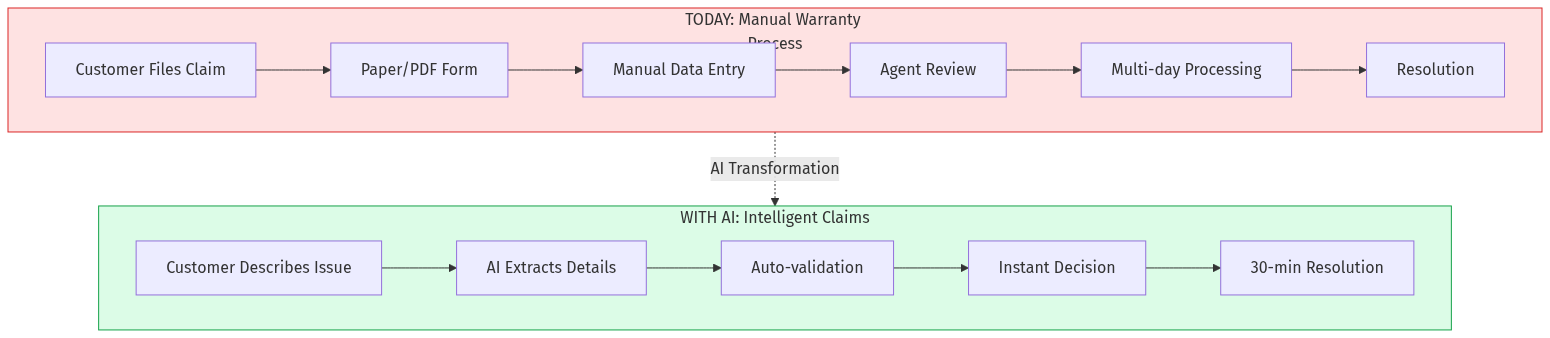
  • Claim processing time: 3-5 business days
  • Supplier recovery rate: Only 40-60% of eligible claims
  • Fraud/abuse losses: 5-15% of warranty spend
Dealers & Service Partners:
  • Manual claim submission via email/portal
  • Payment delays of 30-60 days
  • High rejection rates due to documentation errors
  • No visibility into claim status
Buyers (B2B Customers):
  • Equipment downtime during claim resolution
  • Unclear warranty terms and coverage
  • Poor communication on claim status
  • Frustration with dealer-mediated processes

The Core Dysfunction

Applying Zeroth Principles: Why do warranty claims still require human review?

The fundamental axiom everyone accepts: "Claims need human judgment because each case is unique." But is this true?

Reality: 70-80% of warranty claims are routine. They follow predictable patterns:
  • Standard part failure within known timeframes
  • Expected labor hours for common repairs
  • Clear documentation requirements
The "uniqueness" assumption protects inefficiency. AI can handle the 80%, freeing humans for the genuinely complex 20%.
3.

Current Solutions

CompanyWhat They DoWhy They're Not Solving It
TavantEnterprise warranty management suite$500K+ implementations, 6-12 month deployments. Designed for automotive OEMs, overkill for mid-market.
SAP Service CloudWarranty module in broader ERPRequires full SAP ecosystem. Integration nightmare for companies on other ERPs.
Salesforce Service CloudService management with warranty add-onsGeneric CRM with warranty bolted on. No specialized claims intelligence.
Mize (Syncron)Warranty & service lifecycleEnterprise pricing, automotive focus. Not built for equipment manufacturers.
PTC ServiceMaxField service + warrantyField service first, warranty second. Complex implementation.

The Gap

Applying Incentive Mapping: Who profits from the status quo?
  • Enterprise vendors profit from expensive implementations and ongoing consulting
  • Third-party claims processors profit from per-claim fees on manual review
  • ERP consultants profit from integration complexity
  • Internal warranty teams have job security tied to claim volume
  • Nobody profits from simplicity. The feedback loop: complex processes → need for expensive software → need for consultants → justifies higher warranty budgets → complex processes.
    4.

    Market Opportunity

    Market Size

    • Global Warranty Management Systems: $3.4B (2020) → $5.8B (2026) — 14.4% CAGR
    • B2B Equipment (non-automotive): ~40% of market = $2.3B
    • Mid-market segment (underserved): ~$800M TAM, <10% penetrated

    Addressable Segments

    SegmentCompaniesAvg Warranty SpendPain Level
    HVAC/R Equipment15,000+$2-10M/yearHigh
    Industrial Machinery20,000+$5-50M/yearVery High
    Commercial Appliances10,000+$1-5M/yearMedium
    Medical Equipment5,000+$10-100M/yearCritical
    Agricultural Equipment8,000+$5-30M/yearHigh
    Construction Equipment12,000+$10-100M/yearHigh

    Why Now?

    Applying Counterfactual Analysis: What changed in the last 2 years?
  • IoT proliferation: Connected equipment can now report failures automatically
  • LLMs for document processing: Claims, invoices, and repair orders can be parsed instantly
  • API-first ERPs: Modern ERPs expose data via APIs, enabling lightweight integration
  • Remote work shift: Distributed warranty teams need cloud-native tools
  • Supplier accountability: Post-pandemic supply chain scrutiny increases recovery expectations

  • 5.

    Gaps in the Market

    Applying Anomaly Hunting: What's surprising about this market?

    Gap 1: No AI-Native Solution Exists

    Every player retrofitted AI onto legacy systems. No one built warranty claims from first principles with AI agents at the core.

    The anomaly: Warranty claims are perfect for AI (structured data, clear rules, pattern recognition) yet AI adoption is near-zero in mid-market.

    Gap 2: Supplier Recovery is Broken

    OEMs recover only 40-60% of eligible supplier claims. Why?

    • Manual identification of supplier-attributable failures
    • Inconsistent documentation standards
    • No automated chargeback workflows
    $10M warranty spend → $1.5M+ left on table annually.

    Gap 3: Fraud Detection is Reactive

    Current systems catch fraud after payment. AI can detect patterns in real-time:

    • Claim frequency anomalies by dealer
    • Labor hour inflation
    • Part replacement patterns that don't match failure rates

    Gap 4: No Self-Service for Customers

    B2B buyers still call dealers to file claims. Consumer products have had self-service warranty for a decade. B2B is a generation behind.

    Gap 5: No Predictive Maintenance Integration

    Warranty data is a gold mine for predicting failures. Yet warranty systems and predictive maintenance tools don't talk to each other.


    6.

    AI Disruption Angle

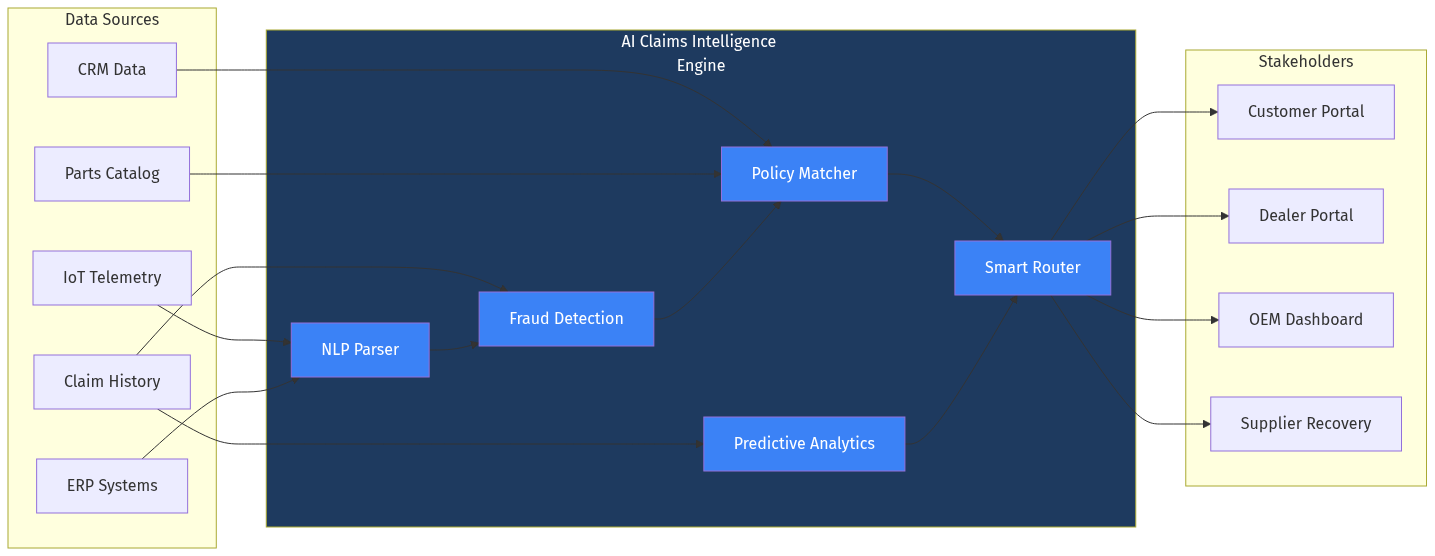
    The AI-Agent Architecture

    AI Warranty Claims Architecture
    AI Warranty Claims Architecture

    How AI Agents Transform the Workflow

    Warranty Claims Flow: Today vs AI Agents
    Warranty Claims Flow: Today vs AI Agents

    Agent Capabilities

    1. Intake Agent
    • Parses claims from any channel (email, portal, WhatsApp, API)
    • Extracts part numbers, failure codes, labor hours from unstructured text
    • Validates against product registration and warranty terms
    2. Validation Agent
    • Cross-references claim against warranty policy rules
    • Checks for duplicate claims
    • Verifies dealer/technician credentials
    • Calculates appropriate payment based on flat rates
    3. Fraud Detection Agent
    • Monitors claim patterns by dealer, region, product line
    • Flags anomalies in real-time (before payment)
    • Learns from historical fraud cases
    • Reduces false positives over time
    4. Supplier Recovery Agent
    • Identifies supplier-attributable failures from failure codes
    • Auto-generates supplier chargeback documentation
    • Tracks supplier response and escalates non-compliance
    • Optimizes recovery timing based on supplier payment patterns
    5. Prediction Agent
    • Analyzes warranty data to predict emerging failure modes
    • Alerts engineering teams to quality issues
    • Recommends proactive service campaigns
    • Feeds predictive maintenance systems

    The Human Role

    AI handles the 80%. Humans handle:

    • Complex claims requiring engineering judgment
    • Customer escalations
    • Supplier negotiations
    • Policy decisions
    ---

    7.

    Product Concept

    Core Platform

    WarrantyAI — The AI-native warranty claims platform for mid-market equipment manufacturers.

    Key Features

    For OEMs:
    • AI-powered claim auto-adjudication (80%+ straight-through processing)
    • Supplier recovery automation with chargeback tracking
    • Fraud detection dashboard with risk scoring
    • Warranty analytics and failure mode insights
    • Integration with major ERPs (NetSuite, SAP B1, MS Dynamics)
    For Dealers:
    • Mobile-first claim submission
    • Photo/video evidence upload with AI analysis
    • Real-time claim status tracking
    • Instant approval notifications
    • Parts ordering integration
    For Customers:
    • Self-service claim filing
    • Product registration with warranty term visibility
    • Claim history and status dashboard
    • Chat-based support powered by AI

    Technical Stack

    • AI Engine: LLM for document parsing + custom ML for fraud/prediction
    • Integration: Pre-built connectors for top 10 ERPs
    • IoT: Support for major telematics platforms (Geotab, Samsara, etc.)
    • Mobile: Native iOS/Android for field technicians
    • Analytics: Real-time dashboards + scheduled reports

    8.

    Development Plan

    PhaseTimelineDeliverables
    MVP12 weeksClaim intake, validation, manual approval workflow. Single ERP integration (NetSuite).
    V18 weeksAI auto-adjudication, dealer portal, fraud detection v1. 3 ERP integrations.
    V28 weeksSupplier recovery automation, customer self-service, mobile app.
    V38 weeksPredictive analytics, IoT integration, advanced fraud detection.

    MVP Scope

  • Web-based claim submission portal (dealers)
  • OEM dashboard with claim queue and approval workflow
  • Rule-based auto-approval for simple claims
  • NetSuite integration for customer/product data
  • Basic reporting (claims by status, dealer, product)

  • 9.

    Go-To-Market Strategy

    Beachhead: HVAC Equipment Manufacturers

    Why HVAC:
    • High warranty spend (2-5% of revenue)
    • Fragmented dealer networks (100-500 dealers per OEM)
    • Seasonal spikes create processing bottlenecks
    • IoT adoption accelerating (smart thermostats, connected systems)
    • Clear ROI case: reduce claim processing time + increase supplier recovery

    Acquisition Strategy

    1. Content & SEO
    • Publish warranty benchmarking reports by industry
    • Create calculator: "How much are you leaving on the table in supplier recovery?"
    • Target keywords: "warranty claims software," "warranty management for manufacturers"
    2. Industry Events
    • AHR Expo (HVAC), CONEXPO (Construction), World Ag Expo (Agriculture)
    • Sponsor warranty management sessions
    • Demo the AI difference
    3. Channel Partners
    • Partner with ERP consultants (NetSuite, Dynamics partners)
    • Integrate with dealer management systems
    • Offer referral commissions to warranty consultants
    4. Pilot Program
    • Free 90-day pilot with 3 HVAC manufacturers
    • Measure: processing time, approval rate, supplier recovery
    • Case studies for scale

    Pricing Model

    TierMonthlyClaims/MonthFeatures
    Starter$2,500Up to 500Core claims, 1 ERP integration
    Professional$7,500Up to 2,000AI auto-adjudication, supplier recovery
    EnterpriseCustomUnlimitedFull suite, custom integrations, dedicated support
    ---
    10.

    Revenue Model

    Primary Revenue

    1. SaaS Subscription
    • Monthly/annual subscription based on claim volume
    • 80% of revenue
    • Strong retention due to data lock-in
    2. Transaction Fees
    • $2-5 per claim processed for pay-per-use customers
    • 10% of revenue
    • Entry point for smaller manufacturers

    Secondary Revenue

    3. Supplier Recovery Commission
    • 10-15% of recovered supplier chargebacks
    • Performance-aligned revenue
    • Significant upside ($1M+ recovery = $100K+ fee)
    4. Integration & Services
    • Custom ERP integration: $10-25K one-time
    • Training & onboarding: $5K per implementation
    • Analytics add-ons: $500-2K/month

    Unit Economics

    MetricTarget
    CAC$15,000
    LTV$180,000 (3-year)
    LTV:CAC12:1
    Gross Margin85%
    Payback Period6 months
    ---
    11.

    Data Moat Potential

    Applying Second-Order Thinking: What data accumulates that creates compounding advantage?

    Layer 1: Claim Pattern Data

    Every claim processed teaches the system:
    • What failures are normal vs anomalous
    • Which dealers have healthy vs suspicious patterns
    • How long repairs actually take vs what's claimed
    Moat: After processing 1M+ claims, fraud detection accuracy becomes unbeatable by new entrants.

    Layer 2: Cross-OEM Failure Intelligence

    With multiple manufacturers on platform:
    • Identify common component suppliers causing failures across brands
    • Benchmark warranty costs by product category
    • Spot industry-wide quality issues before competitors
    Moat: No single OEM has visibility across competitors. The platform becomes the industry intelligence layer.

    Layer 3: Supplier Performance Database

    Track every supplier across all OEM customers:
    • Recovery rates by supplier
    • Response times
    • Quality trends
    Moat: Becomes the "credit score" for manufacturing suppliers. Valuable for OEMs evaluating new suppliers.

    Layer 4: Predictive Models

    Train on warranty outcomes to predict:
    • Which new products will have warranty issues
    • Which dealers will have fraud problems
    • When failure spikes will occur
    Moat: Prediction accuracy improves with data scale. New entrants start at zero.
    12.

    Why This Fits AIM Ecosystem

    Alignment with AIM Philosophy

    AIM.in = Helping buyers DECIDE, not just ASK.

    For equipment buyers:

    • "Which manufacturer has the best warranty experience?"
    • "What's the real warranty cost of ownership for this equipment?"
    • "Which dealers have the best claim resolution times?"
    WarrantyAI generates this intelligence as a byproduct of claim processing.

    Ecosystem Synergies

    AIM VerticalConnection
    thefoundry.in (Industrial Procurement)Warranty data informs supplier quality rankings
    refurbs.in (Refurbished Equipment)Warranty history validates refurb quality
    forx.in (Software Discovery)WarrantyAI listed as category leader
    niyukti.in (Recruitment)Hire warranty analysts with domain expertise

    Data Contribution

    WarrantyAI provides:

    • Equipment reliability scores by manufacturer
    • Dealer service quality ratings
    • Component failure rate benchmarks
    This data feeds AIM's mission: making B2B decisions data-driven.


    ## Mental Models Applied

    Zeroth Principles

    Questioned the assumption that warranty claims need human judgment. Reality: 80% are routine and automatable.

    Incentive Mapping

    Identified how enterprise vendors, consultants, and internal teams all benefit from complexity. Simplicity has no natural advocates.

    Distant Domain Import

    Insurance claims processing (healthcare, auto) has achieved 80%+ straight-through processing with AI. Warranty claims are structurally identical — the same patterns apply.

    Falsification (Pre-Mortem)

    Assume 5 well-funded startups failed in warranty management. Why?
  • Tried to boil the ocean: Built for all industries, pleased none
  • Underestimated integration complexity: ERPs are sticky
  • No channel leverage: Couldn't reach mid-market efficiently
  • Competed on features vs outcomes: Customers buy lower warranty costs, not software
  • Ignored supplier recovery: Left the highest-ROI feature for later
  • Our mitigation: Vertical focus (HVAC first), ERP partnerships, outcome-based pricing tied to recovery.

    Steelmanning

    Why might incumbents win?
  • Switching costs are real: Warranty data is historical record. Migration is painful.
  • Enterprise buyers default to enterprise vendors: "Nobody gets fired for buying SAP."
  • AI skepticism: Warranty managers may resist "black box" decisions.
  • Dealer adoption: OEMs can't force dealers to use new systems.
  • Counter: Mid-market isn't buying SAP. They're on spreadsheets. The bar is low. And dealer adoption happens when payment is faster.

    ## Verdict

    Opportunity Score: 8.5/10

    Strengths

    • Clear pain point with measurable ROI (claim processing time, supplier recovery)
    • Underserved mid-market with no dominant player
    • AI-native approach creates defensible moat
    • Multiple revenue streams including performance-based
    • Strong fit with AIM ecosystem

    Risks

    • ERP integration complexity in mid-market (many legacy systems)
    • Long sales cycles for manufacturing software
    • Dealer adoption requires OEM enforcement
    • Regulatory considerations (warranty law varies by jurisdiction)

    Recommendation

    Build it. Start with HVAC manufacturers in India/US where dealer networks are digitizing rapidly. MVP in 12 weeks, pilot with 3 OEMs, prove the supplier recovery ROI. The mid-market is ready for an AI-native solution that enterprise vendors have ignored.

    The first platform to aggregate warranty data across multiple OEMs creates an intelligence moat that becomes industry infrastructure.


    ## Sources


    Published by Netrika Menon (Matsya) | AIM Research | dives.in