ResearchTuesday, February 17, 2026

AI-Powered Industrial Scrap & Recyclables B2B Intelligence: The $700 Billion WhatsApp Economy

The global scrap metal and recyclables market processes over 700 million metric tons annually — yet pricing, grading, and matching still happen through phone calls, WhatsApp groups, and relationships built over decades. This is the last great frontier of B2B digitization, and AI is about to crack it wide open.

1.

Executive Summary

Industrial scrap and recyclables trading is a $700+ billion global market that remains stubbornly offline. Steel scrap alone accounts for $450 billion annually, with aluminum, copper, e-waste, and paper adding hundreds of billions more. Yet the industry operates like it's 1995: pricing via phone calls, quality assessment through physical inspection, matching through broker networks, and payments through delayed invoices with 60-90 day terms.

The opportunity is extraordinary: build an AI-powered platform that can grade scrap from photos, predict real-time pricing, match sellers to optimal buyers, and orchestrate logistics — all through a WhatsApp-first interface that meets the industry where it already operates.

Mental Model Applied (Zeroth Principles): Before solving "how to digitize scrap trading," we question the axiom that the industry needs digitization. The truth: it doesn't need digitization — it needs trust automation. The real problem isn't information flow; it's that every transaction requires trust verification that currently only humans provide.
2.

Problem Statement

Who Experiences This Pain?

Manufacturers & Generators:
  • Large factories generate 5-15% production scrap daily
  • No visibility into whether they're getting fair prices
  • Forced to accept whatever local kabadiwala (scrap dealer) offers
  • No quality-based pricing — mixed grades sell at lowest grade price
Scrap Dealers & Aggregators:
  • Price information asymmetry (mills know more than dealers)
  • Working capital locked in inventory for weeks
  • Quality disputes cause payment delays
  • No way to access buyers outside their network
Processors & Steel Mills:
  • Inconsistent supply quality leads to production issues
  • Can't optimize procurement across suppliers
  • High procurement overhead (multiple calls, visits, negotiations)
  • Payment terms extend to 90+ days because of quality verification lag

The Real Workflow Today

  • Factory generates scrap → calls local dealer
  • Dealer visits → eyeballs the pile → gives lowball quote
  • Negotiation happens → price agreed
  • Weighing at pickup → frequently disputed
  • Dealer aggregates → sorts → stores for weeks
  • Calls steel mills → gets rejected if quality doesn't match
  • Eventually sells → waits 60-90 days for payment
  • Cycle repeats with zero data retention
  • Mental Model Applied (Incentive Mapping): Who profits from this opacity? Local brokers profit from information asymmetry — they buy low from uninformed sellers and sell high to mills with pricing power. Steel mills profit from extended payment terms that effectively give them free working capital. Both incumbents have strong incentives to resist transparency.
    3.

    Current Solutions

    CompanyWhat They DoWhy They're Not Solving It
    ScrapMonsterPrice data & marketplaceUS-focused, listing-based (not AI), no quality verification
    mjunctionEnterprise auction platformOnly serves large mills, excludes SME ecosystem
    MSTCGovernment e-auctionBureaucratic, serves only PSU scrap disposal
    Scrap MantraIndian scrap marketplaceListing-only, no AI grading, no price intelligence
    RecycleinmeIndian B2B scrap portalBasic classifieds, no transaction completion
    Local KabadiwalasPhysical aggregationEssential but limited by geography and relationships

    Why Current Players Fail

    No AI-Powered Quality Verification: Every platform requires physical inspection. The killer feature would be accurate grading from smartphone photos. Pricing is Static: Markets show "indicative" prices updated weekly. Real prices fluctuate daily based on mill demand, inventory, and geography. No Workflow Integration: They're marketplaces, not workflow tools. A factory procurement manager must still call, negotiate, arrange logistics, and chase payments separately. Trust Layer Missing: No escrow, no quality guarantees, no dispute resolution. This is why everyone reverts to trusted local brokers.
    4.

    Market Opportunity

    Market Size

    SegmentGlobal VolumeGlobal ValueIndia Value
    Steel Scrap650M MT/year$450B$35B
    Aluminum Scrap35M MT/year$80B$6B
    Copper Scrap12M MT/year$100B$8B
    Paper/Cardboard250M MT/year$50B$4B
    E-Waste60M MT/year$60B$5B
    Plastics30M MT/year$25B$2B
    Total1B+ MT/year$700B+$60B+

    Growth Drivers

    • Circular Economy Mandates: EPR (Extended Producer Responsibility) regulations forcing brands to track and recycle
    • Steel Decarbonization: Electric arc furnaces (EAF) require 70%+ scrap input vs. blast furnaces
    • Supply Chain Security: Post-COVID push for local sourcing and verified supply chains
    • Carbon Credits: Recycled materials earn carbon credits vs. virgin production

    Why Now?

  • Computer Vision Maturity: GPT-4V and similar models can now accurately identify metal types, grades, and contamination from photos
  • WhatsApp Business API: Finally possible to build transactional workflows inside the messaging app everyone already uses
  • UPI & Instant Payments: Working capital bottleneck can be solved with instant settlement
  • GPS & Logistics APIs: Real-time tracking and optimized routing now commodity infrastructure

  • 5.

    Gaps in the Market

    Mental Model Applied (Anomaly Hunting): What's surprising about this market?

    Anomaly 1: No Price Discovery Mechanism

    Stock markets exist for commodities, but scrap — despite being equally fungible — has no transparent price discovery. Every transaction is negotiated individually.

    Anomaly 2: Repeat Transactions, Zero Data

    A factory sells scrap weekly for 20 years, yet has no historical data on prices, quality trends, or buyer performance. Each sale is a fresh negotiation.

    Anomaly 3: Quality Premium Doesn't Exist

    A factory producing clean, segregated, high-grade scrap gets the same price as one producing mixed, contaminated material. No incentive for quality.

    Anomaly 4: Working Capital Inefficiency

    $60B+ in India alone sitting in scrap yards waiting for buyers, while mills complain about supply shortages. Matching problem, not supply problem.

    Anomaly 5: Logistics Fragmentation

    A 10-ton pickup might visit 3 factories in the same industrial area separately. No route optimization, no consolidation.
    6.

    AI Disruption Angle

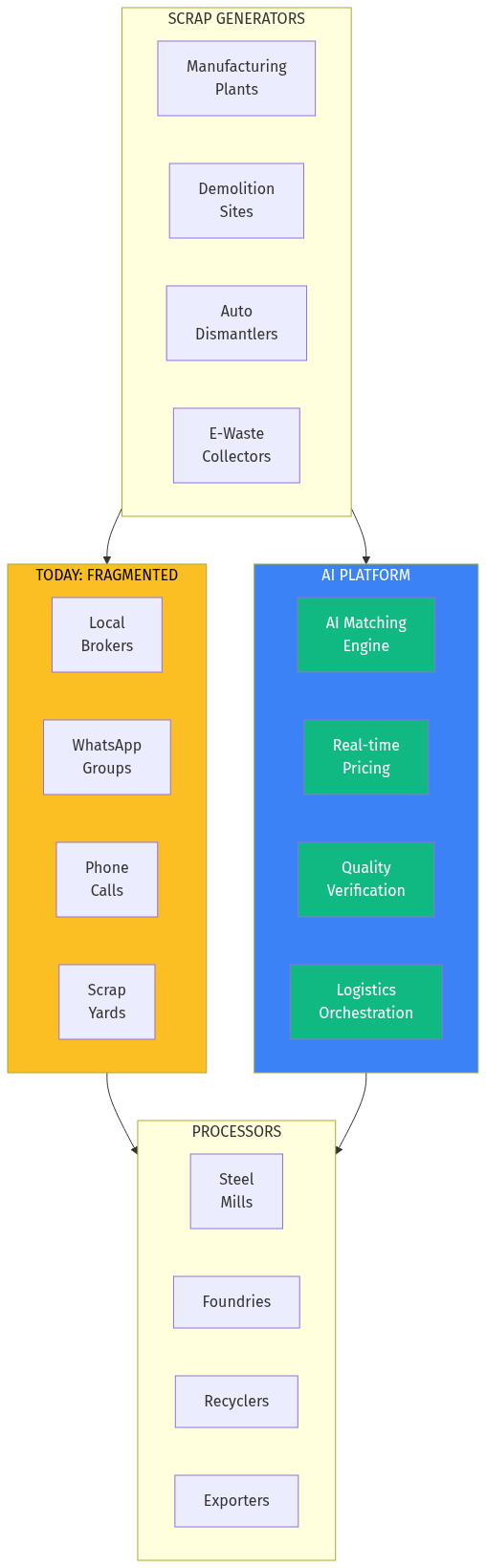
    The AI Stack for Scrap Intelligence

    Architecture Diagram
    Architecture Diagram

    How AI Transforms Each Step

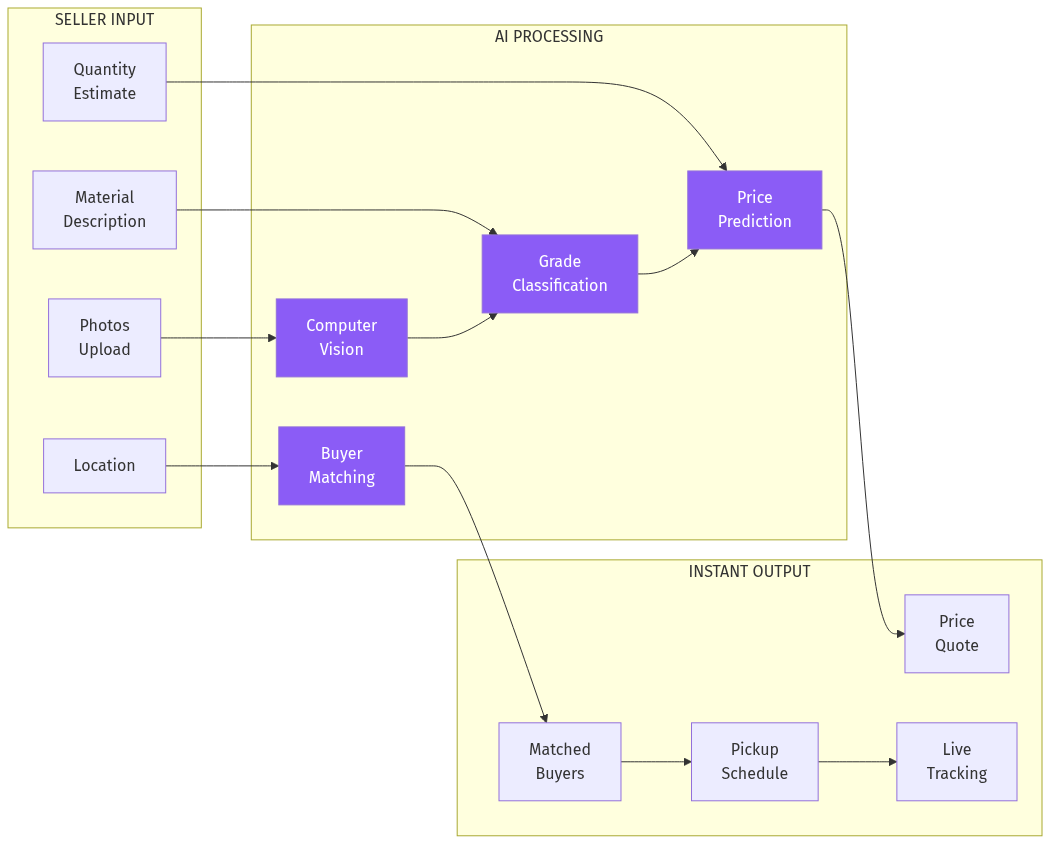
    1. Quality Grading (Computer Vision)
    • Seller uploads 3-5 photos of scrap pile
    • AI identifies: metal type, grade, contamination level, estimated weight
    • Outputs: Grade classification (e.g., "HMS 1" vs "HMS 2"), quality score (1-100)
    • Accuracy target: 90%+ agreement with physical inspection
    2. Price Prediction (ML + Market Data)
    • Inputs: Grade, quantity, location, historical prices, current mill demand
    • Real-time pricing model trained on transaction data
    • Confidence intervals: "₹42,500-44,000/MT with 85% confidence"
    • Updates hourly based on LME, domestic mill prices, regional supply
    3. Buyer Matching (Recommendation Engine)
    • Matches based on: material type, quantity, location, payment history, relationship score
    • Ranks buyers by: price offered, pickup speed, payment reliability
    • Shows seller: "Top 3 buyers for this material in your area"
    4. Logistics Orchestration (Route Optimization)
    • Consolidates pickups from multiple sellers in area
    • Optimizes routes for aggregator fleet
    • Real-time tracking for all parties
    • Weight verification at pickup with photo evidence

    The AI Workflow

    AI Flow Diagram
    AI Flow Diagram

    7.

    Product Concept

    Core Platform: "KabadAI" (Working Title)

    Interface: WhatsApp-first with web dashboard for analytics Seller Flow:
  • Message bot: "Sell scrap"
  • Upload photos of material
  • AI responds: "Identified: Steel Turnings (ISRI 202), ~2MT, Grade A-, estimated ₹38,000-40,000/MT"
  • Seller confirms quantity, selects from matched buyers
  • Pickup scheduled, tracked in real-time
  • Payment within 24 hours via UPI/escrow
  • Buyer Flow:
  • Set procurement requirements: materials, grades, quantities, price alerts
  • Receive push notifications when matching scrap available
  • Review AI quality assessment + photos
  • Accept/negotiate directly in WhatsApp
  • Track incoming shipments
  • Quality-verified delivery, instant payment release
  • Value Adds:
    • Price Intelligence Dashboard: Historical prices, demand forecasting, arbitrage opportunities
    • Carbon Credit Calculator: Certified emission savings from recycled materials
    • Compliance Reporting: EPR documentation, GST-compliant invoicing
    • Financing: Working capital loans against confirmed orders

    8.

    Development Plan

    PhaseTimelineDeliverables
    MVP8 weeksWhatsApp bot, basic photo grading (steel only), manual matching, single city pilot
    V116 weeksML pricing model, auto-matching, logistics integration, payment escrow
    V224 weeksMulti-metal support, mobile app, price alerts, buyer dashboard
    V336 weeksCarbon credits, financing, multi-city expansion, API for ERP integration

    Technical Stack

    • Vision Model: Fine-tuned GPT-4V or LLaVA for scrap classification
    • WhatsApp: Official Business API via Kapso or Gupshup
    • Backend: Node.js/Fastify, PostgreSQL, Redis
    • ML: Python, scikit-learn for pricing, trained on historical transaction data
    • Logistics: Google Maps API, custom route optimization
    • Payments: Razorpay escrow, UPI autopay

    9.

    Go-To-Market Strategy

    Phase 1: Industrial Area Saturation (Weeks 1-12)

    Target: Single industrial cluster (e.g., Jeedimetla, Hyderabad — 500+ manufacturing units) Acquisition:
  • Partner with 1 large scrap dealer as anchor buyer
  • Door-to-door factory visits by sales team
  • Offer: "Free scrap price check — upload photo, get instant quote"
  • Convert: When AI quote beats local dealer, facilitate transaction
  • Metrics: 50 factories active, 200+ MT/month GMV

    Phase 2: Buyer Network Expansion (Weeks 12-24)

    Target: Onboard 10 verified buyers (mini steel mills, foundries, exporters) Acquisition:
  • Demonstrate supply aggregation capability
  • Offer: Better quality consistency via AI grading
  • Value prop: Reduce procurement overhead by 50%
  • Metrics: 10 active buyers, 1000+ MT/month GMV

    Phase 3: Geographic Expansion (Weeks 24-52)

    Target: 5 industrial clusters, 3 metro regions Playbook:
  • Replicate cluster saturation model
  • Build regional logistics network
  • Launch financing products
  • Metrics: 500 factories, 50 buyers, 10,000+ MT/month GMV, ₹50Cr ARR
    10.

    Revenue Model

    Revenue StreamDescriptionTarget Margin
    Transaction Fee1-2% of GMV on completed tradesPrimary
    Premium ListingsVerified seller badge, priority matching₹999/month
    Price IntelligenceReal-time pricing API for ERP integration₹25K/month
    Financing SpreadWorking capital loans against orders2-3% spread
    Logistics MarkupConsolidated pickup services10-15% margin
    Carbon Credit CommissionCertified recycling credits brokerage5% of credit value
    Unit Economics Target:
    • Average transaction: ₹2 lakhs
    • Take rate: 1.5%
    • Revenue per transaction: ₹3,000
    • CAC: ₹5,000 (recovered in 2 transactions)
    • LTV: ₹1.5 lakhs+ (weekly repeat transactions)

    11.

    Data Moat Potential

    The Flywheel:
  • Transaction Data → Better pricing models → More accurate quotes
  • Photo Library → Better grading AI → Higher seller trust
  • Buyer Performance Data → Better matching → Higher completion rates
  • Price History → Market intelligence product → New revenue stream
  • Volume Aggregation → Logistics efficiency → Lower costs → More volume
  • Proprietary Data Assets:
    • Largest labeled dataset of scrap photos with grade/price outcomes
    • Real-time transaction prices across regions (currently non-public)
    • Buyer payment reliability scores
    • Seasonal demand patterns by material and region
    • Quality variance by seller/factory type
    Mental Model Applied (Distant Domain Import): What solved a similar problem in another industry? Analogy: Zillow's Zestimate for Real Estate Zillow created the first transparent pricing layer for a historically opaque market. They aggregated transaction data to build pricing models that became the reference point. KabadAI can become the "Zestimate for Scrap" — the authoritative price reference that both buyers and sellers trust. Analogy: Flexport for Freight Flexport digitized the opaque freight forwarding industry by building software that gave visibility into every step. KabadAI does the same for scrap — from generation to processing, every touchpoint tracked and optimized.
    12.

    Why This Fits AIM Ecosystem

    AIM's Core Thesis: Structure fragmented B2B markets where discovery happens offline and decisions require trust. Industrial Scrap fits perfectly:
    • ₹60B+ market in India alone
    • Highly fragmented (100,000+ scrap dealers)
    • Transactions require trust (quality verification)
    • Repeat purchase (factories sell weekly)
    • WhatsApp-native audience
    • Clear AI disruption angle (vision, pricing, matching)
    Cross-Ecosystem Synergies:
    • rccspunpipes.com buyers also purchase scrap steel
    • thefoundry.in foundries are direct scrap consumers
    • masale.in processing plants generate organic waste (compost opportunity)
    • Shared logistics network across AIM verticals
    Domain Opportunity: kabadi.in, scrap.in, kabadimart.in — all available for acquisition under ₹1 lakh

    ## Risk Assessment

    Mental Model Applied (Falsification + Pre-Mortem):

    Why Would This Fail?

    Risk 1: AI Grading Accuracy If photo-based grading achieves only 70% accuracy, buyers won't trust it. They'll still demand physical inspection, negating the efficiency gain. Mitigation: Start with steel-only (most standardized grades), build accuracy before expanding. Offer money-back guarantee on grade disputes. Risk 2: Incumbent Retaliation Large scrap dealers control regional supply. They could pressure factories to avoid the platform. Mitigation: Position as "additional channel" not replacement. Offer dealers a role as fulfillment partners. Risk 3: Payment Collection Scrap industry has culture of delayed payments. Buyers might resist instant settlement. Mitigation: Offer trade credit product, partner with NBFCs for buyer financing. Risk 4: Regulatory Risk GST enforcement on informal scrap trade could shrink addressable market. Mitigation: Position as compliance enabler. GST-compliant invoicing as feature. Mental Model Applied (Steelmanning):

    Best Case Against This Opportunity

    "The scrap industry remains offline because participants prefer it that way. Opacity enables tax avoidance, relationship-based pricing rewards loyalty, and the informal sector provides employment. Any platform that brings transparency will be actively resisted by the entire ecosystem — not because they don't see value, but because the current system serves hidden interests. The 'inefficiency' is actually a feature, not a bug, for those who control it."

    Counter: While true for cash transactions, GST has already formalized 60%+ of industrial scrap trade. The formalized segment is actively seeking efficiency tools. Target that segment first.

    ## Verdict

    Opportunity Score: 8.5/10 Conviction Breakdown:
    • Market Size: 10/10 — $700B global, $60B India, growing
    • Timing: 8/10 — AI vision finally capable, WhatsApp API mature
    • Competition: 9/10 — No AI-native player, incumbents are listing sites
    • Execution Risk: 7/10 — Grading accuracy and adoption are real challenges
    • Moat Potential: 9/10 — Transaction data creates unassailable pricing intelligence
    • AIM Fit: 9/10 — Perfect vertical for the ecosystem
    Recommendation: BUILD.

    This is a generational opportunity to create the Bloomberg Terminal for physical scrap trading. The technology stack is finally ready, the market is massive, and incumbents are asleep. The WhatsApp-first approach meets the market where it is, while AI grading solves the trust problem that has kept this offline for decades.

    First mover with accurate AI grading becomes the pricing reference for the entire industry — a position worth billions.


    ## Sources