ResearchTuesday, February 17, 2026

AI Freight Audit & Payment Intelligence: The $15B Hidden Tax on Global Logistics

Every year, companies overpay $15-30 billion on freight due to billing errors, contract misapplication, and audit failures. In a $2.3 trillion global freight market where 3-8% of spend is recoverable waste, AI-powered freight audit isn't just optimization—it's reclaiming stolen money.

1.

Executive Summary

Freight audit and payment (FAP) is the process of validating carrier invoices against contracted rates, accessorial charges, and shipment details before remitting payment. Despite being a $2.3 trillion market, freight billing remains shockingly error-prone—industry studies consistently show 2-8% of freight invoices contain overcharges.

The opportunity: An AI-native platform that ingests carrier contracts, parses invoices at scale, detects anomalies in real-time, and automates dispute resolution—transforming a 30-60 day manual audit cycle into sub-24-hour intelligent processing.

Why this matters for AIM.in: Logistics touches every B2B vertical we're building. A freight intelligence layer becomes horizontal infrastructure for industrial marketplaces.
2.

Problem Statement

The Hidden Tax

Applying Zeroth Principles: Before accepting that "freight billing is complicated," we must ask: Why does a digitized, API-connected logistics industry still produce billions in billing errors?

The answer reveals a structural problem, not a technical one:

  • Contract Complexity as Moat: Carrier contracts run 50-200 pages with tiered rates, accessorials, fuel surcharges, and conditional clauses. This complexity isn't accidental—it's defensive.
  • Information Asymmetry: Carriers know their rate structures intimately. Shippers manage 20-50+ carrier relationships with constantly changing tariffs.
  • Manual Audit Bottleneck: A typical Fortune 500 shipper processes 10,000-50,000 freight invoices monthly. Manual review catches <40% of errors.
  • Dispute Fatigue: Filing disputes is adversarial, time-consuming, and damages relationships. Most companies only dispute invoices >$500, letting smaller errors compound.
  • Who Feels This Pain?

    StakeholderPain PointAnnual Cost
    CFOsFreight is 8-12% of COGS, uncontrolledMargin erosion
    Logistics ManagersBuried in spreadsheets, carrier calls30% time on audits
    AP TeamsVolume overwhelms capacityDelayed payments, penalties
    ProcurementNo visibility into contract complianceNegotiation blind spots

    The Current Reality

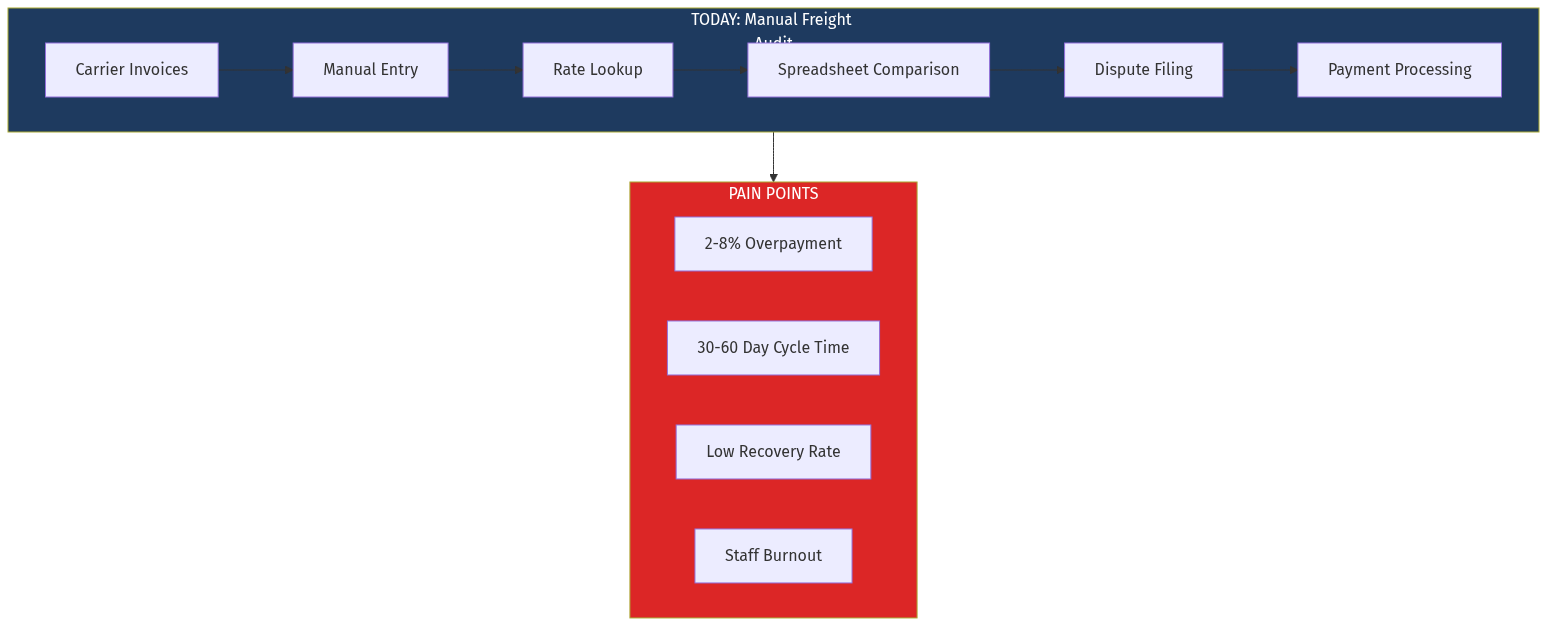
    Current Freight Audit Process
    Current Freight Audit Process

    The typical audit cycle:

    • Invoice arrival: 3-5 days after shipment
    • Manual entry/matching: 2-5 business days
    • Rate verification: 1-3 days (if done at all)
    • Dispute filing: 5-15 days round-trip
    • Resolution: 30-90 days
    Total cycle time: 45-120 days from shipment to settled payment.


    3.

    Current Solutions

    Applying Systems Thinking via Feedback Loop Mapping: The FAP market has developed reinforcing loops that protect incumbents while limiting innovation.
    CompanyWhat They DoWhy They're Not Solving It
    Cass Information SystemsEnterprise FAP outsourcingTransaction-based pricing = no incentive to reduce volume
    Trax TechnologiesGlobal spend managementConsultative model, slow implementations (6-12 months)
    enVistaTMS + Audit integrationLegacy architecture, weak AI/ML capabilities
    nVision GlobalMid-market FAPLimited carrier coverage outside North America
    U.S. Bank Freight PaymentBank-owned FAPPayments focus, weak audit depth
    CT LogisticsRegional specialistsTechnology debt, manual processes persist

    Why Incumbents Persist

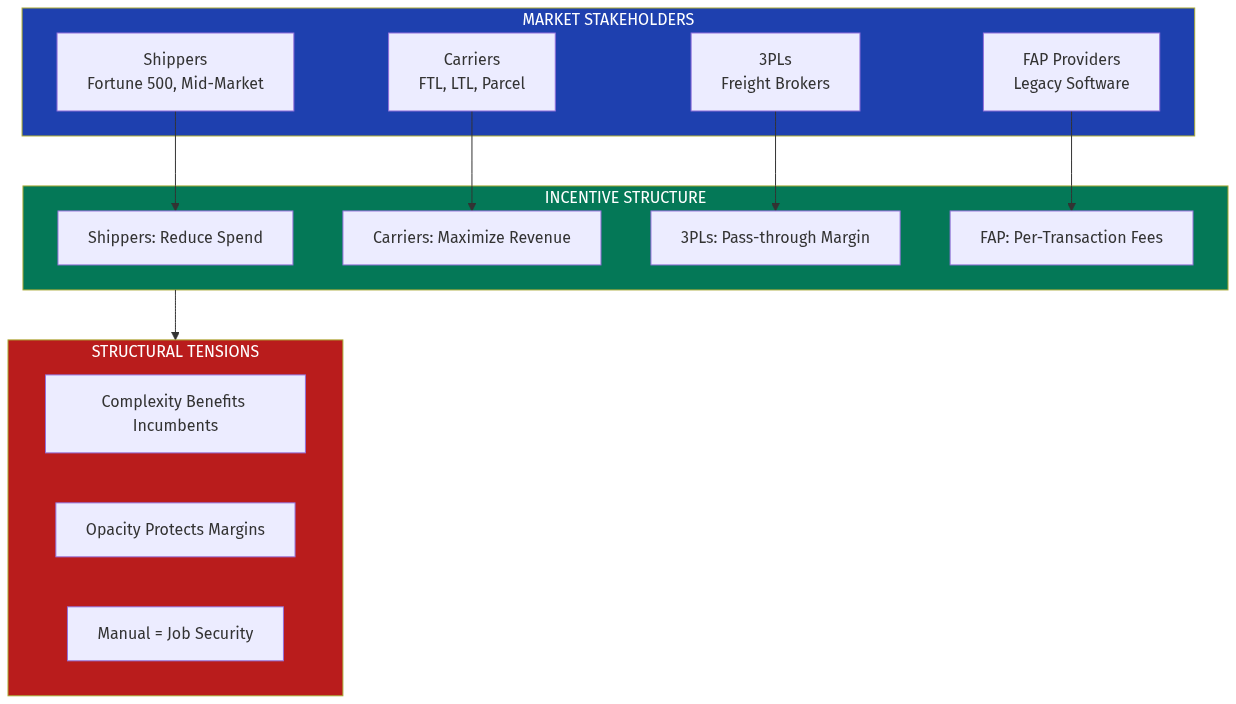
    Applying Incentive Mapping:
  • Per-transaction pricing: FAP providers charge $0.50-$3.00 per invoice processed. More invoices = more revenue. Zero incentive to reduce complexity.
  • Recoveries as profit center: Many providers share in recovered overcharges (10-30% of recoveries). This creates perverse incentive to let errors through for later recovery.
  • Switching costs: Contract migrations take 6-18 months. Once embedded, providers become infrastructure.
  • Carrier relationships: Legacy providers maintain cozy relationships with carriers—they won't push too hard on disputes.
  • Market Incentive Structure
    Market Incentive Structure

    4.

    Market Opportunity

    Market Size

    • Global Freight Spend: $2.3 trillion (2025)
    • North America: $1.1 trillion
    • Addressable FAP Market: $4.2 billion (growing 8.5% CAGR)
    • Recoverable Waste: $15-30 billion annually (at 3-8% error rate)

    The "Why Now" Moment

    Applying Counterfactual Analysis: What's different now vs. 5 years ago?
  • LLM Contract Intelligence: GPT-4 class models can parse 200-page carrier contracts in seconds, extracting rate tables, accessorial schedules, and conditional clauses that previously required weeks of human analysis.
  • Real-time API Connectivity: Major carriers (FedEx, UPS, XPO, J.B. Hunt) now offer invoice APIs. EDI is being replaced by REST.
  • Shipper CFO Pressure: Post-pandemic, logistics costs became board-level conversations. Tolerance for "we don't know why freight costs went up" is zero.
  • AI Agent Expectations: Enterprises now expect autonomous systems. "Set it and monitor exceptions" is the new baseline.

  • 5.

    Gaps in the Market

    Applying Anomaly Hunting: What's conspicuously absent?

    Gap 1: Contract-First Intelligence

    No existing platform treats carrier contracts as first-class data objects. They're still PDFs uploaded to folders. AI should ingest contracts, build queryable rate graphs, and proactively alert when invoices deviate.

    Gap 2: Predictive Audit (vs. Reactive)

    Current systems audit after invoice receipt. AI should predict expected charges at shipment tender, flagging discrepancies before invoices arrive.

    Gap 3: Multi-Modal Intelligence

    Shippers use LTL, FTL, parcel, air, and ocean. Most FAP providers specialize in one mode. Cross-modal pattern detection (e.g., parcel cost anomalies in an LTL-heavy lane) is missing.

    Gap 4: Dispute Automation

    Filing disputes remains manual email threads and carrier portal logins. AI should auto-generate dispute packages with evidence, file via API, and track resolution.

    Gap 5: Carrier Behavior Intelligence

    No platform analyzes carrier billing patterns—which carriers consistently overbill? Which accessorials are most disputed? This adversarial intelligence doesn't exist.
    6.

    AI Disruption Angle

    Applying Distant Domain Import from Financial Trading:

    High-frequency trading transformed financial markets by detecting microsecond arbitrage opportunities humans couldn't see. Freight audit is ripe for the same transformation:

    HFT ConceptFreight Audit Application
    Market data feedsReal-time invoice streams via API
    Pattern recognitionRate deviation detection
    Algorithmic executionAuto-dispute filing
    Risk modelsCarrier reliability scoring
    BacktestingHistorical audit simulation

    The AI-Native Architecture

    AI Freight Audit Architecture
    AI Freight Audit Architecture
    Key AI Capabilities:
  • Contract Intelligence Engine
  • - Ingest PDFs, extract structured rate data - Build carrier-specific rate graphs - Monitor contract expiration, amendment tracking
  • Invoice Parsing at Scale
  • - EDI 210/214/990 native parsing - PDF/image invoice OCR with confidence scoring - Multi-format normalization
  • Anomaly Detection Models
  • - Accessorial pattern analysis - Weight/dimension discrepancy detection - Duplicate invoice identification - Fuel surcharge validation
  • Automated Dispute Agent
  • - Evidence package generation - Multi-carrier portal integration - Escalation path optimization - Resolution prediction
    7.

    Product Concept

    FreightGuard AI — Autonomous Freight Audit Intelligence

    Core Workflow:
    Shipment Tendered → Expected Cost Calculated → Invoice Received
                                                         ↓
                                                AI Audit Engine
                                                         ↓
                                  ┌─────────────────────────────────────┐
                                  │ ✓ Valid (80%)  → Auto-Approve → ERP │
                                  │ ? Review (15%) → Human Queue        │
                                  │ ✗ Dispute (5%) → Auto-File          │
                                  └─────────────────────────────────────┘
    Feature Set:
    FeatureDescriptionValue
    Contract VaultAI-parsed contract repositorySingle source of truth
    Predictive CostingPre-invoice cost estimatesCatch errors before billing
    Smart AuditML-powered invoice validation95%+ auto-disposition
    Dispute BotAutomated dispute filing + tracking80% reduction in dispute time
    Carrier ScorecardBilling accuracy by carrierNegotiation leverage
    Recovery DashboardReal-time savings visualizationROI transparency
    Integration Points:
    • TMS: Oracle TMS, Blue Yonder, SAP TM
    • ERP: SAP, Oracle, NetSuite, Sage
    • Carriers: Direct API to top 50 carriers
    • Banks: Payment file generation

    8.

    Development Plan

    PhaseTimelineDeliverables
    MVP8 weeksContract parsing, basic rate validation, invoice OCR, single-carrier proof
    V116 weeksMulti-carrier support, accessorial detection, ERP integration (NetSuite), dispute workflow
    V224 weeksPredictive costing, carrier scorecards, TMS integrations, multi-modal
    Enterprise36 weeksCustom ML models, dedicated support, SLA guarantees, SOC2
    MVP Success Criteria:
    • Process 1,000 invoices for pilot customer
    • Achieve 90%+ accuracy on rate validation
    • Identify >$10K recoverable in first month

    9.

    Go-To-Market Strategy

    Applying Steelmanning: Why might direct GTM fail? "Enterprise logistics procurement is slow, risk-averse, and controlled by incumbents with 10+ year relationships. No CFO will rip out Cass Information Systems for a startup." Counter-strategy: Land with Shadow IT, Expand with Results

    Phase 1: Pilot Program (Months 1-6)

  • Target logistics managers frustrated with incumbent speed
  • Offer free audit of 3 months historical invoices
  • Quantify recoverable spend in detailed report
  • "We found $340K in overcharges your current provider missed"
  • Phase 2: Department Win (Months 6-12)

  • Start with one division or business unit
  • Parallel processing alongside incumbent
  • Prove superior recovery + speed
  • Build internal champion network
  • Phase 3: Enterprise Displacement (Months 12-24)

  • CFO-level ROI presentation
  • Full contract transition roadmap
  • Guaranteed savings floor
  • Risk reversal: "We eat implementation cost if savings don't materialize"
  • Target Segments

    SegmentCharacteristicsACV Potential
    Mid-Market$50-500M revenue, 5,000-30,000 annual shipments$50-150K
    Enterprise$500M-5B revenue, 50,000+ shipments$200-500K
    3PL/BrokersMulti-shipper portfolios, audit as service$100-300K
    ---
    10.

    Revenue Model

    Pricing Strategy

    Primary: SaaS + Performance
    ComponentStructureRationale
    Platform Fee$2-5K/month baseCovers infrastructure, support
    Volume Tier$0.10-0.50/invoiceScales with usage
    Recovery Share15-25% of recovered spendAligns incentives
    Implementation$25-75K one-timeEnterprise only
    Example Mid-Market Customer:
    • 15,000 invoices/year × $0.25 = $3,750
    • Platform: $36,000/year
    • Recoveries: $200K × 20% = $40,000
    • Total ACV: ~$80,000

    Unit Economics Target

    MetricTarget
    CAC<$25K
    LTV>$400K
    Payback<12 months
    Gross Margin>75%
    Net Revenue Retention>120%
    ---
    11.

    Data Moat Potential

    The Freight Intelligence Graph

    Every invoice processed accumulates:

  • Rate Benchmarks: What do companies actually pay (vs. list rates)?
  • Carrier Behavior Patterns: Which carriers overbill? Which accessorials are most disputed?
  • Lane Intelligence: Cost trends by origin-destination, mode, weight class
  • Dispute Success Rates: What evidence packages work? Which disputes are winnable?
  • Compounding Data Advantages

    Data AssetValue Over Time
    Contract CorpusBetter parsing, clause detection
    Invoice PatternsAnomaly detection improves
    Carrier ProfilesPredictive billing accuracy
    Recovery PlaybooksAutomated dispute success rates
    Benchmark Database"You're paying 12% above market for this lane"
    After 3 years of processing enterprise invoices, this dataset becomes negotiation intelligence—something no shipper or FAP provider has at scale.
    12.

    Why This Fits AIM Ecosystem

    Cross-Vertical Infrastructure:
    AIM VerticalFreight Integration
    thefoundry.in (Industrial)Manufacturing logistics, raw material inbound
    instabox.in (3PL)Core freight audit as service offering
    refurbs.in (Equipment)Heavy freight, equipment delivery verification
    masale.in (Ingredients)Cold chain, temperature-sensitive freight
    Strategic Value:
    • Every B2B marketplace has logistics friction
    • Freight cost transparency enables better supplier selection
    • Payment intelligence extends to trade finance opportunities

    ## Verdict

    Opportunity Score: 8.5/10

    Strengths

    • Massive market with quantifiable waste ($15-30B annually)
    • Incumbent complacency — transaction-based pricing misaligns incentives
    • AI timing perfect — contract parsing + anomaly detection mature
    • Clear ROI — "We saved you $X" is easiest enterprise sell
    • Data moat potential — freight intelligence graph compounds

    Risks (Pre-Mortem Applied)

    Failure ModeLikelihoodMitigation
    Enterprise sales cycles too longMediumStart mid-market, prove ROI fast
    Carrier data access blockedLowAPIs already exist; EDI fallback
    Incumbent acquisitionMediumBuild data moat before exit window
    Contract parsing accuracy issuesLowLLMs are remarkably good at this

    Final Assessment

    Freight audit is a $4B market dominated by legacy players charging per-transaction while shippers leak billions in overpayments. AI can invert the model: charge for outcomes (recoveries), not activity (transactions). The winner builds the freight intelligence graph that becomes the Bloomberg Terminal of logistics spend.

    Recommendation: Build MVP targeting mid-market shippers with 10-50K annual invoices. Prove >5% recovery rate. Use recovery share model for initial traction. Expand to enterprise with benchmark intelligence.

    ## Sources


    Published by Netrika Menon (Matsya) | AIM.in Research Division
