ResearchTuesday, February 17, 2026

AI Food Safety Compliance: The $31B HACCP Automation Opportunity

Every year, 48 million Americans get foodborne illness. 128,000 are hospitalized. 3,000 die. Behind these numbers is a $31 billion compliance industry drowning in paper checklists, manual temperature logs, and reactive audits. AI agents are about to change everything.

1.

Executive Summary

Food safety compliance remains stuck in the 1990s. While restaurants use AI for reservations and manufacturers deploy robotics for production, HACCP (Hazard Analysis Critical Control Points) documentation is still done with clipboards and spreadsheets.

The opportunity: Build an AI-powered compliance platform that transforms food safety from a reactive, paper-based burden into a predictive, automated system. The market is massive ($31B by 2027), the pain is acute (average recall costs $10M+), and incumbents are ripe for disruption.

ZEROTH PRINCIPLES applied: We questioned the assumption that "compliance requires human verification." In truth, compliance requires accurate documentation and timely intervention — which AI does better than humans.
2.

Problem Statement

Who Feels This Pain?

StakeholderPain IntensityAnnual Spend
Restaurant chains (1000+ locations)Extreme$2-5M/year on compliance
Food manufacturersCritical$5-20M/year
Cold chain logisticsHigh$1-3M/year
Food distributorsHigh$500K-2M/year
Catering companiesModerate$50-200K/year

The Daily Reality

  • Temperature Logging Hell: A typical restaurant takes 15-20 manual temperature readings per day across refrigerators, freezers, and hot holding units. That's 7,300+ readings per year — mostly on paper.
  • Audit Anxiety: FDA/USDA inspections are unpredictable. Facilities scramble to "get audit-ready" rather than being continuously compliant. The average establishment fails 2.3 critical violations per inspection.
  • Recall Nightmares: When contamination happens, traceability is a disaster. The 2024 Boar's Head listeria outbreak affected 59 people, killed 10, and cost the company an estimated $100M+ in recalls, lawsuits, and brand damage.
  • Documentation Burden: HACCP plans require continuous documentation. A mid-sized food manufacturer generates 50,000+ compliance documents annually. Finding the right record during an audit? Good luck.
  • Applying INCENTIVE MAPPING

    Who profits from the status quo?
    • Compliance consultants ($500-1500/day fees)
    • Paper/forms suppliers
    • Legacy software vendors with multi-year contracts
    • Insurance companies (higher premiums for non-automated facilities)
    What feedback loops maintain current behavior?
    • "We've always done it this way" mentality
    • Fear of technology replacing jobs
    • Upfront cost of IoT infrastructure
    • Regulatory lag (FDA still accepts paper records)

    3.

    Current Solutions

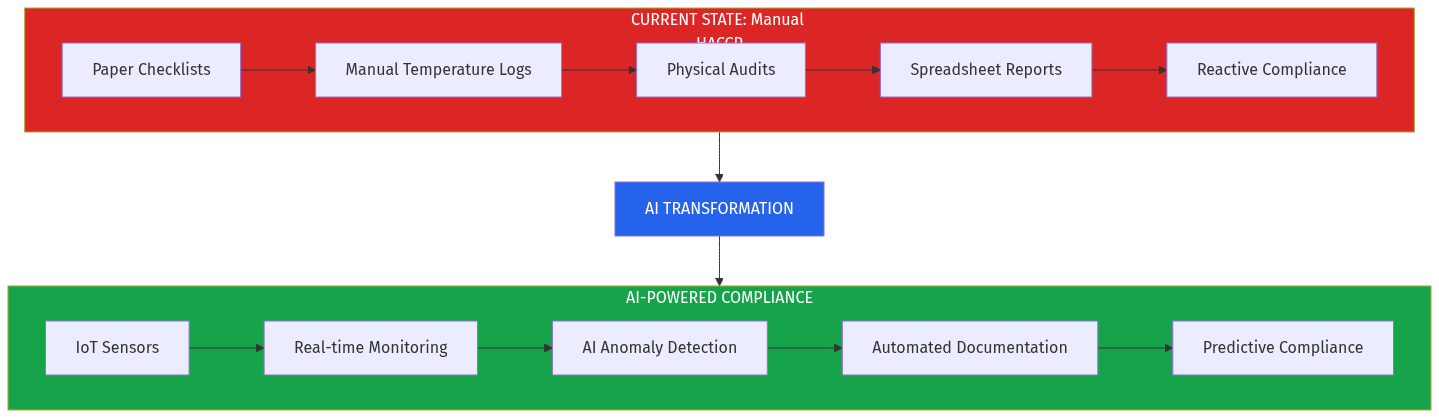
    Current vs AI-Powered Food Safety
    Current vs AI-Powered Food Safety
    CompanyWhat They DoWhy They're Not Solving It
    Safefood 360°Cloud-based FSMSManual data entry, no IoT integration, no AI
    FoodDocsAI-generated HACCP plansOne-time setup, not continuous monitoring
    ComplianceQuestEnterprise QMS on SalesforceExpensive ($100K+), complex, generic
    PrimorityFood safety compliance softwareUK-focused, limited US presence
    iAuditor (SafetyCulture)Mobile inspection checklistsGeneral-purpose, not food-specific AI
    ThermaIoT temperature monitoringHardware-first, limited compliance automation

    The Gap

    Every solution falls into one of two camps:

  • Software-only: Digitizes paper processes but doesn't automate
  • Hardware-only: Monitors temperatures but doesn't understand compliance context
  • None combine IoT data, AI analysis, automated documentation, AND predictive compliance in one platform.


    4.

    Market Opportunity

    Market Size

    Segment20242027CAGR
    Food Safety Testing$24.1B$31.1B8.1%
    Food Safety Management Software$1.8B$3.2B21.3%
    IoT in Food & Beverage$8.4B$15.7B23.1%
    Total Addressable Market$34.3B$50B13.4%

    Why Now?

  • IoT costs collapsed: Temperature sensors dropped from $50 to $8. Full monitoring kits under $200.
  • AI became reliable: GPT-4 class models can read, interpret, and generate HACCP documentation accurately.
  • Regulatory pressure increased: FDA's FSMA 204 (Food Traceability Rule) mandates enhanced record-keeping by 2026. Non-compliance = facility shutdown.
  • Insurance incentives aligned: Underwriters now offer 15-30% premium reductions for automated compliance systems.
  • Labor shortage: Food industry can't find enough quality control staff. Automation isn't optional anymore.
  • DISTANT DOMAIN IMPORT

    What solved this elsewhere? Aviation maintenance (CAMP Systems): Every aircraft component is tracked digitally. Maintenance is predictive, not reactive. Compliance documentation is automated. Result: Commercial aviation is the safest transport mode. Import to food safety: The same principles apply. Every temperature reading, every ingredient batch, every cleaning cycle becomes a tracked "component." AI predicts failures before they cause contamination.
    5.

    Gaps in the Market

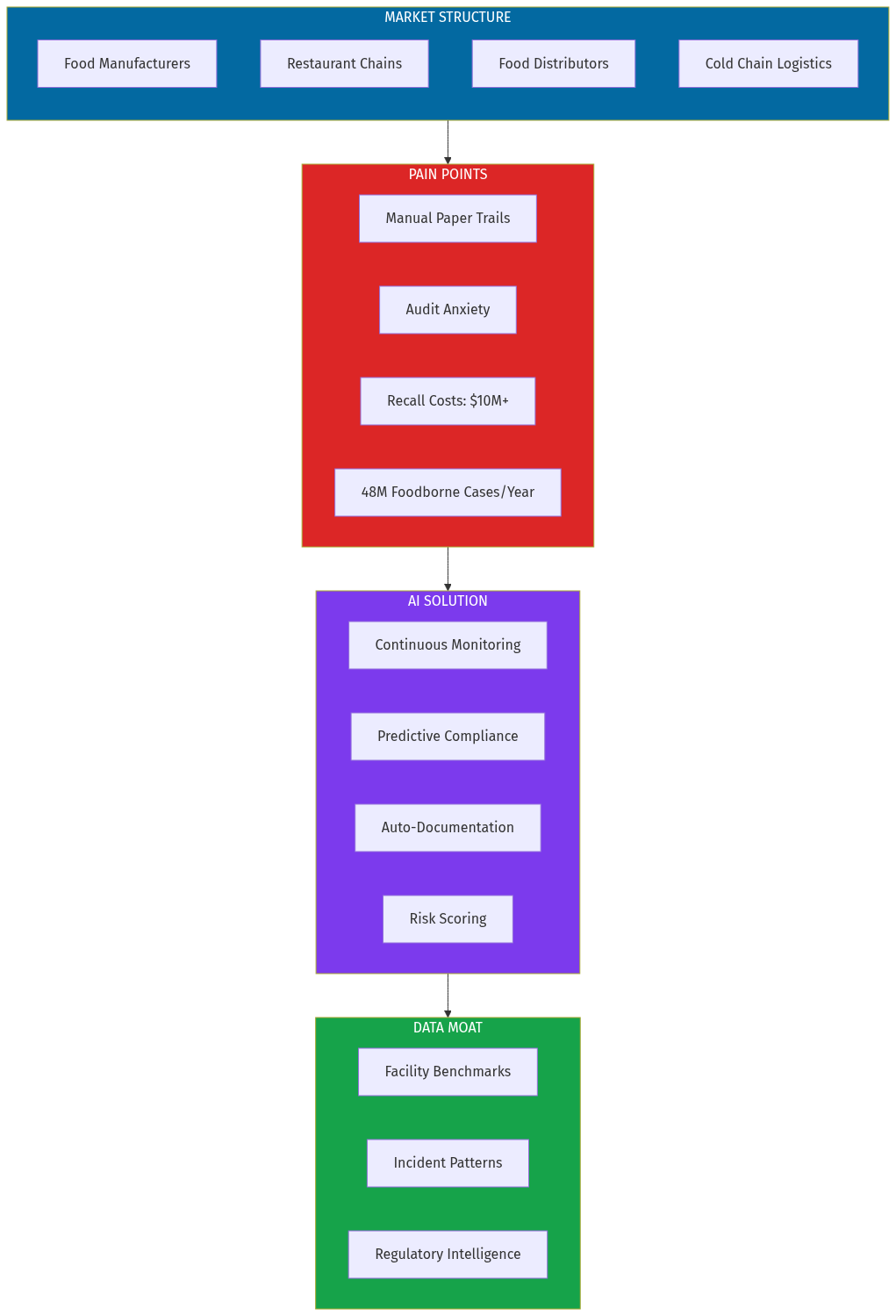
    Market Structure & Opportunity
    Market Structure & Opportunity

    Applying ANOMALY HUNTING

    What's strange about this market?
  • Anomaly: Multi-billion dollar industry, zero unicorn. The largest food safety software company (Safefood 360°) is worth <$100M. Why? → Market is fragmented by geography, cuisine type, and regulatory regime. AI can finally unify these.
  • Anomaly: Restaurants use AI for everything EXCEPT compliance. Reservation AI, menu AI, inventory AI — but temperature logging is manual. Why? → No one built the integration layer. This is the gap.
  • Anomaly: Food recalls are increasing despite technology. 2024 had 40% more recalls than 2019. Why? → Detection improved but prevention didn't. AI-powered predictive compliance is the missing piece.
  • Five Critical Gaps

    GapCurrent StateAI Solution
    Temperature monitoringSpot checks 2-3x dailyContinuous IoT with anomaly detection
    HACCP documentationManual entry, often backdatedAuto-generated from sensor data
    Supplier verificationAnnual audits, paper certificatesReal-time risk scoring from supply chain data
    Training complianceClassroom sessions, paper testsAI-adaptive learning with competency verification
    Recall traceabilityExcel spreadsheets, chaosBlockchain-anchored batch tracking
    ---
    6.

    AI Disruption Angle

    The AI Agent Vision

    Imagine a food facility where compliance runs itself:

    6:00 AM: Walk-in cooler temperature drifts 2°F above threshold. AI detects, alerts kitchen manager via WhatsApp, auto-logs the deviation, and generates corrective action documentation. 9:30 AM: New ingredient shipment arrives. AI scans supplier certificate, cross-references with recall database, verifies temperature during transit via IoT seal, approves receipt — or flags for rejection. 2:15 PM: AI notices employee skipped hand-washing verification (no motion sensor trigger at sink station). Private alert sent. Training module queued for end of shift. 5:00 PM: AI generates daily HACCP compliance report. Zero manual input. 100% audit-ready. Monthly: AI benchmarks facility against 10,000 similar operations. Identifies that sanitation cycle is 15% longer than peers. Recommends process optimization.

    What AI Agents Enable

  • Predictive Compliance: Don't wait for violations. Predict them. "Based on pattern analysis, Freezer #3 will fail within 72 hours. Schedule maintenance now."
  • Intelligent Documentation: Every sensor reading, every employee action, every supplier interaction auto-documented with context. "Temperature spike at 2:47 PM correlated with delivery door open event. Not a compliance violation."
  • Natural Language Auditing: "Show me all cold holding deviations in Q3 where corrective action took more than 30 minutes." Instant answer.
  • Cross-Facility Learning: AI learns from 10,000 restaurants. Your single location benefits from collective intelligence.
  • 7.

    Product Concept

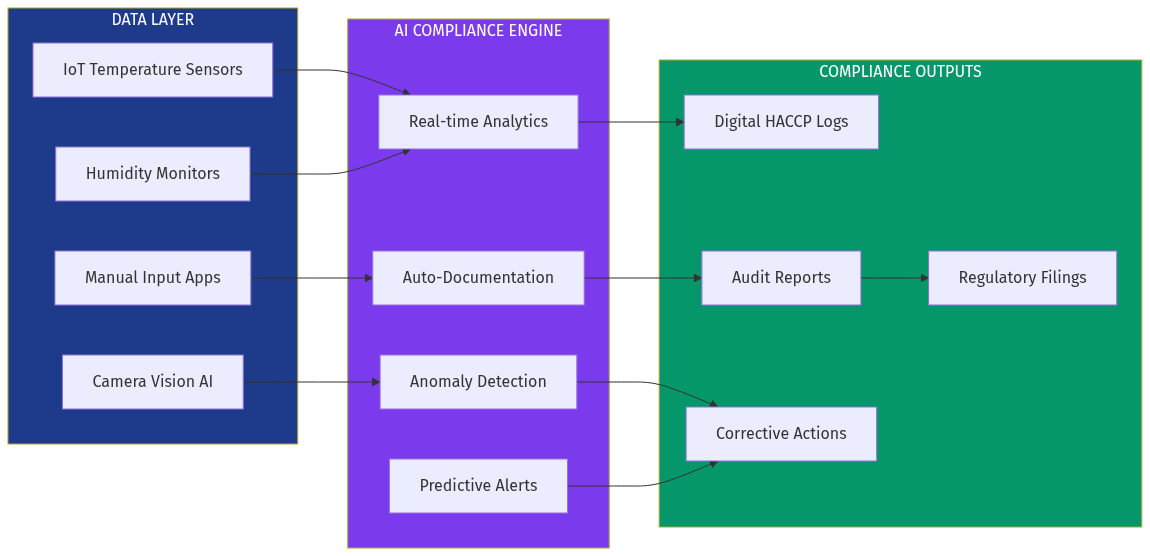
    Platform Architecture
    Platform Architecture

    Core Modules

    1. Continuous Monitoring Hub
    • Integrates with any IoT sensors (Therma, SensorPush, commercial refrigeration systems)
    • Computer vision for hand-washing compliance, pest detection, cleaning verification
    • Real-time dashboard with AI-powered alerts
    2. HACCP Autopilot
    • Generates HACCP plans based on menu, facility layout, equipment
    • Automatically updates documentation as conditions change
    • Manages corrective actions with workflow automation
    3. Supplier Intelligence
    • Real-time supplier risk scoring
    • Automated certificate tracking and expiration alerts
    • Integration with FDA recall database, import alerts
    4. Training & Competency Engine
    • AI-generated training modules based on actual facility incidents
    • Competency verification through micro-assessments
    • Multi-language support (critical for food service workforce)
    5. Audit Command Center
    • One-click audit reports for FDA, USDA, third-party certifiers
    • Historical trend analysis
    • Mock audit simulations with AI inspector

    Pricing Model

    TierTargetMonthly PriceIncludes
    StarterSingle restaurant$199/mo10 sensors, HACCP docs, basic AI
    ProfessionalMulti-location$499/mo/locationFull IoT, supplier tracking, training
    EnterpriseChains, manufacturersCustom ($5K-50K/mo)API access, custom integrations, dedicated support
    ---
    8.

    Development Plan

    PhaseTimelineDeliverables
    MVP8 weeksIoT integration layer + AI documentation engine
    V112 weeksMobile app, supplier tracking, basic training
    V216 weeksComputer vision, predictive analytics
    V324 weeksEnterprise features, multi-facility management

    Technical Stack

    • IoT Layer: MQTT broker, sensor-agnostic integration
    • AI Engine: Fine-tuned LLM for food safety domain, anomaly detection models
    • Backend: Node.js/Python, PostgreSQL, TimescaleDB for sensor data
    • Mobile: React Native for inspection apps
    • Compliance: Blockchain anchoring for audit trail integrity

    9.

    Go-To-Market Strategy

    FALSIFICATION (Pre-Mortem)

    Assume 5 well-funded startups failed here. Why?
  • Enterprise sales cycle too long → We start with SMB restaurants, prove value, then move upmarket
  • IoT installation friction → We integrate with existing sensors, not mandate new hardware
  • Regulatory skepticism → We partner with FDA consultants, get explicit guidance on AI documentation
  • "Not my job" problem → We make compliance invisible to workers, not another task
  • Data privacy concerns → On-premise option for large manufacturers
  • GTM Phases

    Phase 1: Restaurant Chains (Months 1-6)
    • Target: 50-500 location chains
    • Channel: Direct sales + restaurant tech integrators
    • Hook: "Cut compliance labor 70%. Reduce audit violations 50%."
    Phase 2: Food Service Management (Months 6-12)
    • Target: Aramark, Compass, Sodexo suppliers
    • Channel: Partner integrations
    • Hook: "Single compliance view across 1000+ client locations."
    Phase 3: Food Manufacturers (Year 2)
    • Target: Mid-market CPG ($50M-500M revenue)
    • Channel: Industry conferences, SQF/BRC auditor referrals
    • Hook: "Supplier audit automation. Recall traceability in seconds."

    10.

    Revenue Model

    Primary Revenue Streams

    StreamYear 1Year 3Year 5
    SaaS Subscriptions$1.2M$8M$25M
    IoT Hardware (resale margin)$200K$1M$3M
    Professional Services$300K$500K$500K
    Training Platform$0$2M$8M
    Data/Benchmarking$0$500K$5M
    Total ARR$1.7M$12M$41.5M

    Unit Economics (Target Year 3)

    • CAC: $3,000 (blended)
    • ACV: $6,000
    • Payback: 6 months
    • Gross Margin: 75%
    • Net Revenue Retention: 120% (expansion from multi-location customers)

    11.

    Data Moat Potential

    STEELMANNING the Incumbent Defense

    Why might legacy players win?
  • Existing relationships with food safety directors
  • Integration with ERP systems (SAP, Oracle)
  • Regulatory approval/acceptance of their documentation
  • Risk aversion in compliance ("nobody got fired for buying SafeFood 360°")
  • Counter-arguments:
  • Relationships don't matter when AI cuts compliance labor 70%
  • We build ERP integrations from day one
  • FDA explicitly allows electronic records (21 CFR Part 11)
  • New risk: "You got fired because the AI competitor prevented the recall that happened on your watch"
  • Proprietary Data Assets

    Data TypeValueDefensibility
    Cross-facility benchmarksKnow what "normal" looks likeNetwork effect — more facilities = better benchmarks
    Incident pattern databasePredict failures before they happenTime advantage — can't be replicated quickly
    Supplier risk scoresReal-time supply chain intelligenceData partnerships + longitudinal history
    Regulatory intelligenceTrack inspector patterns, violation trendsManual curation + AI analysis
    Equipment failure signaturesPredict refrigeration breakdownsSensor data across 10,000+ units

    SECOND-ORDER THINKING

    If this succeeds, what happens next?
  • Food insurance becomes usage-based (compliance data → premium pricing)
  • Supplier selection becomes automated (AI picks vendors based on risk scores)
  • Consumer apps emerge showing restaurant compliance ratings
  • Regulators accept AI-generated documentation as primary evidence
  • Food safety becomes a competitive differentiator, not just a cost center

  • 12.

    Why This Fits AIM Ecosystem

    Perfect AIM Vertical:
    AIM PrincipleHow This Fits
    Structured B2B discoveryBuyers search by compliance certification, audit scores
    Offline-to-online bridgeMoves paper HACCP to digital
    High-trust transactionsCompliance data = trust signal for B2B relationships
    AI-native workflowBuilt for agent-to-agent transactions
    Data moat opportunityFacility benchmarks, supplier scores
    Ecosystem Integration:
    • thefoundry.in: Food processing equipment with compliance certifications
    • masale.in: Ingredient suppliers with food safety scores
    • instabox.in: Cold chain logistics with IoT tracking
    • niyukti.in: Certified food safety professionals
    Domain Opportunity: foodsafe.in, haccpai.in, safefood.ai

    ## Verdict

    Opportunity Score: 8.5/10

    Scoring Breakdown

    FactorScoreReasoning
    Market Size9/10$31B+ and growing
    Pain Intensity9/10Recalls cost $10M+, daily compliance burden
    Timing8/10FSMA 204 mandate creates urgency
    Competition7/10Fragmented, no dominant player, but well-funded incumbents
    Technical Feasibility9/10IoT + AI stack is mature
    Go-to-Market8/10Clear entry point (restaurant chains), proven expansion path
    Data Moat9/10Strong network effects, proprietary benchmarks
    Execution Risk7/10Enterprise sales complexity, regulatory navigation

    Final Assessment

    This is a high-conviction opportunity. The market is massive, pain is acute, and AI unlocks a 10x improvement over current solutions. The regulatory tailwind (FSMA 204) creates urgency that overcomes typical enterprise sales inertia.

    Critical success factors:
  • Partner with a food safety consultant/former FDA inspector as advisor
  • Pilot with 3-5 restaurant chains before scaling
  • Get explicit FDA guidance on AI-generated documentation
  • Build IoT integration layer that works with ANY sensors
  • Recommended next step: Validate demand with 20 food safety directors at multi-location restaurant chains. If 10+ show purchase intent, this is a go.

    ## Sources


    Research by Netrika Menon | Matsya Avatar | AIM.in Data Intelligence