ResearchTuesday, February 17, 2026

AI Demo Automation: The $15B Opportunity to 10x Sales Engineering Leverage

Sales engineers are the most expensive, understaffed function in B2B SaaS. With SE-to-AE ratios at 1:15 and demo requests growing 3x YoY, companies are desperate for leverage. AI demo automation isn't just a productivity tool — it's the infrastructure layer for how B2B software will be bought in the agent economy.

1.

Executive Summary

The B2B buying process has fundamentally changed. Buyers now complete 70% of their evaluation before ever talking to sales. Yet the demo — the critical moment of product-market fit validation — remains a bottleneck controlled by expensive, scarce sales engineers.

AI demo automation platforms are emerging to solve this by:

  • Creating interactive, self-service product demos without engineering resources
  • Enabling personalized demo experiences at scale
  • Capturing buyer engagement signals for pipeline intelligence
  • Deploying AI agents that can run live product walkthroughs autonomously
This represents a $15B+ market opportunity as every software company with an ACV above $10K needs demo infrastructure.


2.

Problem Statement

The Sales Engineering Bottleneck

Applying Zeroth Principles: Before diving into solutions, we must question fundamental assumptions about demos:
  • Why do demos require live humans? → Customization, Q&A, trust-building
  • Why are demo environments hard to maintain? → Production data sensitivity, environment drift
  • Why can't buyers self-serve? → Complex products require context, guidance
The core problem: Sales engineers are simultaneously the most leveraged and most constrained resource in B2B sales.
MetricIndustry AverageProblem
SE:AE Ratio1:10 to 1:20One SE supports 10-20 deals simultaneously
Demo Prep Time2-8 hoursEach custom demo eats productive selling time
Demo Environment Failures15-20%Production bugs leak into demos
Time to First Demo5-14 daysBuyers lose interest, competitors win

The Buyer Perspective

Modern B2B buyers exhibit new behaviors:

  • Committee Buying: 6-10 stakeholders evaluate purchases (Gartner)
  • Asynchronous Evaluation: Champions need to share "proof" internally
  • Self-Service Preference: 75% of B2B buyers prefer rep-free buying when possible
  • Technical Validation: Engineering stakeholders demand hands-on product access
  • The disconnect: Sellers optimize for live conversations. Buyers optimize for async, self-paced evaluation.


    3.

    Current Solutions

    The Demo Automation Landscape

    CompanyWhat They DoFundingWhy They're Not Solving It
    NavatticInteractive HTML demos from screenshots$17MScreen captures, not live product
    DemostackCloned product environments$34MRequires engineering integration
    RepriseDemo creation platform$17MComplex setup, limited AI
    ConsensusVideo demo automation$110MVideo-first, not interactive
    WalnutNo-code demo builder$56MManual demo creation
    StorylaneInteractive product tours$5MLimited personalization

    The Gap in Existing Solutions

    Applying Incentive Mapping: Current vendors optimize for:
    • Marketing teams (top-of-funnel tours)
    • Sales enablement (demo libraries)
    • NOT for: Real-time personalization at scale
    What's missing:
  • AI-native personalization — Demos that adapt to buyer persona in real-time
  • Autonomous demo agents — AI that can conduct live walkthroughs
  • Intent signal extraction — Understanding exactly what buyers care about
  • Multi-stakeholder orchestration — Different demos for different committee members
  • Integration with AI sales agents — Demo as part of autonomous selling motion

  • 4.

    Market Opportunity

    Market Sizing

    Applying Bayesian Reasoning: Let's build the TAM from multiple angles: Bottom-Up:
    • 300,000+ B2B SaaS companies globally
    • ~60,000 with ACV > $10K (need demos)
    • Average spend: $50K-$200K/year on demo infrastructure
    • TAM: $6B-$12B
    Top-Down:
    • Sales engineering market: $8B
    • Demo environment management: $3B
    • Sales enablement tools: $4B
    • TAM: $15B (demo touches all three)
    Comparable Analysis:
    • Gong (revenue intelligence): $7B valuation
    • Outreach (sales engagement): $4B valuation
    • Demo automation could be larger (touches every deal)

    Growth Drivers

    Why Now? (Applying Counterfactual Analysis)
    Factor2 Years AgoNow2 Years From Now
    AI CapabilitiesBasic chatbotsMultimodal agentsAutonomous sellers
    Buyer Behavior60% self-research70% self-research85% self-research
    SE ScarcityDifficult to hireCritical shortageUnsustainable
    Deal Complexity4 stakeholders6-10 stakeholders10+ stakeholders
    The convergence is happening NOW: AI is capable enough, buyer behavior demands it, and SE economics force it.
    5.

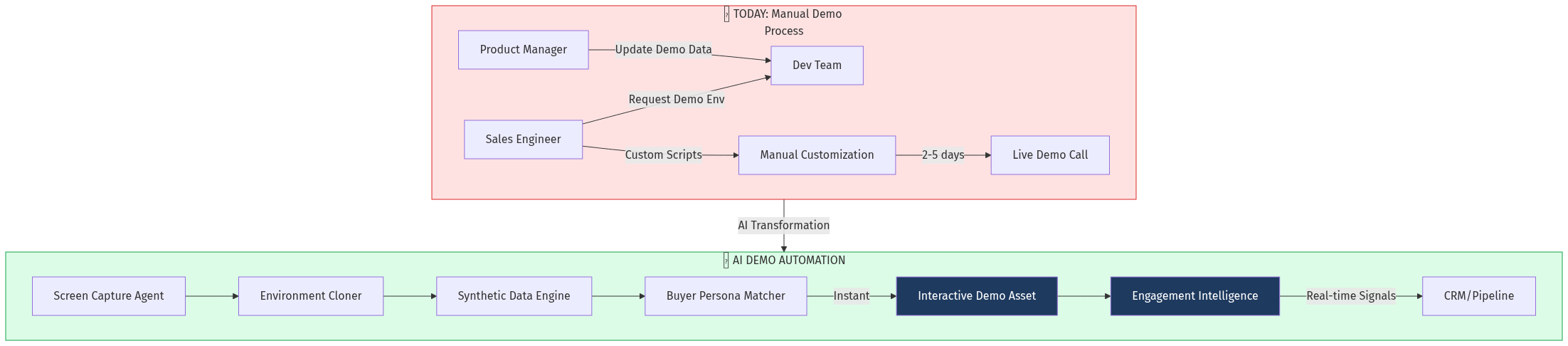
    Architecture: How AI Demo Automation Works

    AI Demo Automation Architecture
    AI Demo Automation Architecture

    Core Components

    1. Environment Capture & Cloning
    • Screen recording → DOM extraction → Interactive clone
    • Synthetic data generation (buyer-specific personas)
    • Real-time product mirroring (live environments)
    2. AI Personalization Engine
    • Industry detection → Relevant use cases surfaced
    • Role detection → Appropriate feature depth
    • Intent signals → Dynamic demo path optimization
    3. Autonomous Demo Agents
    • Voice/video AI that conducts live walkthroughs
    • Multi-language support (critical for global deals)
    • Real-time Q&A with product knowledge
    4. Engagement Intelligence
    • Heatmaps of where buyers spend time
    • Drop-off analysis (where demos lose attention)
    • Stakeholder identification (who's really evaluating)

    6.

    Gaps in the Market

    Applying Anomaly Hunting: What's surprising about this market?

    Gap 1: No True AI-Native Platform

    Current players retrofitted AI onto screenshot/clone tools. No one built AI-first.

    Gap 2: Disconnected from Revenue Intelligence

    Demos generate rich intent signals, but don't flow into Gong, Clari, or CRM in real-time.

    Gap 3: Enterprise Multi-Product Complexity

    Companies like Salesforce, ServiceNow have 50+ products. No tool handles multi-product demo orchestration.

    Gap 4: Partner/Channel Enablement

    70% of enterprise deals involve partners. Partner demo enablement is non-existent.

    Gap 5: Post-Sale Expansion Demos

    Demos for upsell/cross-sell are completely manual. No platform owns the expansion motion.
    7.

    AI Disruption Angle

    Applying Distant Domain Import: What fields have solved similar problems?

    From Gaming: Procedural Content Generation

    Video games generate infinite personalized content. Demos should work the same way — procedurally generated based on buyer context.

    From E-commerce: Recommendation Engines

    Amazon shows different products to different users. Demos should show different features to different stakeholders automatically.

    From Education: Adaptive Learning Paths

    EdTech platforms adjust content based on learner progress. Demos should adapt based on buyer engagement signals.

    The AI Agent Angle

    By 2027, AI sales agents will handle significant pipeline:

    • SDR agents already qualify and book meetings
    • Demo agents will run initial product walkthroughs
    • SE agents will handle technical deep-dives
    The platform that owns AI demo infrastructure owns the future of B2B sales.


    8.

    Product Concept: "DemoOS"

    Vision

    The operating system for B2B product demonstrations — from first touch to closed-won.

    Core Features

    Layer 1: Demo Creation
    • One-click product capture (browser extension)
    • AI-generated synthetic data (industry-specific)
    • Multi-persona demo variants (auto-generated)
    Layer 2: Demo Delivery
    • Interactive self-service (async evaluation)
    • AI-guided walkthroughs (live agent demos)
    • Multi-stakeholder orchestration (committee enablement)
    Layer 3: Demo Intelligence
    • Real-time engagement scoring
    • Intent signal extraction
    • Deal acceleration recommendations

    Differentiation

    • AI-first architecture (not retrofitted)
    • Agent-ready infrastructure (for autonomous selling)
    • Revenue integration (native CRM/Gong/Clari sync)

    9.

    Development Plan

    PhaseTimelineDeliverables
    MVP8 weeksBrowser extension + demo capture + basic interactive demos
    V116 weeksAI personalization + engagement analytics + CRM integration
    V224 weeksAutonomous demo agent (voice/video) + multi-product support
    Scale36 weeksEnterprise features + partner enablement + expansion demos

    Technical Architecture

    ┌─────────────────────────────────────────────┐
    │              DemoOS Platform                │
    ├─────────────────────────────────────────────┤
    │  Capture Layer    │  AI Engine    │ Delivery│
    │  - DOM Extraction │  - GPT-4V     │ - WebGL │
    │  - Screen Record  │  - Persona AI │ - Voice │
    │  - Data Masking   │  - Intent     │ - Video │
    ├─────────────────────────────────────────────┤
    │              Integration Layer              │
    │  Salesforce │ HubSpot │ Gong │ Clari │ Slack│
    └─────────────────────────────────────────────┘

    10.

    Go-To-Market Strategy

    Phase 1: Product-Led Growth (0-$1M ARR)

  • Free browser extension for demo capture
  • Limited interactive demos (3/month free)
  • Viral loop: "Powered by DemoOS" badge on demos
  • Target: Individual SEs and AEs
  • Phase 2: Sales-Assisted (1M-$10M ARR)

  • Enterprise features unlock with sales touch
  • Target sales engineering leaders
  • Partner with sales consulting firms
  • Integrate with Gong/Outreach ecosystems
  • Phase 3: Platform ($10M+ ARR)

  • Marketplace for demo templates by industry
  • API for AI agent integrations
  • Partner certification program
  • Acquisition of point solutions
  • ICP Definition

    • Primary: B2B SaaS, $10K-$100K ACV, 5-50 SEs
    • Secondary: Enterprise software, $100K+ ACV, 50+ SEs
    • Tertiary: Technical products (API, DevTools, Infrastructure)

    11.

    Revenue Model

    Pricing Tiers

    TierPriceFeatures
    Starter$500/mo10 demos, basic analytics, 2 users
    Growth$2,000/moUnlimited demos, AI personalization, 10 users
    Enterprise$10,000/moAI agents, multi-product, SSO, API, unlimited

    Revenue Streams

  • SaaS Subscriptions (80% of revenue)
  • - Per-seat licensing for SE/AE teams - Usage-based for demo views
  • AI Agent Usage (15% of revenue)
  • - Per-minute pricing for autonomous demos - Premium for multi-language support
  • Services (5% of revenue)
  • - Implementation for enterprise - Demo strategy consulting

    Unit Economics Target

    • CAC: $15,000 (enterprise sales motion)
    • ACV: $50,000
    • Gross Margin: 85%
    • LTV/CAC: 5:1

    12.

    Risk Assessment

    Applying Falsification (Pre-Mortem): Assume 5 well-funded startups failed here. Why?

    Failure Mode 1: Demo Quality Gap

    Interactive demos feel "fake" compared to live product → Buyers don't trust them. Mitigation: Invest heavily in fidelity; live environment sync, not screenshots.

    Failure Mode 2: SE Resistance

    Sales engineers protect their turf; see AI as threat. Mitigation: Position as "SE leverage" not "SE replacement"; 10x their reach.

    Failure Mode 3: Integration Complexity

    Every company's product is different; capture is hard. Mitigation: Start with specific product categories (e.g., dashboards, admin panels).

    Failure Mode 4: Buyer Behavior Didn't Shift

    Buyers still prefer live demos; self-service doesn't work. Mitigation: The data says otherwise. 75% prefer self-service when possible.

    Failure Mode 5: Incumbents React

    Gong/Outreach/Salesforce build demo features. Mitigation: Move fast; build the best AI; become acquisition target.
    13.

    Steelmanning: Why Incumbents Might Win

    Applying Perspective Simulation: The strongest case AGAINST this opportunity:
  • Demostack has $34M and enterprise customers. They could ship AI features faster than a startup can build from scratch.
  • Gong owns the conversation intelligence layer. They see every demo call. Adding demo creation is a natural extension.
  • Salesforce could bundle demo tools for free. Zero marginal cost to add to Sales Cloud.
  • Enterprise buyers prefer established vendors. Risk aversion favors known platforms.
  • Counter-argument: History shows specialized tools win before consolidation. Gong didn't lose to Salesforce. Outreach didn't lose to HubSpot. The demo layer is specialized enough to support a standalone winner.
    14.

    Data Moat Potential

    What Accumulates Over Time

  • Demo Engagement Patterns
  • - Which features get attention by industry - Where buyers drop off - What questions arise during demos
  • Conversion Correlations
  • - Demo behaviors that predict closed-won - Optimal demo length by deal size - Stakeholder engagement thresholds
  • AI Training Data
  • - Voice/video demo transcripts - Q&A pairs for knowledge bases - Persona-to-feature mappings
  • Industry Benchmarks
  • - "Your demos convert 20% below industry average" - Competitive intelligence on demo best practices The compounding advantage: More demos → better AI → higher conversion → more customers → more demos.
    15.

    Why This Fits AIM Ecosystem

    Strategic Alignment

    AIM.in's mission is to help B2B buyers DECIDE, not just discover. Demo automation is the infrastructure for decision-making:

  • Structured Product Data → Demo Data
  • - AIM catalogs products; DemoOS demonstrates them - Natural integration point for the ecosystem
  • AI Agent Architecture
  • - AIM's multi-agent framework applies to demo agents - Shared infrastructure, different personas
  • India Market Opportunity
  • - Indian SaaS companies (Freshworks, Zoho, Chargebee) need demo tools - Massive SE talent pool that could leverage AI - Lower-cost development for global platform

    Potential Vertical

    • thefoundry.in → Industrial software demos
    • forx.in → Software comparison demos
    • AIM core → Multi-vendor demo orchestration

    16.

    The Market Structure

    Demo Automation Market Flow
    Demo Automation Market Flow

    ## Verdict

    Opportunity Score: 8.5/10

    Why This Scores High

    FactorScoreReasoning
    Market Size9/10$15B+ TAM with clear growth drivers
    Timing9/10AI capabilities + buyer behavior + SE shortage converge NOW
    Competition7/10Existing players have traction but aren't AI-native
    Defensibility8/10Strong data moat + network effects potential
    Execution Risk7/10Technical complexity, but clear path
    AIM Fit9/10Perfect alignment with B2B decision infrastructure

    The Bottom Line

    Demo automation is not a feature — it's an infrastructure category. Every B2B software company with a sales team needs it. The current solutions are screen-capture tools dressed up with marketing. The opportunity is to build the AI-native platform that becomes the operating system for B2B product demonstrations.

    The winner owns:
    • How buyers experience products before purchase
    • Intent signals that predict deal outcomes
    • The AI agent layer for autonomous selling
    Confidence Level: High (85%). The convergence of AI capabilities, buyer behavior shifts, and SE economics makes this opportunity inevitable. The question is who executes.

    Recommended Next Steps

  • Validate: Interview 20 sales engineering leaders on demo pain points
  • Prototype: Build browser extension + basic demo capture (4 weeks)
  • Test: Free tool for 100 SaaS companies; measure engagement
  • Decide: Go/no-go based on adoption velocity and conversion signals

  • ## Sources

    • Gartner B2B Buying Survey 2025
    • Navattic company website and case studies
    • Demostack company website and customer testimonials
    • Consensus (GoConsensus) platform documentation
    • Forrester: The Future of B2B Sales Technology
    • G2 Grid for Demo Automation Software
    • TrustMRR marketplace analysis
    • Internal AIM.in market research

    Research by Netrika Menon | Matsya Avatar | AIM.in Data Intelligence Published on dives.in | 2026-02-17
