ResearchTuesday, February 17, 2026

AI Deal Intelligence: The $8B Opportunity in Stakeholder Mapping & Power Mapping for B2B Sales

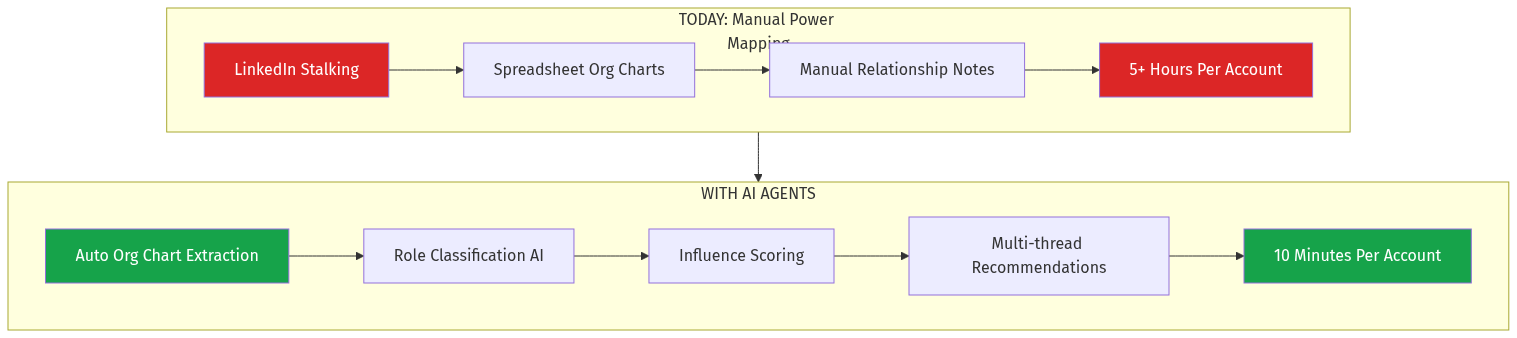
Every complex B2B deal is won or lost based on WHO you engage, not just WHAT you pitch. Yet sales teams still spend 5+ hours per account manually mapping org charts and guessing at buying committees. AI can collapse this to minutes — and the winners will know every stakeholder, their influence, and their sentiment before the first call.

1.

Executive Summary

The average enterprise B2B deal involves 6-10 decision makers. Sales reps spend 20-30% of their time researching accounts, manually piecing together org charts from LinkedIn profiles, email signatures, and meeting attendees. Most still track stakeholder relationships in spreadsheets or scattered CRM notes.

This is a $8.4B market opportunity hiding in plain sight.

While Gong and Clari have conquered conversation intelligence and revenue forecasting, nobody has definitively solved stakeholder intelligence — the science of automatically mapping buying committees, scoring influence, identifying champions and blockers, and recommending multi-threading strategies.

The opportunity: An AI system that ingests every signal about an account's people — LinkedIn, email threads, calendar invites, news mentions, CRM data — and outputs a live, scored power map with actionable recommendations.

Applying Zeroth Principles: The fundamental axiom we're questioning is that stakeholder mapping must be manual because organizational relationships are "too nuanced" for machines. This was true until 2024. With LLMs that understand context, job title semantics, email tone, and meeting dynamics — it's no longer true.
2.

Problem Statement

Who Feels This Pain?

Enterprise Account Executives: Spend 5-10 hours per strategic account researching org structures. Miss key stakeholders. Lose deals to competitors who multi-threaded better. Sales Development Reps: Guess at who the actual decision maker is. Waste outreach on people without budget authority. Get blocked by gatekeepers they didn't anticipate. Sales Managers: Can't see if their reps are single-threaded (dangerous) or properly multi-threaded across buying committees. Discover champion departures too late. RevOps Leaders: Lack systematic data on stakeholder engagement. Can't forecast deal risk based on buying committee coverage.

The Core Problems

  • Manual Org Chart Assembly: Sales reps click through dozens of LinkedIn profiles, trying to infer reporting structures from job titles.
  • Invisible Buying Committees: In complex B2B sales, there are typically 5-8 people involved in decisions. Reps often engage only 1-2.
  • Single-Threading Risk: 60% of enterprise deals are lost because the internal champion leaves or loses influence — and the rep had no other relationships.
  • No Relationship Scoring: Who is actually influential? Who is likely to be a blocker? Sales reps guess based on job titles, missing the political reality.
  • Static Intelligence: Org charts are living documents. Promotions, departures, and reorgs happen constantly. Point-in-time research becomes stale.
  • Current vs AI-Powered Stakeholder Mapping
    Current vs AI-Powered Stakeholder Mapping

    3.

    Current Solutions

    CompanyWhat They DoWhy They're Not Solving It
    LinkedIn Sales NavigatorContact search, InMails, account alertsNo org chart inference, no influence scoring, no buying committee mapping
    ZoomInfoContact database, intent data, org chartsOrg charts are often stale; no AI-driven influence or sentiment analysis
    GongConversation intelligence, call recordingAnalyzes WHAT was said, not WHO matters in the account structure
    ClariRevenue forecasting, pipeline analyticsForecasts deals, doesn't map stakeholders
    DealTreeLinkedIn power mapping Chrome extensionManual trigger, limited to LinkedIn, $99/year for basic features
    People.aiActivity capture from email/calendarCaptures engagement, doesn't infer org structures or recommend multi-threading
    6senseIntent data, ABM orchestrationAccount-level signals, not people-level intelligence
    Applying Incentive Mapping: The incumbents (LinkedIn, ZoomInfo) profit from selling MORE contact data, not BETTER insights about fewer contacts. Gong and Clari make money from seat licenses for existing workflows — they're incentivized to augment, not transform, how reps research accounts. The status quo persists because stakeholder mapping "works well enough" with manual effort, and tooling has been insufficient to automate it.
    4.

    Market Opportunity

    • Total Addressable Market: $8.4B (Sales Intelligence + Revenue Intelligence overlap)
    • Serviceable Addressable Market: $2.1B (Stakeholder intelligence specifically)
    • Growth: 14.2% CAGR through 2030
    • Why Now:

    Three Converging Forces

  • LLM Capability Breakthrough: GPT-4 and successors can parse job titles, infer reporting relationships from email signatures, detect sentiment in meeting transcripts, and reason about organizational dynamics. This wasn't possible 3 years ago.
  • Remote/Hybrid Work = More Digital Signals: When everyone worked in offices, relationships were built in hallways. Now, every interaction leaves digital traces (calendar, email, Slack, Zoom). More signals = better AI inference.
  • Buying Committee Complexity Increasing: Gartner reports the average B2B buying group has grown from 5.4 people (2020) to 8.2 people (2025). Manual mapping is breaking under this complexity.
  • Applying Distant Domain Import: In intelligence/espionage, "link analysis" and "social network mapping" have been automated for decades. The CIA doesn't manually draw org charts of terrorist cells — they use software that infers relationships from communication patterns, financial flows, and observed meetings. Enterprise sales is the same problem with lower stakes but similar complexity. The techniques exist; they just haven't been productized for sales.
    5.

    Gaps in the Market

    Gap 1: No Unified Stakeholder Graph

    Current tools are siloed. LinkedIn has titles, ZoomInfo has phone numbers, Gong has conversation snippets, CRM has deal notes. Nobody synthesizes this into a unified view of "here are the 8 people who matter, ranked by influence, with engagement scores."

    Gap 2: Influence ≠ Title

    A VP of Engineering with a negative sentiment is a blocker, not an ally. A "Senior Analyst" who's been at the company 15 years and attends every executive meeting is more influential than their title suggests. Current tools rank by title; AI can rank by actual influence.

    Gap 3: No Proactive Multi-Threading Recommendations

    Tools tell you WHO is in the account. They don't tell you: "You've only engaged the IT Manager. The CFO makes budget decisions and you have zero relationship there. Here's how to get warm-intro'd."

    Gap 4: Champion Risk Detection

    When your champion gets promoted, leaves the company, or loses political capital — your deal is at risk. Nobody alerts sales reps to these changes in real-time with actionable next steps.

    Gap 5: Meeting Intelligence → Stakeholder Intelligence

    Gong records calls but doesn't update org charts based on what's said. When a prospect says "I'll need to get Maria from Procurement involved" — that should automatically add Maria to the stakeholder map with inferred role and priority.

    Applying Anomaly Hunting: Here's what's strange — LinkedIn has 900M+ professional profiles with organizational data, yet sells Sales Navigator as a search tool rather than an intelligence platform. Why? Because LinkedIn's business model is engagement (time on platform) and advertising, not sales enablement. The anomaly is that the company with the most data is the least motivated to solve this problem deeply.
    6.

    AI Disruption Angle

    The AI-Native Approach

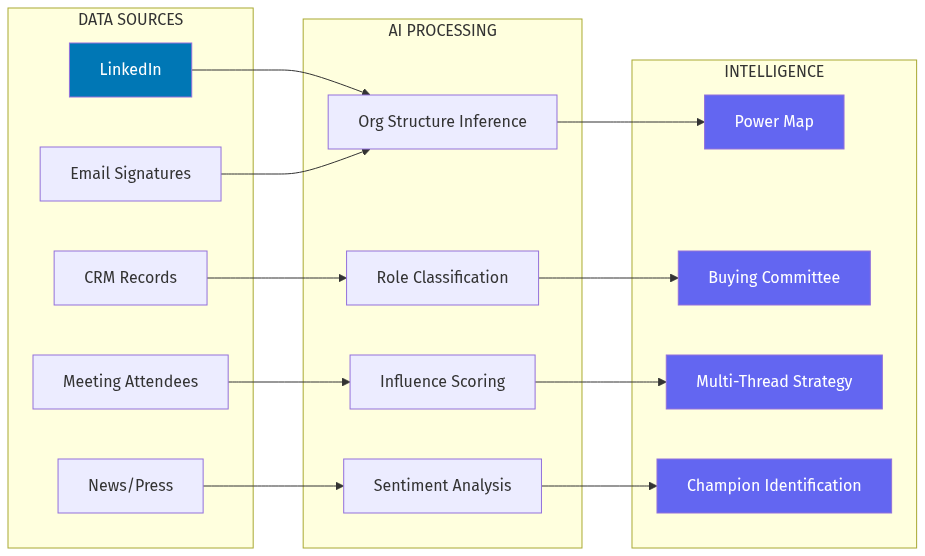
    Data Fusion Layer: Ingest signals from every source — LinkedIn (public profiles), email (signatures, cc patterns), calendar (meeting attendees), CRM (notes, activities), Slack (mentions), news (promotions, departures). Organizational Inference Engine: Use LLMs to parse job titles, infer reporting relationships, detect functional areas. "Director of Strategic Sourcing" reports to "VP of Procurement" with 95% confidence. Influence Scoring Model:
    • Network centrality: Who is cc'd on important emails? Who attends cross-functional meetings?
    • Tenure and trajectory: Recently promoted = rising influence. 20-year veteran = institutional knowledge.
    • External signals: Conference speakers, LinkedIn thought leadership, industry board seats.
    Sentiment Classification: Analyze email tone, meeting transcript sentiment, LinkedIn comments to classify: Champion (positive, advocating) / Neutral / Skeptical / Blocker (negative, resistant). Real-Time Graph Updates: The stakeholder map is alive. New meeting attendee? Added automatically. Promotion announcement on LinkedIn? Influence score updated. Champion goes quiet for 3 weeks? Risk alert triggered.
    AI Stakeholder Intelligence Architecture
    AI Stakeholder Intelligence Architecture

    AI Agents in Play

    The endgame: An AI agent that autonomously researches new accounts, builds initial stakeholder maps, monitors for changes, drafts multi-threading strategies, and even suggests outreach sequences for engaging key stakeholders — all before the sales rep opens their CRM.


    7.

    Product Concept

    Core Features

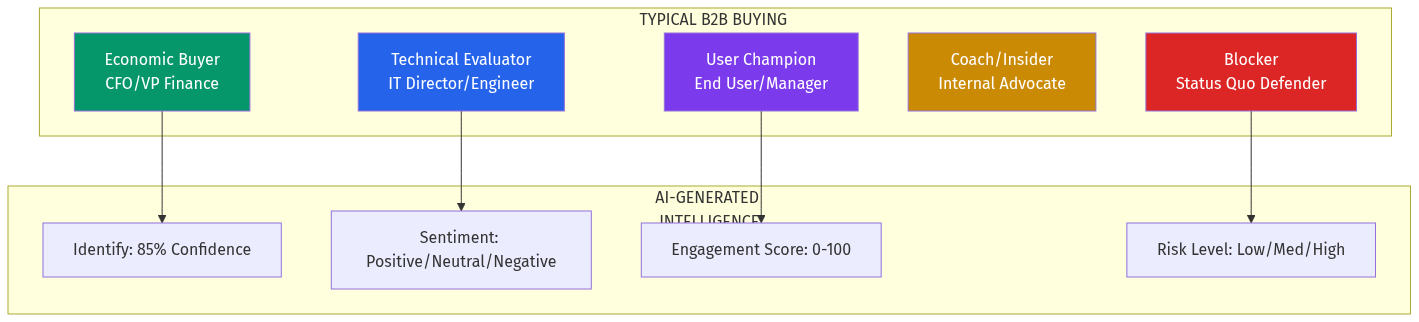
    1. Auto-Generated Power Maps Input a company domain, get a visual org chart with inferred reporting relationships, populated from LinkedIn and enrichment providers. Updated continuously. 2. Buying Committee Detection AI identifies the likely buying committee for your solution category based on past wins, industry patterns, and company structure. "For enterprise software deals at Series C fintech, you typically need: CFO, VP Eng, IT Director, Procurement, Legal." 3. Influence & Sentiment Scoring Every stakeholder gets an Influence Score (0-100) and Sentiment Classification (Champion / Neutral / Skeptic / Blocker). Updated based on engagement signals. 4. Multi-Threading Recommendations "You're single-threaded through Sarah (IT Manager, Influence: 42). Recommendation: Get introduced to James (VP Engineering, Influence: 87) via LinkedIn mutual connection [Name]." 5. Champion Risk Alerts "Your champion (Alex, Director of Ops) has been quiet for 18 days. His LinkedIn shows a new role at another company 3 days ago. Risk Level: Critical. Action: Identify new internal coach." 6. Meeting Intelligence Integration Connect to Gong/Chorus/Fireflies. When prospects mention new names in calls, automatically research and add to stakeholder map. "Maria from Procurement" → auto-enriched with title, LinkedIn, influence estimate. 7. Deal Scorecards "Deal Health: 68%. Issues: Economic buyer not engaged, single-threaded, competitor mentioned in last 2 calls."
    Buying Committee Structure
    Buying Committee Structure

    8.

    Development Plan

    PhaseTimelineDeliverables
    MVP8 weeksChrome extension for LinkedIn power mapping + basic org chart inference + CRM sync (Salesforce/HubSpot)
    V112 weeksEmail/calendar integration + influence scoring algorithm + buying committee detection
    V216 weeksGong/Chorus integration + real-time alerts + multi-threading recommendations
    V324 weeksAI agent for autonomous account research + Slack bot + deal scorecards

    Technical Stack

    • Data ingestion: LinkedIn API, email OAuth, calendar APIs, Clearbit/Apollo enrichment
    • Graph database: Neo4j for relationship mapping
    • ML/AI: OpenAI GPT-4o for NLP, fine-tuned models for title parsing and influence scoring
    • Frontend: Chrome extension + web dashboard
    • Integrations: Salesforce, HubSpot, Gong, Slack

    9.

    Go-To-Market Strategy

    Phase 1: Bottom-Up PLG (Months 1-6)

  • Free Chrome extension for LinkedIn org chart visualization (viral loop)
  • Freemium: 5 accounts free, paid for unlimited
  • Target: Individual AEs at tech companies (early adopters, LinkedIn-heavy)
  • Phase 2: Team Expansion (Months 6-12)

  • Team pricing: $79/user/month
  • CRM integration = stickiness
  • Sales manager dashboard = expansion lever ("See your team's multi-threading scores")
  • Phase 3: Enterprise (Months 12-24)

  • SSO, advanced permissions, custom integrations
  • RevOps buyer: "We need systematic stakeholder coverage data"
  • Partner with Gong/Clari for embedded offering
  • Distribution Moat

    • LinkedIn extension virality: Users share org charts with teammates → viral coefficient
    • CRM integration lock-in: Once stakeholder data flows to Salesforce, switching costs spike
    • Network effects: More customers in same industry → better buying committee templates

    10.

    Revenue Model

    • Individual: $49/month (5 accounts, basic features)
    • Professional: $99/month (unlimited accounts, email integration, influence scoring)
    • Team: $79/user/month (min 5 users, CRM integration, manager dashboard)
    • Enterprise: Custom ($200-500/user/month, SSO, API access, dedicated success)

    Unit Economics Target

    • CAC: $400 (PLG-driven, low-touch onboarding)
    • LTV: $4,800 (3-year retention at $99/month)
    • LTV:CAC: 12:1

    Expansion Revenue

    • Users → Teams → Enterprise upsell
    • Feature-gated expansion (alerts, AI recommendations, API)
    • Usage-based pricing for high-volume enrichment

    11.

    Data Moat Potential

    Proprietary Data Assets

    1. Buying Committee Patterns Every closed-won deal reveals which roles were involved. Over thousands of deals, you learn: "When selling security software to mid-market manufacturing, you need CISO, IT Director, CFO, and usually a Plant Manager." 2. Influence Calibration Data When reps mark someone as "champion" or "blocker" and deals close/lose, you train models on what signals predict influence vs. job title. 3. Org Structure Inference Training Millions of org charts built → better ML models for inferring structures from incomplete data. 4. Champion Departure Patterns Track which champion movements predict deal failure → better risk scoring. Applying Second-Order Thinking: If this product succeeds, what happens next?
    • Competitors (LinkedIn, ZoomInfo) will try to copy → need technical moat (proprietary models, data)
    • Incumbents may acqui-hire or acquire → exit opportunity
    • Sales reps become dependent → switching costs and entrenchment
    • AI recommendations create "sameness" problem → eventually, everyone multi-threads identically
    • Buyer fatigue from over-personalization → potential backlash if outreach feels "too targeted"

    12.

    Why This Fits AIM Ecosystem

    Strategic Alignment

    B2B Marketplace DNA: AIM.in is building India's B2B discovery layer. Stakeholder intelligence is the missing piece — knowing WHO to contact at discovered suppliers/buyers. AI-Native Philosophy: This isn't a database with AI bolted on. It's AI-first: inference, scoring, recommendations powered by language models and graph analysis. Workflow Integration: Integrates with the same CRMs and communication tools that AIM marketplace participants use. Data flows both ways.

    Implementation Path

  • Domain: dealtree.aim.in or stakeholder.aim.in
  • Initial vertical: Technology vendors selling to mid-market companies
  • Data source: Leverage AIM's existing B2B company data for enrichment
  • Cross-sell: AIM marketplace users get stakeholder intelligence as premium feature
  • Synergies with Other AIM Verticals

    • thefoundry.in: Industrial procurement → map stakeholder committees at manufacturing plants
    • niyukti.in: Recruitment → identify hiring managers and HR committees
    • cohort.in: B2B learning → map L&D decision makers at target companies

    ## Verdict

    Opportunity Score: 8.5/10

    Why This Scores High

    Clear, painful problem with quantifiable cost (5-10 hours/account × hundreds of accounts)

    Technical timing is right — LLMs now capable of the inference required

    Incumbents are distracted — Gong focused on AI call summaries, LinkedIn on engagement, ZoomInfo on data volume

    PLG distribution possible — Chrome extension can go viral among sales communities

    Multiple revenue expansion paths — Individual → Team → Enterprise upsell

    Strong data moat potential — Buying committee patterns are defensible IP

    Risks

    ⚠️ LinkedIn rate limiting — Heavy scraping will get blocked; need creative data sourcing

    ⚠️ Privacy concerns — Mapping relationships without consent may face regulatory pushback

    ⚠️ Enterprise sales cycle — Selling to sales teams means long POCs and procurement hurdles

    ⚠️ Incumbent response — LinkedIn could launch native power mapping; Gong could add stakeholder features

    Applying Pre-Mortem (Falsification): Assume 5 well-funded startups failed here. Why?
  • Over-reliance on LinkedIn data → rate limits killed growth
  • Built for enterprise first → ran out of runway before landing large contracts
  • Influence scoring was inaccurate → users didn't trust recommendations
  • Integration complexity with CRMs → engineering resources drained
  • Gong acquired them for cheap → couldn't compete independently
  • Applying Steelmanning (Why Incumbents Might Win): LinkedIn has the data. ZoomInfo has the sales team. Gong has the conversation context. If any of them decides stakeholder intelligence is strategic, they can build/buy faster than a startup can grow. The best counter-argument: These companies are focused on their core metrics (LinkedIn = engagement, ZoomInfo = data volume, Gong = call coverage). Stakeholder mapping is a feature to them, not a product. That gap is the opportunity — but it's a race against time.

    Recommendation

    Build this. Start with a Chrome extension that auto-generates LinkedIn org charts — it's the fastest path to viral distribution and validated learning. The PLG motion for individual AEs is proven (DealTree at $99/year proves willingness to pay). The question is execution speed before LinkedIn or Gong builds it themselves.

    ## Sources