ResearchTuesday, February 17, 2026

AI Calibration Intelligence: The $8B Precision Measurement Marketplace Nobody's Disrupted

Every measurement device in aerospace, pharma, manufacturing, and food processing requires periodic calibration to maintain compliance. Yet this $8 billion market still runs on phone calls, paper certificates, and Excel spreadsheets. The opportunity isn't just digitization—it's building the intelligence layer that matches equipment to optimal labs, predicts calibration needs, and automates the entire compliance chain.

1.

Executive Summary

The calibration services market—projected to reach $8.1 billion by 2030—represents a peculiar blind spot in B2B digitization. While procurement, logistics, and manufacturing have been transformed by software, the precision measurement industry remains stubbornly analog.

Companies managing thousands of instruments still track calibration due dates in spreadsheets. Finding an ISO 17025-accredited lab for a specific equipment type requires phone calls and Google searches. Certificates arrive as PDFs via email, manually filed into folders. Auditors still request paper trails.

This isn't a technology problem. It's an information architecture problem. The market is fragmented across 10,000+ calibration labs worldwide, each with different capabilities, accreditations, turnaround times, and pricing structures. No single platform has aggregated this into a searchable, bookable, trackable marketplace.

The AI opportunity: Build the intelligence layer that sits between equipment owners and calibration providers—matching, scheduling, optimizing, and maintaining compliance automatically.


2.

Problem Statement

Who Experiences This Pain?

Quality Managers at Manufacturing Plants
  • Track 500-5,000 instruments per facility
  • Each instrument has different calibration intervals (30 days to 2 years)
  • Different instruments require different lab capabilities
  • One expired calibration certificate can halt FDA or ISO audits
Procurement Teams
  • No price transparency—quotes require individual RFQs
  • Vendor qualification takes weeks (checking ISO 17025 accreditation, scope of services)
  • No way to compare turnaround times across providers
  • Relationships locked to historical vendors, even if suboptimal
Calibration Lab Owners
  • Underutilized capacity with no marketplace to fill gaps
  • Customer acquisition via trade shows, cold calls, word-of-mouth
  • No dynamic pricing based on demand
  • Mobile calibration teams drive routes based on gut feel, not optimization

The Workflow Today

Current vs Future Calibration Workflow

A typical calibration event in 2026:

  • Quality manager notices instrument approaching due date (often late)
  • Searches for labs that can calibrate that specific equipment type
  • Makes 3-5 phone calls or sends emails requesting quotes
  • Waits 2-7 days for responses
  • Manually compares pricing, turnaround, and accreditation scope
  • Ships equipment (or schedules on-site visit)
  • Waits 1-4 weeks for service
  • Receives paper or PDF certificate
  • Manually enters data into quality management system
  • Files certificate for audit trail
  • Average time per calibration event: 8-15 hours of labor Average cost of mismanaged calibration: $50,000+ per audit finding
    3.

    Current Solutions

    Major Players

    CompanyWhat They DoWhy They're Not Solving It
    TrescalWorld's largest calibration service provider (180+ labs globally)They're a provider, not a marketplace. No price transparency. Single-vendor lock-in.
    Fluke CalibrationEquipment + software for in-house calibrationFocused on equipment sales. Software is single-tenant, not networked.
    BeamexCalibration management softwareDocument management only. No marketplace, no provider matching.
    Blue Mountain RAMAsset management for calibrationTracks schedules but doesn't connect to providers. Manual RFQ process.
    Calibration ControlQMS-integrated calibration trackingInternal tracking only. No external provider network.
    IndySoftCalibration lab management softwareBuilt for labs, not buyers. No marketplace component.

    Applying Chesterton's Fence

    Before proposing disruption, we must understand WHY the market remains fragmented:
  • Accreditation complexity: Labs are accredited for specific measurement ranges and uncertainties. A lab that calibrates pressure gauges 0-1000 PSI may not be accredited for 0-10,000 PSI. This granularity makes matching non-trivial.
  • Traceability requirements: Calibration must trace back to national metrology institutes (NIST in US, NPL in India). Each step in the chain matters for compliance.
  • Equipment diversity: A single manufacturing plant may have 50+ different instrument categories. No single lab serves all needs.
  • Regulatory fragmentation: FDA, ISO 9001, ISO 17025, AS9100, IATF 16949 each have different requirements. Compliance isn't one-size-fits-all.
  • Trust and relationships: When your $50,000 pressure standard needs calibration, you don't want the cheapest option—you want the lab you trust.

  • 4.

    Market Opportunity

    Market Size

    • Global calibration services market: $5.7B (2023) → $8.1B (2030)
    • CAGR: 5.3%
    • North America: ~35% of market
    • Asia-Pacific: Fastest growing (7.2% CAGR)

    Segment Breakdown

    SegmentMarket ShareGrowth Driver
    Electrical calibration32%IoT sensors, smart manufacturing
    Mechanical/Dimensional28%Precision manufacturing, 3D printing QC
    Temperature18%Pharma cold chain, food safety
    Pressure12%Oil & gas, aerospace
    Flow/Humidity/Other10%Specialty applications

    Why Now?

    Zeroth Principles Analysis: What fundamental axiom is changing?

    The axiom "calibration is local and relationship-based" is being disrupted by three forces:

  • Remote work changed expectations: Quality managers now expect Instacart-level convenience for everything.
  • Digital certificate acceptance: More regulators now accept digitally signed certificates, removing the paper chain requirement.
  • Consolidation in manufacturing: Fewer, larger plants means centralized procurement teams seeking efficiency over relationships.
  • AI agent readiness: For the first time, AI can understand equipment specifications, match against lab capabilities, and optimize scheduling without human intervention.

  • 5.

    Gaps in the Market

    Applying Anomaly Hunting

    What's surprising about this market that doesn't fit the standard narrative? Gap 1: No price discovery Unlike almost every other B2B service, calibration pricing is opaque. You can't Google "calibration cost for Fluke 87V multimeter." This information asymmetry benefits incumbents. Gap 2: No aggregated lab directory There's no TripAdvisor for calibration labs. NABL (India) and A2LA (USA) publish accredited lab lists, but they're not searchable by capability or location. Gap 3: No scheduling optimization Mobile calibration services drive routes without optimization. A lab might send a truck to Factory A on Monday and Factory B (5 km away) on Friday—when both could be served in one trip. Gap 4: No predictive maintenance integration Calibration happens on fixed schedules (e.g., every 12 months). But instrument drift is measurable. AI could predict when calibration is actually needed, reducing unnecessary service while catching early failures. Gap 5: Certificate verification is manual When a supplier sends a calibration certificate, buyers have no easy way to verify it's legitimate. Fraudulent certificates exist in the market.
    6.

    AI Disruption Angle

    Distant Domain Import

    What fields have solved structurally similar problems? From Travel (Kayak/Booking.com):
    • Aggregated fragmented supply (hotels/labs)
    • Standardized inventory display (room types/capabilities)
    • Real-time availability and pricing
    • Reviews and ratings
    From Healthcare (Zocdoc):
    • Matching patients to specialists based on specific needs
    • Insurance (accreditation) filtering
    • Scheduling with availability constraints
    From Logistics (Uber Freight):
    • Dynamic pricing based on supply/demand
    • Route optimization for field service
    • Real-time tracking

    AI Agent Capabilities

    AI Calibration Agent Workflow
    AI Calibration Agent Workflow
    1. Intelligent Matching
    • Ingest equipment specification → Extract calibration parameters
    • Match against lab accreditation scopes (not just "we do pressure" but "we do 0-10,000 PSI ±0.02%")
    • Rank by: accuracy capability, turnaround, price, proximity, reviews
    2. Predictive Due Dates
    • Analyze historical calibration data
    • Detect instruments drifting out of tolerance faster than expected
    • Recommend early calibration or replacement
    3. Automated RFQ
    • Generate standardized quote requests
    • Aggregate responses
    • Negotiate based on volume commitments
    4. Route Optimization
    • Cluster nearby calibration needs
    • Negotiate bulk discounts for mobile service runs
    • Minimize equipment downtime
    5. Digital Certificate Vault
    • Blockchain-anchored certificate verification
    • Auto-extract calibration data into QMS
    • Audit-ready compliance reports on demand

    7.

    Product Concept

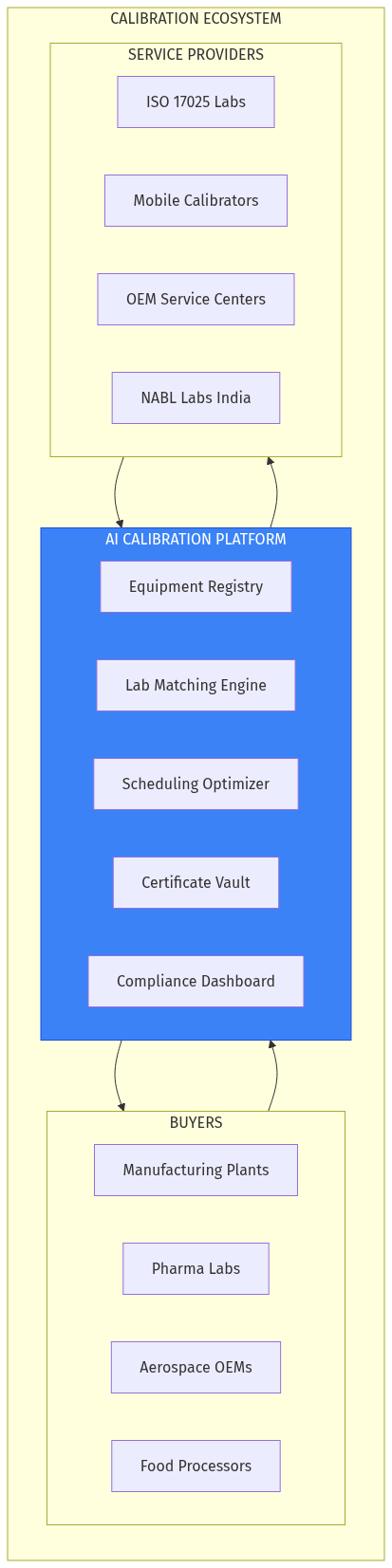
    Core Platform Architecture

    Calibration Marketplace Structure
    Calibration Marketplace Structure

    Key Features

    For Equipment Owners:
    • Equipment registry with automatic due date tracking
    • One-click "Get Quotes" for any equipment type
    • Price comparison dashboard (finally, transparency!)
    • Digital certificate vault with audit export
    • Compliance dashboard by regulation (FDA, ISO, AS9100)
    • WhatsApp/email alerts for upcoming due dates
    For Calibration Labs:
    • Profile management with detailed capability listing
    • Dynamic pricing based on utilization
    • Automated quote response
    • Route optimization for mobile services
    • Demand forecasting by geography and equipment type
    AI Agent Layer:
    • "Calibrate my equipment" natural language interface
    • Automatic vendor qualification checking
    • Smart scheduling recommendations
    • Certificate authenticity verification

    8.

    Development Plan

    PhaseTimelineDeliverables
    MVP8 weeksEquipment registry, lab directory (India NABL + USA A2LA), basic quote request flow
    V116 weeksAI matching engine, digital certificate upload, compliance dashboard
    V224 weeksMobile calibration routing, predictive due dates, WhatsApp bot
    V336 weeksCertificate blockchain anchoring, API for QMS integration, dynamic pricing

    Technical Stack

    • Frontend: Next.js with equipment-centric UI
    • Backend: Node.js + PostgreSQL for equipment/lab data
    • AI: Claude for equipment spec extraction, matching recommendations
    • Search: Meilisearch for lab capability filtering
    • Mobile: React Native for field technicians
    • Compliance: SOC 2 Type II, 21 CFR Part 11 (FDA)

    9.

    Go-To-Market Strategy

    Phase 1: Single Vertical (Pharma)

    Why Pharma First:
    • Highest compliance pressure (FDA 483 citations are public record)
    • Concentrated buyers (top 50 pharma companies = 40% of market)
    • Established calibration budgets
    • Willing to pay premium for compliance assurance
    Acquisition:
  • Partner with 3 NABL labs in Hyderabad (India's pharma hub)
  • Offer free equipment registry to pharma QA managers
  • Generate leads when equipment approaches due dates
  • Referral incentive: ₹5,000 per new facility onboarded
  • Phase 2: Expand to Manufacturing

    • Automotive (IATF 16949 compliance)
    • Aerospace (AS9100 compliance)
    • Food processing (FSSC 22000)

    Phase 3: WhatsApp-Native Experience (India)

    "Send photo of your equipment, we'll find a calibration lab"

    Indian SME manufacturers communicate via WhatsApp. Meet them where they are.


    10.

    Revenue Model

    Commission Model (Primary)

    • 8-12% commission on calibration services booked through platform
    • Market average calibration cost: $150-500 per instrument
    • Target: 1,000 bookings/month = $15,000-50,000 MRR

    Subscription Model (Enterprise)

    • ₹50,000/month for unlimited equipment registry + compliance dashboard
    • Target: 20 enterprise accounts = ₹10 lakh MRR

    Premium Services

    • Certificate verification API: ₹5 per verification (for procurement teams validating supplier certs)
    • Expedited service network: Premium for guaranteed 48-hour turnaround
    • Compliance audit prep: ₹25,000 per audit readiness report

    Long-term: Embedded Financing

    • Finance large calibration programs (100+ instruments)
    • Spread annual calibration costs over 12 months
    • Interest revenue + increased platform stickiness

    11.

    Data Moat Potential

    First-Mover Advantages

  • Equipment database: Every registered instrument is a recurring revenue asset. Competitors would need years to build equivalent asset registries.
  • Lab performance data: Actual turnaround times, customer ratings, and quality scores become proprietary intelligence over time.
  • Pricing intelligence: First platform to have comprehensive pricing data across equipment types and regions.
  • Calibration history: Multi-year instrument calibration records enable predictive maintenance algorithms that improve with data volume.
  • Compliance knowledge graph: Which instruments are required for which certifications, in which jurisdictions—complex knowledge that compounds.
  • Network Effects

    • More labs → more equipment choices → more buyers → more labs (classic marketplace flywheel)
    • More calibration data → better predictions → more value to buyers → more data

    12.

    Why This Fits AIM Ecosystem

    AIM.in Mission: Help B2B buyers DECIDE, not just discover.

    Calibration is a perfect vertical:

    • Highly fragmented supply: 10,000+ labs globally, no aggregation
    • Complex decision criteria: Not just price—accreditation, turnaround, accuracy
    • Repeat transactions: Same instruments need calibration annually
    • Compliance-driven: Buyers are motivated by regulatory requirements
    • India opportunity: 2,000+ NABL labs, massive manufacturing base, low digitization
    Integration with AIM:
    • thefoundry.in → Cross-sell calibration to industrial equipment buyers
    • masale.in → Food processing equipment calibration (temperature, scales)
    • niyukti.in → Calibration technician staffing
    ---

    ## Verdict

    Falsification (Pre-Mortem)

    Assume this fails. Why?
  • Labs refuse to list prices publicly: Possible, but unlikely—first movers get most bookings, creating incentive to participate.
  • Large labs buy the platform: Trescal or Intertek could acquire and kill. Mitigation: build open network, not walled garden.
  • Compliance software vendors add marketplace: SAP, Oracle could add. But they're slow and expensive—SME opportunity remains.
  • AI matching isn't good enough: Calibration specs are complex. Requires significant investment in taxonomy. Risk: mitigated by starting with narrow verticals.
  • Steelmanning: Why Incumbents Might Win

    Best argument against this opportunity:
    • Trust is earned: A manufacturer won't trust a new platform with their $100,000 pressure standard. Relationships matter in precision measurement.
    • Accreditation is complex: Regulators audit calibration chains. A platform that gets it wrong causes compliance disasters.
    • Low margins: 8-12% commission on a $200 calibration is $20. Scale is essential; unit economics are thin.

    Counter-Argument

    The counter is that trust can be built through transparency. When a platform shows verified accreditation scopes, actual customer reviews, and guaranteed compliance—it becomes MORE trustworthy than an opaque phone-call-based relationship.

    Opportunity Score: 7.5/10

    Strong thesis:
    • Large market ($8B+) with low digitization
    • Clear pain points (time, price opacity, compliance risk)
    • AI-native workflow improvement is substantial
    • Recurring revenue model (annual calibrations)
    • India timing is right (NABL expansion, manufacturing growth)
    Key risks:
    • Building lab supply network is chicken-and-egg
    • Calibration is low-frequency per instrument (hard to build habit)
    • Regulatory complexity requires deep domain expertise
    Recommendation: Build focused MVP for pharma calibration in India. Prove unit economics with 50 enterprise customers before expanding. Partner with NABL labs for supply-side validation.

    ## Sources