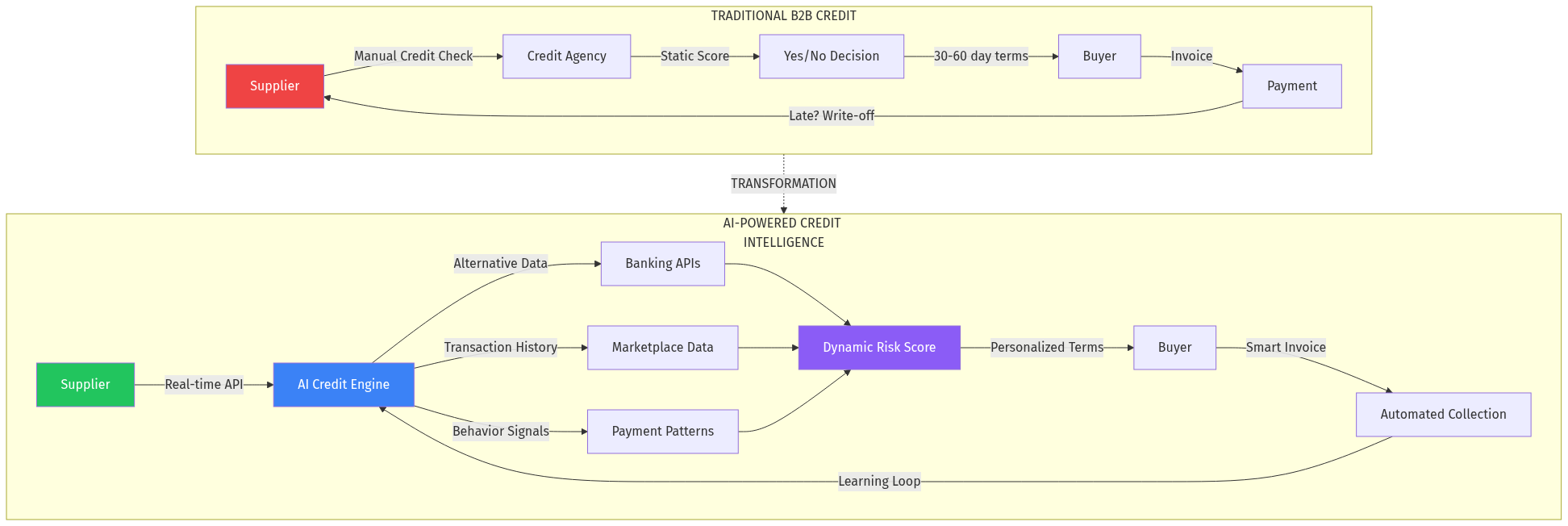
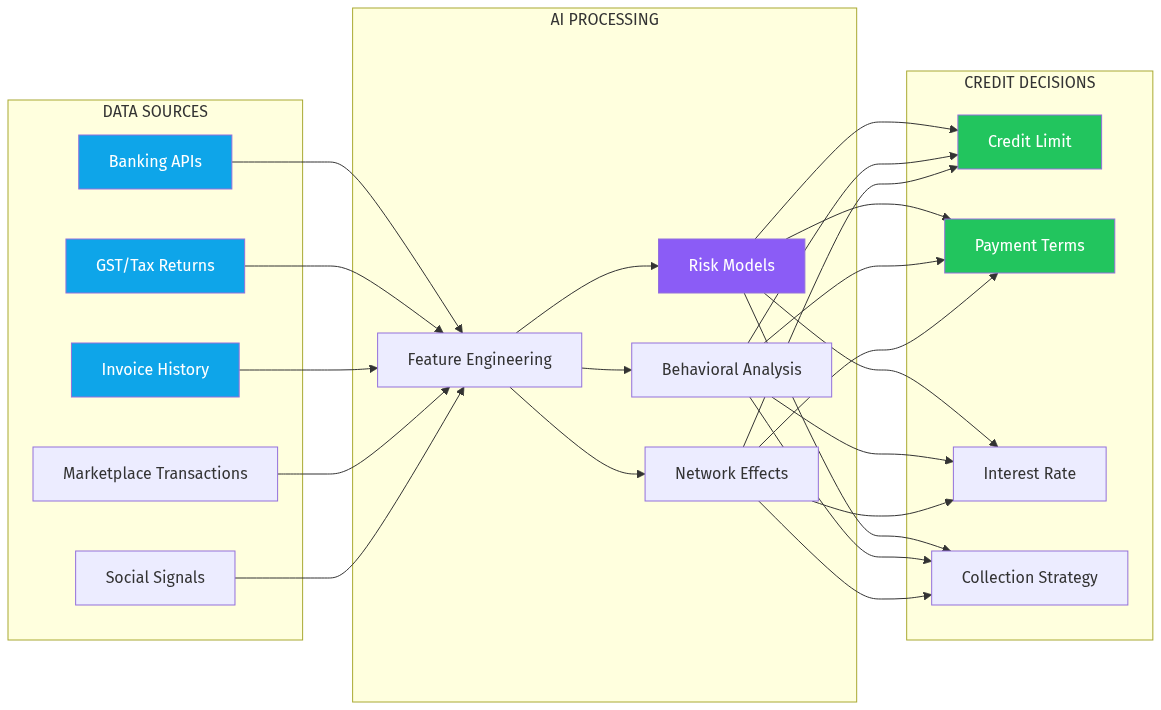
Strategic Alignment
AIM.in's mission is to help B2B buyers DECIDE. Credit is the ultimate decision enabler—without financing, many SMB purchases don't happen.
Integration points:
- masale.in: Ingredient buyers need credit to stock inventory
- thefoundry.in: Industrial procurement often requires payment terms
- forx.in: Software purchases increasingly offered with financing
- rccspunpipes.com: Construction materials are high-ticket, credit-dependent
Cross-Vertical Credit Network
Every AIM vertical generates credit data:
- Payment behavior on masale.in informs credit decisions on thefoundry.in
- A buyer with good history across verticals gets premium terms everywhere
This creates a
credit utility layer that sits beneath all AIM marketplaces—the "Visa for B2B."
Revenue Amplification
- B2B marketplaces with embedded credit see 30-50% higher GMV
- Suppliers pay for credit certainty; AIM takes a cut
- Buyers prefer platforms where they can get terms; stickiness increases
Build vs. Partner Decision
Build: Core credit intelligence (competitive advantage, data moat)
Partner: Credit insurance (Coface, Euler Hermes for catastrophic coverage)
Buy: Banking integrations (Account Aggregator TSPs)
## Verdict
Opportunity Score: 9/10
Why High Conviction
Massive market: $40 trillion in trade credit globally
Clear pain: 3-5% bad debt, thin-file SMBs, static scoring
Timing: Open banking + AI + embedded finance convergence
Defensible: Payment outcome data creates unfair advantage over time
AIM synergy: Credit layer amplifies every vertical marketplace
Risk Assessment (Pre-Mortem)
Assume this fails in 3 years. Why?
Regulatory risk: Government mandates specific credit infrastructure (e.g., India creating public trade credit registry)
-
Mitigation: Build on top of public infrastructure, don't compete with it
Data access blocked: Banks/aggregators restrict API access
-
Mitigation: Multi-source strategy; never depend on single data provider
Incumbents respond: D&B launches real-time product
-
Mitigation: Move fast; outcome data moat takes years to build
Credit losses: Model fails, platform takes credit risk
-
Mitigation: Don't take credit risk—only provide decisioning; let suppliers hold risk
Sales cycle too long: Enterprise suppliers slow to adopt
-
Mitigation: Start with SMB suppliers on marketplaces; enterprise follows
Steelmanning: Why Incumbents Might Win
D&B's defense:
- Brand trust with CFOs
- Existing enterprise contracts
- Regulatory relationships
- Can acquire real-time data startups
Counter: D&B's business model is selling reports. Real-time credit threatens their $1B+ report revenue. Innovator's dilemma applies.
Banks' defense:
- Already have the data (account holders)
- Can offer credit + trade finance bundled
- Regulatory moat
Counter: Banks don't serve SMBs profitably today. API-first credit intelligence can partner with banks, not compete.
Recommendation
Build this as AIM.in's credit infrastructure layer.
Start with a vertical pilot (industrial supplies), prove the model, then integrate across all AIM marketplaces. The compounding network effects of cross-vertical credit data create a moat that grows with every transaction.
The winners in B2B credit intelligence will own the most valuable dataset in commerce: who pays and who doesn't.
## Sources