ResearchMonday, February 16, 2026

AI-Powered Vendor Onboarding & Qualification Intelligence: The $47B Due Diligence Revolution

Every enterprise spends 4-8 weeks onboarding new suppliers. Most of that time is spent chasing documents, manually verifying claims, and running the same compliance checks that could be automated in minutes. AI agents are about to collapse this timeline to days—and fundamentally reshape supplier risk management.

1.

Executive Summary

Vendor onboarding and qualification is one of the last major enterprise workflows that remains stubbornly manual. Large enterprises add 500-2,000 new suppliers annually, each requiring document collection, verification, compliance checks, financial due diligence, and approval workflows. The average time-to-onboard is 4-8 weeks. The cost per supplier: $500-$3,000.

AI agents can reduce this to 2-5 days at 80% lower cost—while providing continuous risk monitoring that human reviewers cannot match.

This opportunity sits at the intersection of three converging trends:

  • Supply chain fragmentation — Companies now manage 2-5x more suppliers than a decade ago
  • Regulatory complexity — ESG, sanctions, anti-bribery, and sustainability reporting requirements have exploded
  • AI capability maturity — Document understanding, entity verification, and risk scoring are now production-ready
  • The market: $47B in procurement software, with vendor management and risk intelligence the fastest-growing segments.


    Transformation Flow
    Transformation Flow

    2.

    Problem Statement

    Who Experiences This Pain?

    Procurement Teams at mid-to-large enterprises (500+ employees) who must:
    • Collect and verify supplier documentation (certificates, financials, insurance, compliance)
    • Assess financial health and business continuity risk
    • Check sanctions lists, litigation records, and adverse media
    • Validate ESG claims and sustainability certifications
    • Maintain audit trails for regulatory compliance
    Suppliers who must:
    • Complete lengthy onboarding forms (often 50-100 fields)
    • Provide the same documents to every new customer
    • Wait weeks for approval while business opportunities slip away
    • Update their information manually across dozens of customer portals

    The Core Dysfunction

    Applying Zeroth Principles: Before examining solutions, we must question the fundamental axiom: Why does vendor onboarding exist as a separate, manual process at all?

    The answer reveals structural dysfunction:

  • Information asymmetry — Buyers don't trust supplier claims, so they demand documentation
  • Static snapshots — Verification happens at onboarding, then never again (until a crisis)
  • Siloed systems — Every enterprise maintains its own supplier database with no interoperability
  • Human bottlenecks — Compliance and legal teams are gatekeepers, creating 2-4 week delays
  • The real problem isn't document collection—it's trust verification at scale with continuous monitoring. Current processes achieve neither.

    The Numbers

    MetricCurrent StateImpact
    Avg. onboarding time4-8 weeksLost opportunities, supplier frustration
    Cost per supplier$500-$3,000Hidden procurement overhead
    Manual tasks per onboarding40-80Human error, inconsistency
    Post-onboarding monitoring<10% of suppliersRisk blindness
    Supplier data accuracy after 1 year~60%Stale, dangerous decisions
    ---
    3.

    Current Solutions

    Applying Incentive Mapping: Who profits from the status quo? Large procurement suites make money selling complexity. Point solutions fragment the workflow. Consultants profit from implementation projects.
    CompanyWhat They DoWhy They're Not Solving It
    SAP AribaEnd-to-end procurement with supplier managementHeavyweight, expensive ($150K+/year), form-based onboarding still manual
    CoupaSpend management with supplier portalFocus is on spend, not risk; qualification is checkbox-driven
    JaggaerProcurement with supplier networkLegacy architecture, slow to adopt AI, portal fatigue
    TradeshiftB2B network with supplier financingNetwork effects weak outside invoice financing
    RiskMethodsSupply chain risk monitoringMonitoring-only, doesn't handle onboarding workflow
    Craft.coSupplier intelligence platformIntelligence layer only, no workflow automation
    TrustpairVendor fraud preventionNarrow focus on payment fraud, not full qualification

    The Gap

    Every incumbent falls into one of two traps:

  • Workflow without intelligence — They digitize forms but don't automate verification
  • Intelligence without workflow — They provide data but don't integrate into procurement operations
  • None offer an AI agent that can:

    • Converse with suppliers via WhatsApp/email to collect missing information
    • Auto-verify documents against authoritative sources
    • Generate dynamic risk scores that update continuously
    • Replace human reviewers for routine qualifications
    Market Structure
    Market Structure


    4.

    Market Opportunity

    Market Size

    SegmentValueGrowth
    Global Procurement Software$47B by 202811.2% CAGR
    Supplier Risk Management$8.4B by 202714.8% CAGR
    Vendor Management Systems$12.1B by 202612.5% CAGR
    Third-Party Risk Management$15.2B by 202816.3% CAGR

    Why Now?

    Applying Distant Domain Import: What other fields have solved continuous verification at scale?
    • Credit bureaus solved consumer creditworthiness with continuous data feeds
    • Background check companies automated employment verification with API integrations
    • Identity verification (Jumio, Onfido) cracked document + biometric matching
    The vendor onboarding space lacks its "credit bureau moment"—a trusted, continuously-updated verification layer that all parties can rely on. Enabling conditions in 2026:
  • Document AI maturity — GPT-4 Vision and Claude can extract structured data from certificates, financial statements, and compliance documents with >95% accuracy
  • Entity verification APIs — Company registries, sanctions lists, and financial databases are increasingly API-accessible
  • Regulatory pressure — EU Supply Chain Due Diligence Act (2024) and similar regulations mandate proactive supplier screening
  • ESG accountability — Public companies must now verify supplier sustainability claims or face investor scrutiny

  • 5.

    Gaps in the Market

    Applying Anomaly Hunting: What's strange about this market?

    Gap 1: No Supplier-Side Value

    Current systems treat suppliers as data entry clerks. They get nothing in return for completing onboarding—no portable credential, no efficiency in subsequent onboardings. Anomaly: Why hasn't a "supplier passport" emerged that works across buyers?

    Gap 2: Verification Theatre

    Most platforms "verify" by checking that documents exist, not that claims are true. A supplier uploads an ISO certificate; no one confirms it's valid or current. Anomaly: Why do enterprises accept unverified documents as verification?

    Gap 3: Point-in-Time Blindness

    Qualification happens once. If a supplier's financial health deteriorates, gets sued, or loses a critical certification, buyers learn about it from news headlines—not their procurement system. Anomaly: Why is monitoring sold as a separate product from onboarding?

    Gap 4: WhatsApp-Shaped Hole

    In emerging markets, supplier communication happens on WhatsApp. Yet every vendor management system forces suppliers into web portals. The UX mismatch causes 40%+ abandonment rates. Anomaly: Why hasn't anyone built WhatsApp-native supplier onboarding?

    Gap 5: No Risk-Based Tiering

    All suppliers go through the same onboarding process—whether they're a $10M strategic partner or a $500/month office supply vendor. This wastes resources and creates bottlenecks. Anomaly: Why isn't risk-based automation standard?
    6.

    AI Disruption Angle

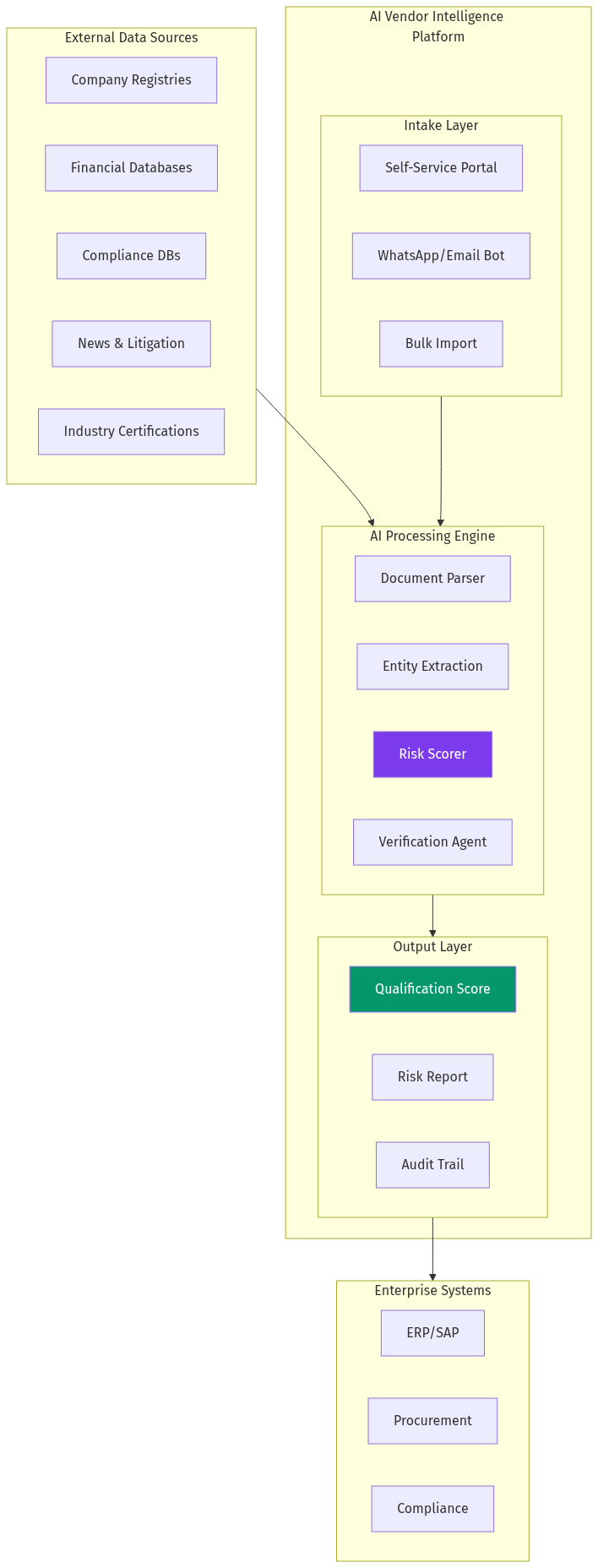
    The Agent Architecture

    An AI vendor qualification agent operates on three layers:

    Layer 1: Intake Agent
    • Multi-channel communication (WhatsApp, email, web portal)
    • Conversational document collection ("Can you send your ISO 9001 certificate?")
    • Smart form pre-fill from public data sources
    • Language-agnostic interaction
    Layer 2: Verification Agent
    • Document parsing and entity extraction
    • Cross-reference against authoritative sources (company registries, certification bodies)
    • Financial health scoring from public filings
    • Sanctions/adverse media/litigation screening
    • ESG claim validation
    Layer 3: Risk Scoring Agent
    • Dynamic composite risk score
    • Segment-specific weighting (manufacturing vs. services vs. IT)
    • Anomaly detection for inconsistencies
    • Continuous monitoring with alert triggers
    Platform Architecture
    Platform Architecture

    How AI Changes the Game

    Current ProcessAI Agent Approach
    Manual form fillingConversational data collection
    Document storageDocument understanding + verification
    Annual reviewsContinuous monitoring
    Binary approve/rejectNuanced risk scoring with confidence levels
    Human bottleneck at complianceAI pre-screening with human override for edge cases
    Supplier treated as adversarySupplier treated as participant in shared trust network

    The Trust Network Vision

    The end state isn't just better onboarding—it's a portable supplier trust layer. Once a supplier is verified by one buyer, that verification (with consent) can be shared. This creates:

    • Network effects for the platform
    • Value for suppliers (faster onboarding everywhere)
    • Higher accuracy (more verification events = more data)
    This is the "credit bureau for B2B suppliers" that the market lacks.
    7.

    Product Concept

    Core Product: VendorIQ

    Tagline: "Onboard suppliers in days, not weeks. Monitor risk continuously, not annually."

    Key Features

    For Buyers (Procurement Teams)
  • AI Qualification Engine
  • - Risk-tiered onboarding flows (light/standard/enhanced due diligence) - Automatic document verification against 50+ authoritative sources - Dynamic risk scores with explainable factors - Compliance framework mapping (ISO, SOC2, GDPR, ESG)
  • Continuous Monitoring
  • - Financial health alerts (credit downgrades, litigation, news) - Certification expiry tracking - Sanctions/adverse media screening (daily refresh) - ESG score changes
  • Workflow Automation
  • - Approval routing based on risk level - Audit trail generation for regulators - ERP/procurement system integration For Suppliers
  • Supplier Passport
  • - Portable verified profile - One-time document upload, reusable across buyers - Control over what's shared
  • WhatsApp-First UX
  • - Complete onboarding via chat - Document upload via photo - Status updates and reminders
  • Self-Service Dashboard
  • - See how buyers perceive your risk - Improvement recommendations - Certification renewal alerts
    8.

    Development Plan

    PhaseTimelineDeliverables
    MVP8 weeksAI document parser, basic risk scoring, single buyer onboarding, WhatsApp intake for suppliers
    V1+8 weeksMulti-source verification, continuous monitoring, ERP integrations (SAP, Oracle, NetSuite)
    V2+12 weeksSupplier network/passport, risk-based tiering, compliance framework templates
    V3+16 weeksIndustry-specific modules (manufacturing, pharma, financial services), API for embedded qualification

    Technical Stack

    • Document AI: Claude/GPT-4 for extraction, custom fine-tuned models for certificates
    • Entity resolution: Graph database for supplier identity matching
    • Risk scoring: Ensemble model combining financial ratios, news sentiment, verification signals
    • Integration: iPaaS layer for ERP connectivity (Workato/Tray.io pattern)
    • WhatsApp: Official Business API with agent conversation management

    9.

    Go-To-Market Strategy

    Applying Second-Order Thinking: If we win buyers, suppliers follow. But supplier experience is the differentiator. This creates a chicken-and-egg that we solve by starting with pain.

    Phase 1: Vertical Wedge (Months 1-6)

    Target: Mid-market manufacturing companies (500-5,000 employees) with 200+ suppliers. Why manufacturing?
    • Highest supplier complexity (certifications, quality requirements)
    • Strong regulatory pressure (ISO, industry standards)
    • Underserved by enterprise-focused incumbents
    • Clear ROI case (reduce onboarding cost by 60%)
    Acquisition:
    • Direct outreach to VP Procurement / CPO
    • Content marketing: "The Hidden Cost of Vendor Onboarding" calculator
    • Industry association partnerships (ISM, CIPS)

    Phase 2: Supplier Network (Months 6-12)

    • Launch Supplier Passport as free tier
    • Suppliers who complete enhanced verification get "Verified" badge
    • Buyers incentivized to invite suppliers to the network

    Phase 3: Expand to Adjacent Verticals (Year 2)

    • Financial services (regulatory intensity)
    • Healthcare/pharma (quality and compliance requirements)
    • Retail/CPG (supply chain resilience focus)

    Phase 4: Platform/API (Year 3)

    • White-label for procurement suites
    • Embedded verification API for fintech/lenders
    • Data products for credit bureaus and insurers

    10.

    Revenue Model

    Primary Revenue Streams

    StreamModelTarget Price
    Buyer SubscriptionPer-supplier/month$15-50/supplier/month
    Onboarding CreditsPer verification event$50-200/enhanced verification
    Monitoring SubscriptionAnnual per-supplier$100-300/supplier/year
    API AccessUsage-based$0.50-2.00/API call

    Unit Economics (Year 2 Target)

    MetricTarget
    ACV per mid-market customer$40,000-80,000
    Gross margin75-80%
    CAC payback<12 months
    Net revenue retention120%+

    The Data Moat Revenue

    As the network grows, secondary revenue emerges:

    • Anonymized benchmarks — "How does your supplier portfolio compare to industry?"
    • Risk signals to insurers — Supply chain insurance underwriting data
    • Credit enhancement — Verified suppliers can access better trade credit terms
    ---

    11.

    Data Moat Potential

    Applying Pre-Mortem (Falsification): Assume this startup fails. Why?

    Most likely failure mode: Incumbents add AI features faster than we can build workflows.

    Defense: The data moat is the only durable advantage.

    Data Assets That Accumulate

    Data TypeValue Proposition
    Verified supplier profilesPortable trust—only valuable in a network
    Verification outcomesTraining data for better risk models
    Document corpusFine-tuned extraction models for certificates
    Risk event historyPredictive risk scoring (leading indicators)
    Supplier performance dataAggregate quality/delivery benchmarks

    Network Effects

  • Cross-buyer verification: Each verification event makes future verifications faster
  • Supplier convenience: Suppliers prefer platforms where credentials are reusable
  • Data density: More suppliers = better risk models = more accurate scores = more buyers trust the platform

  • 12.

    Why This Fits AIM Ecosystem

    This opportunity aligns with AIM's core thesis:

  • Structure over scale: Supplier qualification is structured decision-making over document chaos
  • Buyer assistance: Helps buyers DECIDE (is this supplier qualified?) not just FIND
  • WhatsApp-native: Natural fit for India/emerging market deployment where supplier communication is WhatsApp-first
  • B2B marketplace DNA: Could integrate with existing AIM verticals (manufacturing, industrial, procurement)
  • AI-agent architecture: Core competency in building AI that transacts
  • Potential AIM integration:
    • When buyers find suppliers on AIM marketplaces, one-click to verify qualification
    • Verified AIM suppliers get preferential ranking
    • AIM becomes the trusted B2B network with built-in qualification

    ## Verdict

    Opportunity Score: 8.5/10

    Scoring Breakdown

    FactorScoreRationale
    Market size9/10$47B+ addressable, $8B+ directly relevant
    Problem severity9/104-8 week delays, $500-3K per supplier, universal pain
    AI fit9/10Document understanding + verification + monitoring = perfect LLM use case
    Competitive intensity7/10Incumbents are slow but well-funded
    Network effect potential8/10Supplier passport creates defensibility
    Execution complexity7/10Integration-heavy, requires enterprise sales
    India relevance8/10WhatsApp-first UX is differentiated for emerging markets

    Mental Model Assessment

    Steelmanning the opposition: SAP Ariba has 4M+ suppliers in their network. They could build AI qualification tomorrow. But enterprise software companies optimize for contract value, not UX innovation. Their incentive is to sell more seats, not reduce procurement headcount. An AI-native player can move faster and start bottom-up with supplier experience. Pre-mortem considerations:
    • Enterprise sales cycles (6-12 months) require capital patience
    • Data accuracy in emerging markets is lower—verification sources may be unreliable
    • Supplier adoption requires clear value exchange (the passport must work across multiple buyers quickly)

    Recommendation

    Build this. The timing is right: AI document understanding has crossed the accuracy threshold, regulatory pressure is intensifying, and no incumbent has built an AI-native solution. Start with manufacturing mid-market where pain is highest and incumbents are weakest. Use WhatsApp-first supplier UX as the wedge to drive adoption in India/emerging markets.

    The data moat opportunity—a verified supplier trust network—is the real prize. The onboarding tool is just the entry point.


    ## Sources