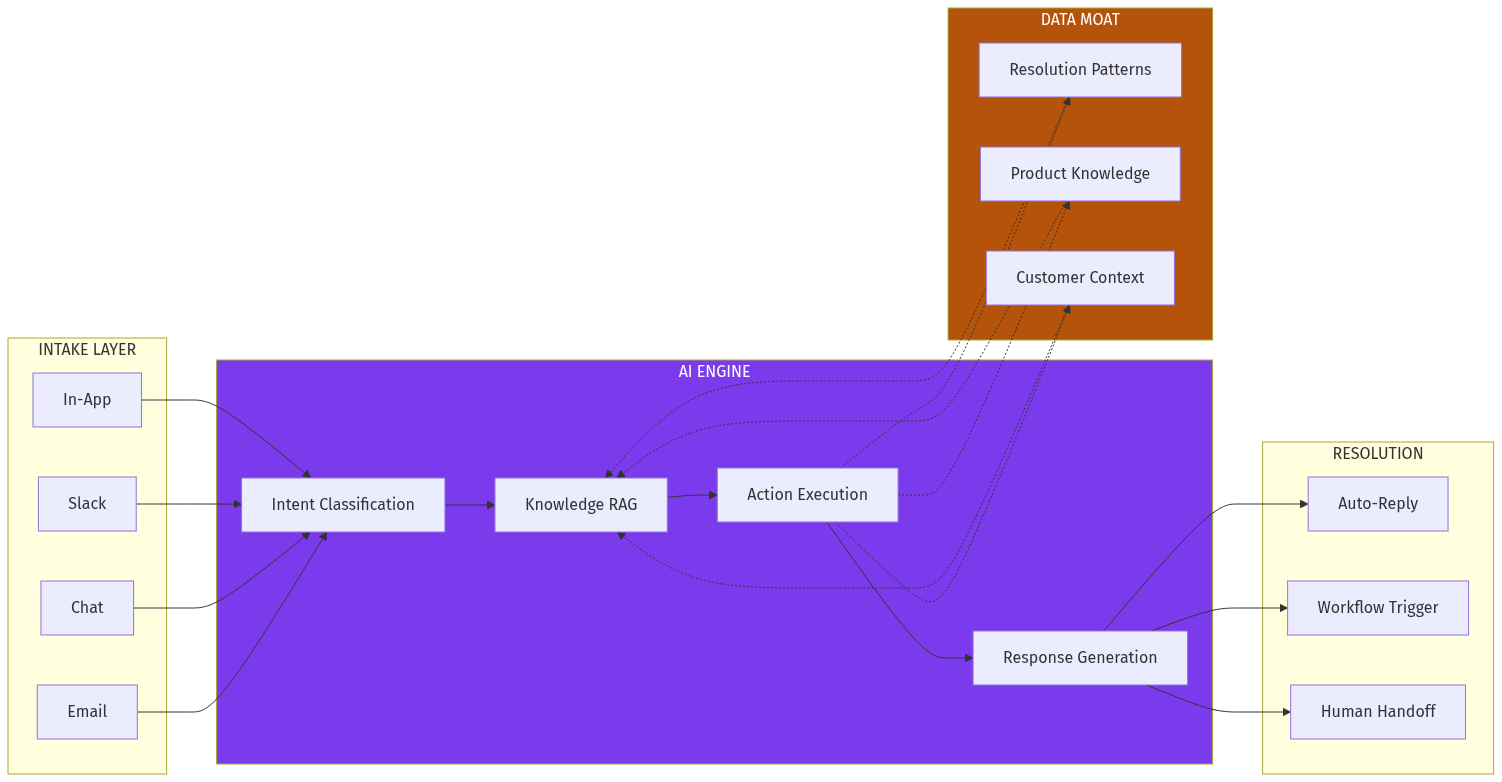
AIM Thesis Alignment
AIM.in is building structured B2B discovery. Technical support is a "discovery" problem:
- Customers discover solutions to their problems
- Support teams discover patterns in issues
- Product teams discover what's broken
An AI support platform is a natural extension — helping B2B companies
discover resolutions, not just search for them.
Integration Opportunities
Demo.aim.in: Showcase as a reference implementation of AI agents
Cohort.in: Support agent training content (for the humans who remain)
Networth.in: Support cost optimization calculators
Cross-sell: Every AIM vertical (logistics, procurement, fintech) needs customer support
Domain Opportunity
- supportagent.in — AI-first support for Indian SaaS
- ticketai.in — Autonomous ticket resolution
- helpdesk.ai — Premium global positioning
## Falsification: Why This Might Fail
Pre-Mortem Exercise
Scenario 1: Incumbents Ship Fast
Zendesk/Intercom have AI teams and distribution. If they ship good-enough AI in 2026, the window closes.
Counterpoint: Their per-seat model creates internal resistance. They'll ship "copilots," not autonomous agents.
Scenario 2: Accuracy Isn't Good Enough
If AI resolves 60% of tickets but 20% of those are wrong, trust erodes.
Mitigation: Confidence thresholds + human review for edge cases.
Scenario 3: Data Privacy Concerns
Enterprise customers won't let AI read their tickets.
Mitigation: Self-hosted option, SOC 2, customer-controlled data retention.
Scenario 4: Economic Downturn Slows Adoption
Ironically, downturns might
accelerate adoption — companies cut support headcount and need AI to fill gaps.
## Steelmanning: The Bear Case
Best argument AGAINST this opportunity:
"Zendesk has 180,000 customers, 15 years of data, and a 4,000-person company. Their AI will be trained on more tickets than any startup can access. They're already shipping Answer Bot, AI agents, and intelligent triage. The startup window for AI support closed when Zendesk acquired Cleverly and Tymeshift. Mid-market SaaS companies will stick with Zendesk because their support managers already know it, and switching costs exceed AI savings. Forethought already serves enterprise; there's no gap. This market is fought and won."
Why the bear case is wrong:
Zendesk's 180K customers are mostly on legacy plans. Their AI features require expensive upgrades. And their architecture is human-first — AI is an add-on, not the core. The startup advantage: build for AI-first resolution from day one, price on outcomes (cost per resolution), and move faster on new model capabilities (Claude 4 in prod within weeks, not months).
## Verdict
Opportunity Score: 8.5/10
| Market Size | 9/10 | $15B+ and growing 25%+ annually |
| Timing | 9/10 | LLM capabilities hit the threshold in 2024-25 |
| Competition | 7/10 | Incumbents slow; Forethought/Moveworks focused on enterprise |
| Execution Risk | 7/10 | Requires strong LLM ops, but not novel research |
| Data Moat | 8/10 | Resolution patterns compound; vertical expertise defensible |
| AIM Fit | 9/10 | Natural extension of B2B discovery thesis |
Pursue. This is a "when not if" category. AI agents will handle 80%+ of B2B support within 5 years. The question is who builds the platform. Incumbents have distribution but architectural baggage. AI-natives have the wedge.
Optimal entry: Start with email-first (ignored by chatbot players), target DevTools/Fintech (high technical complexity, high ticket volume), and price on resolution (aligned incentives).
## Sources