ResearchMonday, February 16, 2026

AI Quote-to-Cash Automation: The Untapped $3.5B B2B Revenue Lifecycle Opportunity

Every B2B sale involves the same painful sequence: configure the product, calculate the price, generate a quote, negotiate, create a contract, invoice, and collect payment. Enterprise players like Salesforce CPQ charge $150+/user/month while SMBs still fumble with Excel and email. AI agents can now automate the entire quote-to-cash lifecycle at a fraction of the cost — and SMBs are completely underserved.

1.

Executive Summary

The Configure-Price-Quote (CPQ) market is projected to exceed $3.5 billion by 2028, growing at 15%+ CAGR. Yet the market is bifurcated: enterprise behemoths (Salesforce, Oracle, SAP) dominate the top, while startups and SMBs struggle with spreadsheets, PDF generators, and manual billing processes.

This creates a massive opportunity for AI-native quote-to-cash automation — a unified platform that uses large language models and intelligent agents to:

  • Auto-configure product bundles from natural language requests
  • Dynamically price deals based on customer segments, deal size, and competitive intelligence
  • Generate professional quotes and contracts in seconds
  • Orchestrate the full billing and payment collection cycle
  • Provide revenue intelligence and forecasting

The key insight: CPQ is fundamentally a language problem. Products are described in language. Pricing rules are expressed as logic. Quotes are documents. Contracts are text. AI is now capable of handling all of this — without the traditional rules engine complexity that makes legacy CPQ implementations notoriously difficult.


2.

Problem Statement

Current Manual Quote-to-Cash Flow

The Broken Status Quo

For Sales Teams:
  • Average time to create a complex quote: 4-8 hours
  • Error rate in manual pricing: 20-40% (leading to margin erosion or lost deals)
  • Quote revision cycles: 3-5 rounds before customer acceptance
  • Sales reps spend 65% of time on non-selling activities (admin, quoting, approvals)
For Finance/Operations:
  • Billing disconnected from quoting (different systems, manual data entry)
  • Revenue recognition complexity with subscription/usage models
  • Cash collection averages 45+ days for B2B invoices
  • No visibility into pipeline-to-cash conversion
For Leadership:
  • Deals fall through cracks between quote and close
  • No unified revenue intelligence across the lifecycle
  • Difficulty forecasting when quote-to-cash is fragmented

Zeroth Principles Analysis

What are we assuming that everyone takes for granted?
  • "CPQ requires complex rules engines" — Legacy CPQ was built on if-then-else rules because natural language processing couldn't handle ambiguity. This is no longer true. LLMs can interpret "give them the enterprise bundle with 20% discount for annual commit" and translate it to the right configuration + pricing.
  • "Quoting and billing must be separate systems" — Historical technical limitations forced this separation. Modern architectures can unify the data model from opportunity → quote → contract → invoice → payment.
  • "Enterprise-grade means enterprise-priced" — AI dramatically reduces the marginal cost of sophisticated functionality. What required $200K implementations can now be delivered as $500/month SaaS.

  • 3.

    Current Solutions

    CompanyWhat They DoWhy They're Not Solving It
    Salesforce CPQEnterprise CPQ, deeply integrated with Salesforce CRM$150+/user/month, 6-12 month implementation, requires certified consultants, SMBs priced out
    Oracle CPQEnterprise configure-price-quote for complex manufacturing$200K+ implementations, designed for ERP integration, not standalone
    Conga CPQFull quote-to-cash suite (formerly Apttus)Still enterprise-focused, complex setup, $100K+ annual contracts
    DealHubMid-market CPQ with playbooks$500-800/user/month, still requires significant configuration
    PandaDocDocument + e-signature focusedGreat for proposals, but limited CPQ depth, no billing integration
    ProposifyProposal software for sales teamsDocument-centric, lacks pricing intelligence and billing
    Stripe QuotesBasic quoting for Stripe usersExtremely limited configuration, no CPQ logic
    ChargebeeSubscription billingStarts after the quote — doesn't handle configuration or pricing

    Incentive Mapping

    Who profits from the status quo?
    • Systems Integrators (Deloitte, Accenture): Earn $500K-$2M per CPQ implementation. Complex products = more billable hours.
    • Legacy Vendors (Salesforce, Oracle): High switching costs keep customers locked in. Complexity justifies premium pricing.
    • Spreadsheet Inertia: Excel is "free" (ignoring the hidden costs of errors, time, and margin leakage).
    The incumbents have no incentive to simplify. Their business models depend on complexity.
    4.

    Market Opportunity

    • Global CPQ Market Size: $3.5B (2025), projected $7.8B by 2030
    • CAGR: 15-17% annually
    • B2B E-commerce GMV: $18 trillion globally
    • SMB Segment (underserved): ~6 million B2B companies globally with 10-500 employees

    Why Now?

  • LLM Capability Inflection: GPT-4/Claude can now understand complex product configurations, pricing logic, and contract language. Two years ago, this required brittle rules engines.
  • API-First Billing Infrastructure: Stripe, Chargebee, and others provide billing APIs that can be orchestrated programmatically. The "last mile" of quote-to-cash is now accessible.
  • Remote/Async Selling: Post-2020, buyers expect self-service pricing, instant quotes, and frictionless procurement. The "call for pricing" model is dying.
  • SMB Tech Adoption: SMBs now adopt SaaS tools like enterprises did a decade ago. They're ready for verticalized, AI-powered solutions.
  • Distant Domain Import

    What field has already solved a similar problem? Insurance Underwriting: The insurance industry has spent decades automating the configure-price-quote process for policies. Modern insurtech (Lemonade, Root) uses AI to:
    • Understand risk profiles from natural language inputs
    • Dynamically price based on hundreds of variables
    • Generate policy documents instantly
    • Handle the full lifecycle from quote to claims
    B2B quoting is structurally identical. The patterns are proven.
    5.

    Gaps in the Market

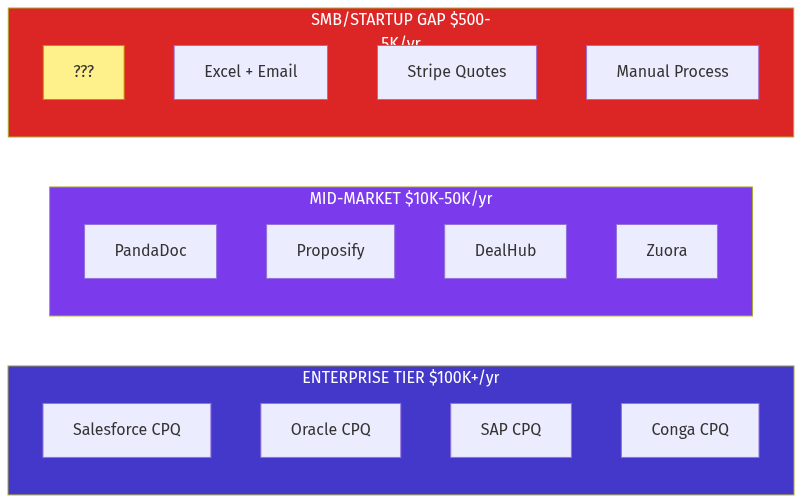
    Market Structure Gap
    Market Structure Gap

    Gap 1: The SMB Black Hole

    Companies with $1M-$50M revenue need CPQ functionality but can't afford Salesforce implementations. They use spreadsheets, lose deals to faster competitors, and leak margin through pricing errors.

    Gap 2: Quote-to-Cash Fragmentation

    Current tools specialize in one part of the lifecycle:
    • CRM (HubSpot, Pipedrive) → Opportunity tracking
    • CPQ (Salesforce, DealHub) → Quote generation
    • E-signature (DocuSign, PandaDoc) → Contract execution
    • Billing (Stripe, Chargebee) → Invoicing
    • Collections (Accounts receivable tools)
    Each handoff introduces friction, errors, and delays.

    Gap 3: AI-Native Pricing Intelligence

    Legacy CPQ uses static rules. Modern pricing should:
    • Analyze win/loss data to recommend optimal prices
    • Factor in competitive intelligence
    • Adjust for customer segment, deal size, and timing
    • Suggest upsells and cross-sells contextually

    Gap 4: Conversational Configuration

    Buyers increasingly want to self-serve. But product configurators are terrible UX — endless dropdowns and forms. An AI agent that understands "I need something like what Company X has, but for a team of 50" is transformative.

    Anomaly Hunting

    What's strange about this market? The bottleneck isn't technology — it's change management. Enterprise CPQ implementations fail at 40%+ rates, not because the software doesn't work, but because organizations can't adapt their processes. AI-native tools that start simple and progressively automate (instead of requiring "big bang" implementations) could bypass this entirely.
    6.

    AI Disruption Angle

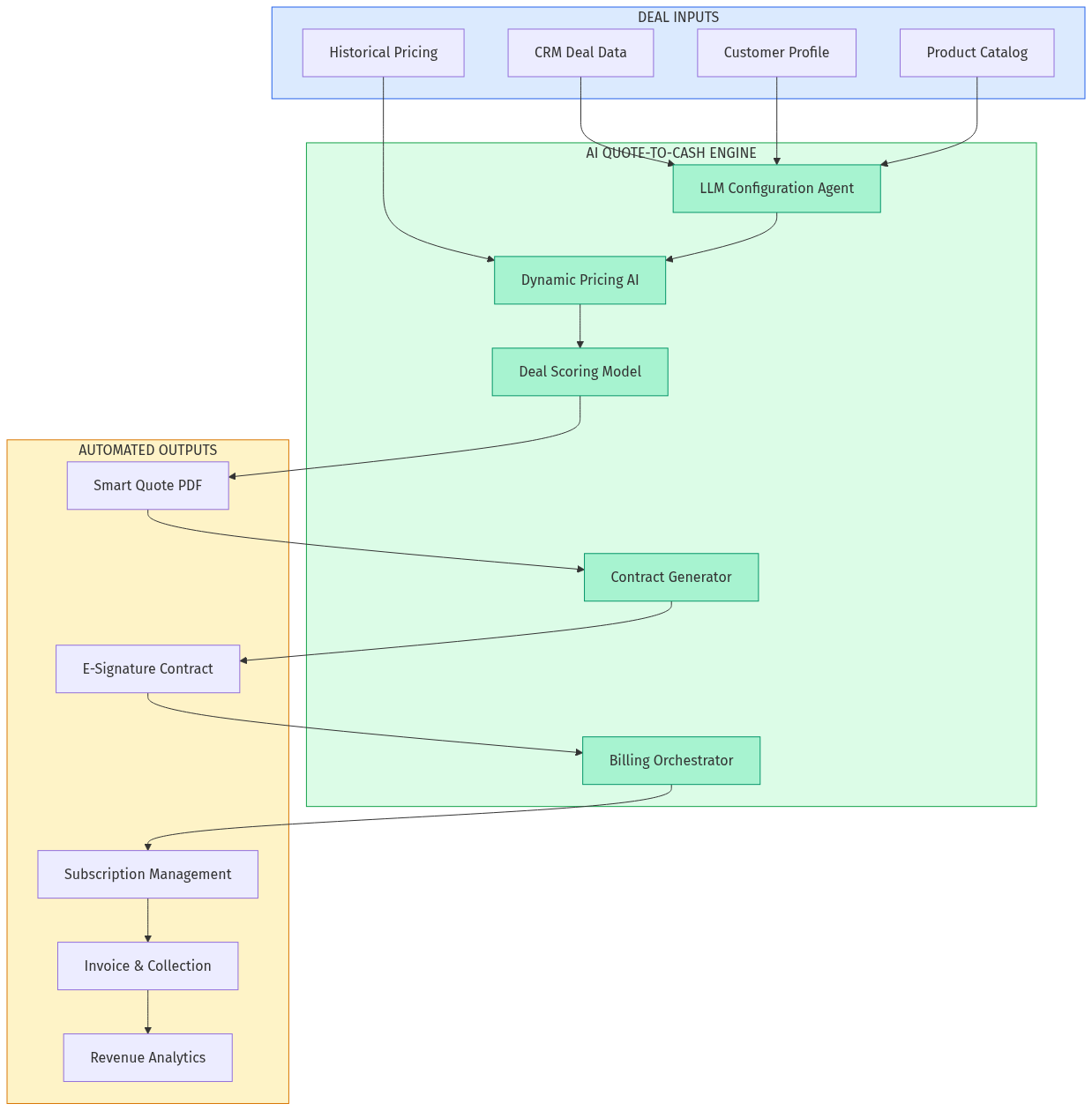
    AI Quote-to-Cash Architecture
    AI Quote-to-Cash Architecture

    The AI-Native Quote-to-Cash Stack

    Layer 1: Configuration Agent
    • Natural language input: "Enterprise plan, 50 seats, with SSO and dedicated support"
    • LLM interprets intent, validates against product catalog, handles edge cases
    • No rules engine required — the model learns from historical configurations
    Layer 2: Pricing Intelligence
    • Dynamic pricing based on:
    - Customer segment (enterprise vs. startup) - Deal size (volume discounts) - Win probability (competitive situations) - Historical close rates at different price points
    • AI recommends optimal price + discount authority
    Layer 3: Document Generation
    • Quote, proposal, and contract created from structured data
    • Personalized for customer context
    • Version control and audit trail
    Layer 4: Approval Orchestration
    • AI routes for approval based on deal characteristics
    • Predicts approval likelihood, suggests modifications to get faster sign-off
    • Learns approval patterns over time
    Layer 5: Billing & Collections Agent
    • Auto-generates invoices from signed contracts
    • Sends payment reminders with optimal timing
    • Handles dunning sequences
    • Reconciles payments, updates revenue recognition
    The Vision: A sales rep types "create quote for Acme Corp, 100 seats, annual commit" and the system:
  • Pulls Acme's profile from CRM
  • Recommends the right bundle based on their industry/size
  • Prices with an optimal discount (not too high, not too low)
  • Generates a beautiful, personalized quote
  • Routes for approval (or auto-approves if within policy)
  • Sends to customer with e-signature
  • Schedules billing upon signature
  • Tracks payment and follows up automatically
  • Total time: 2 minutes, not 4 hours.


    7.

    Product Concept

    Core Features (MVP)

  • Smart Product Catalog
  • - Import existing products (CSV, Shopify, Stripe) - AI-assisted categorization and bundling - Natural language search ("show me everything with API access")
  • Conversational Quote Builder
  • - Sales rep or customer describes need in plain English - System recommends configuration, explains reasoning - Real-time pricing with discount visibility
  • AI Pricing Engine
  • - Set pricing rules (floor, ceiling, approval thresholds) - AI recommends optimal price within bounds - Win/loss analysis feedback loop
  • Quote/Proposal Generator
  • - Professional templates with brand customization - Dynamic content blocks (case studies, testimonials relevant to customer) - E-signature integration (DocuSign, PandaDoc, native)
  • Billing Orchestration
  • - Connect to Stripe, Chargebee, or native billing - Auto-create subscriptions from signed contracts - Usage-based billing support
  • Revenue Dashboard
  • - Pipeline → Quote → Close → Cash visibility - Forecasting with AI predictions - Margin analysis and leakage alerts

    Differentiators

    • Zero-config onboarding: Import products, start quoting in <30 minutes
    • AI-first UX: Conversational interface, not form-filling
    • Unified lifecycle: One system from opportunity to cash
    • SMB pricing: $99-499/month, not $150/user/month

    8.

    Development Plan

    PhaseTimelineDeliverables
    MVP8 weeksProduct catalog, conversational quote builder, basic pricing rules, PDF quote generation, Stripe integration
    V112 weeksE-signature integration, approval workflows, contract templates, basic billing sync
    V216 weeksAI pricing recommendations, revenue dashboard, advanced billing (usage, tiers), CRM integrations (HubSpot, Pipedrive)
    V320 weeksCustomer self-service portal, collections automation, revenue recognition, Salesforce integration

    Technical Architecture

    • Backend: Node.js/Python FastAPI
    • AI Layer: Claude/GPT-4 for configuration + pricing, fine-tuned models for document generation
    • Database: PostgreSQL + vector store for semantic product search
    • Billing: Stripe Billing API as primary, Chargebee as secondary
    • Documents: React-PDF for generation, DocuSign/PandaDoc APIs for signature

    9.

    Go-To-Market Strategy

    Phase 1: Founder-Led Sales (Months 1-6)

  • Target ICP: B2B SaaS companies, $1M-$10M ARR, 10-50 employees, using spreadsheets + Stripe
  • Channel: LinkedIn outreach to RevOps/Sales Ops leaders
  • Offer: Free migration from spreadsheet quotes, 14-day trial
  • Goal: 50 paying customers, deep feedback loops
  • Phase 2: Product-Led Growth (Months 6-12)

  • Freemium tier: 10 quotes/month free, conversion to paid at usage
  • Content: "Excel to CPQ" migration guides, ROI calculators
  • Integrations: HubSpot/Pipedrive marketplace listings
  • Goal: 500 customers, $50K MRR
  • Phase 3: Vertical Expansion (Year 2)

  • Vertical templates: SaaS, Professional Services, Wholesale Distribution
  • Partner channel: Accountants, fractional CFOs, RevOps consultants
  • Enterprise motion: Move upmarket with compliance features
  • Goal: $1M ARR, 2,000 customers
  • ICP Deep Dive

    • Primary: B2B SaaS startups using Stripe, growing 50%+ YoY, sales team of 3-15
    • Secondary: Professional services firms (agencies, consultants) with project-based pricing
    • Tertiary: Wholesale distributors with complex product catalogs

    10.

    Revenue Model

    TierPriceFeaturesTarget
    Starter$99/month50 quotes, 3 users, basic templates, Stripe integrationSolo founders, small teams
    Growth$299/monthUnlimited quotes, 10 users, custom branding, approvals, HubSpot integrationGrowing startups
    Scale$499/monthUnlimited users, AI pricing, revenue dashboard, priority support, API accessEstablished SMBs
    EnterpriseCustomSSO, custom integrations, dedicated CSM, SLAMid-market ($10M+ revenue)

    Revenue Projections (Conservative)

    • Year 1: 300 customers × $200 avg. ARPU = $720K ARR
    • Year 2: 1,500 customers × $250 avg. ARPU = $4.5M ARR
    • Year 3: 5,000 customers × $300 avg. ARPU = $18M ARR

    Unit Economics Target

    • CAC: $300-500 (PLG-heavy)
    • LTV: $6,000+ (24-month payback assumption)
    • Gross Margin: 80%+ (SaaS standard, AI costs manageable with caching/fine-tuning)

    11.

    Data Moat Potential

    Proprietary Data Accumulates Over Time

  • Pricing Intelligence Corpus
  • - Every quote sent, won, or lost builds pricing optimization data - "What price wins for 50-seat SaaS deals in healthcare vertical?" - Network effects: More customers → better pricing recommendations → more customers
  • Product Configuration Patterns
  • - Cross-company insights: "Companies buying X usually also need Y" - Industry benchmarks: "Typical professional services bundle for agencies"
  • Win/Loss Signals
  • - Correlate quote characteristics with outcomes - Build predictive models for deal scoring
  • Revenue Benchmarks
  • - Quote-to-close rates by segment - Days-to-payment by industry - Discount depth vs. close probability

    Defensibility Timeline

    • Month 1-12: Feature differentiation (AI-native UX)
    • Month 12-24: Integration ecosystem (sticky via workflows)
    • Month 24+: Data moat (pricing intelligence no competitor can replicate)

    12.

    Why This Fits AIM Ecosystem

    Direct Alignment with AIM.in Vision

    AIM.in is building India's largest structured B2B discovery platform. Quote-to-cash automation is the transaction layer that monetizes discovery:

  • Marketplace Transaction Rails: When a buyer finds a supplier on AIM.in, they need to transact. A CPQ layer handles custom pricing, quotes, contracts, and payments — creating revenue share opportunities.
  • Supplier Onboarding: SMB suppliers on AIM.in struggle with professional quoting. Offering embedded quote-to-cash tools increases supplier activation and stickiness.
  • B2B Payment Intelligence: Transaction data from quote-to-cash feeds back into AIM.in's understanding of market dynamics, pricing trends, and buyer-supplier relationships.
  • Vertical Specialization: Each AIM.in vertical (masale.in for spices, forx.in for software, niyukti.in for recruitment) could have tailored quote-to-cash workflows.
  • Implementation Path

    • Phase 1: Build standalone SaaS, validate product-market fit
    • Phase 2: Integrate as AIM.in "Request Quote" infrastructure
    • Phase 3: White-label for marketplace operators

    ## Verdict

    Opportunity Score: 8.5/10

    Pre-Mortem (Falsification)

    Assume 5 well-funded startups failed here. Why?
  • Enterprise gravity: Tried to compete with Salesforce head-on, couldn't win deals
  • Integration hell: Underestimated the complexity of billing system integrations
  • Sales cycle mismatch: Built enterprise product, tried PLG GTM (or vice versa)
  • AI overpromise: Claimed "autonomous" when it still needed significant human input
  • Pricing model wrong: Per-user pricing alienated SMBs, flat pricing couldn't sustain enterprise features
  • Mitigation: Start firmly SMB-focused with PLG motion. Avoid enterprise deals until product is mature. Integrate deeply with one billing system (Stripe) before expanding. Be honest about AI capabilities (augmentation, not replacement).

    Steelmanning the Opposition

    Why might incumbents win?
    • Salesforce: Already has CPQ + Billing + Revenue Cloud. If they simplified pricing and created an "SMB edition," they could crush this market overnight.
    • Stripe: Could extend Stripe Quotes into a full CPQ product, leveraging their massive distribution.
    • HubSpot: Has quotes functionality, could deepen it with AI and billing.
    Counter-argument: Large companies are notoriously slow at simplification. Salesforce has been "working on SMB" for a decade with limited progress. Stripe's DNA is payment infrastructure, not sales workflow software. HubSpot is a CRM company, not a revenue operations company. The opportunity window exists for 2-3 years.

    Second-Order Thinking

    If this succeeds, what happens next?
  • Revenue teams restructure: The "Sales Ops" role evolves into "Revenue AI Trainer" — teaching the system rather than doing the work
  • Pricing becomes dynamic: B2B moves toward real-time, personalized pricing (like B2C e-commerce)
  • Buyer expectations shift: Prospects expect instant quotes and frictionless procurement
  • Mid-market consolidation: Winners in quote-to-cash acquire billing, e-signature, and CRM tools to build integrated stacks
  • Final Assessment

    This is a strong opportunity with clear market need, proven pain points, and an AI-enabled differentiation path. The SMB segment is dramatically underserved, and the timing is right (LLM capabilities + Stripe infrastructure + remote selling trends).

    Key risk: Execution complexity at the billing integration layer. Mitigate by starting with Stripe-only and expanding methodically. Recommended next step: Build an MVP focused on the "spreadsheet → professional quote" use case for B2B SaaS companies. Validate with 10-20 beta customers before expanding scope.

    ## Sources