AI-Powered Proposal & Document Intelligence: The $10B Sales Automation Opportunity
Sales teams spend 20+ hours crafting each proposal. Incumbents digitized templates and e-signatures. The next wave: AI that generates winning proposals from CRM data, call transcripts, and competitive intelligence—in minutes, not days.
8
Opportunity
Score out of 10
1.
Executive Summary
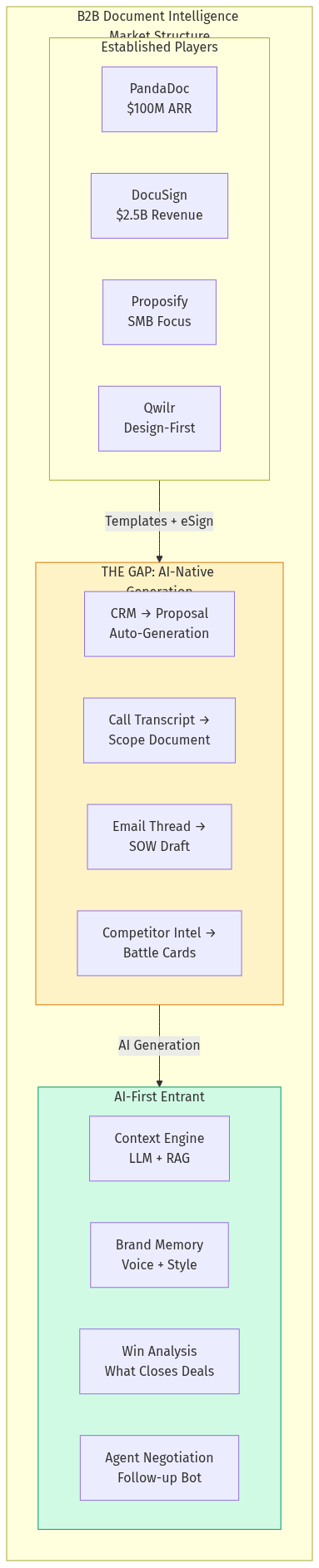
The sales enablement and document automation market is massive ($2.6B by 2024, 19.8% CAGR) yet fundamentally stuck in the template era. Players like PandaDoc ($100M ARR, $1B valuation) and DocuSign ($2.5B revenue) have digitized the delivery of documents—e-signatures, tracking, workflows—but not the creation.
The gap: Sales reps still manually customize every proposal, often spending 4-8 hours per document. AI can collapse this to 15 minutes by:
Auto-generating proposals from CRM data and call transcripts
Learning what language, structure, and pricing wins deals
Personalizing every document to the specific buyer's context
Automating follow-up based on engagement signals
This is not incremental improvement—it's a category redefinition from "document management" to "document intelligence."
2.
Problem Statement
Who Experiences This Pain?
Sales Representatives:
Spend 20-40% of time on non-selling activities
Create 15-25 proposals per month on average
Each proposal takes 4-8 hours of customization
Copy-paste from old proposals introduces errors
Lose deals due to slow turnaround
Sales Leaders:
No visibility into what proposal content works
Can't enforce consistency across team
Deal velocity bottlenecked by document creation
Win/loss analysis is gut feeling, not data
Buyers:
Receive generic, template-feeling proposals
Key requirements from calls don't appear in docs
Pricing doesn't reflect discussed scope
Experience disconnect between sales conversation and proposal
Applying Zeroth Principles
Before assuming the problem is "slow proposal creation," question the axiom.
The deeper truth: Sales documents are disconnected from sales conversations.
Everything discussed on discovery calls—pain points, priorities, budget, timeline, competitive alternatives—exists only in the rep's memory. The proposal is then created from scratch, hoping to recall and incorporate all relevant context.
This isn't a speed problem. It's a context capture and synthesis problem.
Call Transcription: Gong, Chorus, and native Zoom transcription create raw material
CRM Data Richness: Modern CRMs have deep prospect data waiting to be synthesized
Buyer Expectations: Post-ChatGPT, personalization is table stakes
Distant Domain Import: What Other Field Solved This?
Legal Tech: Companies like Harvey and Casetext use AI to draft legal documents from case context. The same pattern applies—synthesize context, generate professional output, human review.
Code Generation: GitHub Copilot generates code from natural language and context. Proposals are just "code" for business transactions.
Medical Records: AI systems that generate clinical summaries from patient encounters—same pattern of conversation → structured document.
5.
Gaps in the Market
Gap 1: Call-to-Document Pipeline
No solution automatically transforms sales call transcripts into proposal sections. Reps manually extract key points and retype them.
Gap 2: Win Pattern Learning
Nobody systematically analyzes which proposal language, structure, and pricing correlates with closed-won deals. Every proposal reinvents the wheel.
Gap 3: Competitive Intelligence Integration
Battle cards and competitive data sit in separate systems. Proposals don't automatically incorporate relevant differentiators.
Gap 4: Multi-Document Coherence
A single deal might need: proposal, SOW, contract, pricing sheet, executive summary. Each is created separately with inconsistent messaging.
Gap 5: Intelligent Follow-Up
Proposal tracking exists, but no system auto-generates follow-up messages based on which sections the buyer viewed and for how long.
Anomaly Hunting: What's Surprising?
Surprising observation: Despite Gong/Chorus capturing 100% of sales conversations, and despite LLMs being able to generate documents, nobody has connected them.
Why? The call intelligence vendors see themselves in "sales coaching." The document vendors see themselves in "document management." The AI-native synthesis opportunity sits in the gap between them.
6.
AI Disruption Angle
AI Proposal Automation Flow
The AI-First Document Intelligence Stack
Layer 1: Context Capture Engine
Ingest CRM data (company, contacts, deal stage, history)
Process call transcripts (Gong, Chorus, Zoom, Meet)
Parse email threads for commitments and requirements
Extract competitive mentions and objections
Layer 2: Knowledge Synthesis
RAG over company's proposal history (what worked)
Product/service database for accurate descriptions
Pricing rules and discount logic
Case studies matched to buyer industry/size
Layer 3: Document Generation
Multi-section proposal with appropriate structure
Personalized messaging based on buyer's stated priorities
Dynamically selected case studies and proof points
Pricing configured to discussed scope
Layer 4: Optimization Loop
Track which proposals win/lose
Analyze engagement (time per section, revisits)
A/B test messaging and structure
Continuously improve generation model
What the Future Looks Like
Today (4-8 hours):
Rep remembers call details (imperfectly)
Opens template, manually edits 20+ fields
Searches for relevant case study
Calculates pricing, builds table
Sends for internal review
Revises based on feedback
Sends to buyer
Manually follows up
Tomorrow (15 minutes):
AI ingests call transcript + CRM data
Generates complete proposal draft
Rep reviews, makes minor edits
One-click internal approval
Smart delivery with tracking
AI drafts follow-up based on engagement
Rep approves and sends
7.
Product Concept
Core Product: PropelDocs (working name)
Vision: The AI copilot that turns sales conversations into winning proposals.
Gross margin: 80%+ (LLM costs manageable per proposal)
LTV:CAC: 5:1 target
11.
Data Moat Potential
Proprietary Data Assets
1. Proposal Outcome Corpus
Win/loss linked to proposal content
Industry-specific patterns
Pricing sensitivity by segment
2. Engagement Behavior Database
How buyers interact with proposals
Predictive signals for deal outcomes
Optimal follow-up timing
3. Brand Voice Models
Fine-tuned models for each customer's voice
Switching cost: competitor can't replicate
4. Competitive Intelligence Graph
How competitors are positioned across deals
What objection patterns emerge
Real-time competitive landscape
Flywheel: More proposals → better win pattern models → higher win rates → more adoption → more proposals.
12.
Why This Fits AIM Ecosystem
Market StructureAIM.in Thesis: India's largest structured B2B discovery platform. Help buyers DECIDE, not just ASK.
PropelDocs Fit:
B2B Workflow: Core to enterprise sales processes
India Opportunity:
- Growing SaaS sector with proposal-heavy sales
- IT services companies send thousands of proposals/month
- Massive opportunity in government RFP responses
Vertical Expansion: Industry-specific proposal templates (construction, IT services, consulting)
Cross-Sell Potential:
AIM directory listings → PropelDocs as proposal tool
Supplier profiles feed into proposal generation
Transaction data improves win pattern models
## Verdict
Pre-Mortem: Why Would This Fail?
Incumbent Response: PandaDoc has $100M ARR and could acquire/build AI features fast
Integration Complexity: Gong/Chorus/CRM integrations take time; data access is gated
Enterprise Sales Cycle: Large deals take 6-12 months; cash burn before revenue
LLM Costs: At scale, generation costs could compress margins
Quality Consistency: LLM hallucinations in proposals = lost deals
Steelmanning the Incumbents
PandaDoc could win because:
They have the CRM integrations already built
Customer templates are hard to migrate
E-signature is sticky; bundling is powerful
They can acquire any AI startup that gains traction
Falsification: What Would Prove This Wrong?
If PandaDoc's AI features achieve >50% proposal automation within 12 months
If sales teams reject AI-generated content due to quality concerns
If call transcription vendors (Gong) launch native proposal generation
If LLM costs increase significantly, making per-proposal economics unviable
Bayesian Confidence Assessment
Prior: Document automation is a validated market. AI generation is transforming adjacent categories (code, legal, medical).
New Evidence:
PandaDoc's AI features are bolt-on, not native
No current solution connects call → proposal pipeline
Explicit pain point in sales communities
Posterior Confidence: 8/10
The opportunity is real. The timing is right. The question is execution speed vs incumbent response.
Opportunity Score: 8/10
Recommendation: Strong opportunity for an AI-native entrant. The key differentiator is the call transcript → proposal pipeline that no incumbent has built. Start with high-velocity SaaS sales teams who generate 15+ proposals/month and feel the pain acutely. Build the Gong/HubSpot integration first, prove time savings (4-8 hours → 30 minutes), then expand.
The data moat from win/loss patterns is defensible. The risk is incumbent acquisition or fast-follow. Move fast, get customer logos, and establish category leadership before PandaDoc pivots.