Partner Relationship Management (PRM) is a $7.2 billion market growing at 14% CAGR, yet most solutions remain stuck in 2015-era thinking: portals, dashboards, and manual workflows. Companies like Impartner, Channeltivity, and PartnerStack have built solid businesses serving enterprises, but they've left massive gaps in intelligence, automation, and accessibility.
The opportunity: Build an AI-native PRM that transforms partner management from a cost center into a competitive advantage. Instead of partners logging into portals, AI agents handle lead routing, commission tracking, performance prediction, and dispute resolution in real-time across WhatsApp, email, and CRM systems. Why now: LLMs can finally understand the nuanced context of partner communications. The rise of ecosystem-led growth strategies means more companies are building partner channels. And the SMB market (5-50 partners) remains completely underserved.1.
Executive Summary
2.
Problem Statement
Applying Zeroth Principles: Questioning the Axioms
Before assuming "PRM software" is the right frame, let's question the underlying axioms:
Axiom 1: "Partners need a portal to manage their relationship with vendors." Reality: Partners hate portals. They already juggle 15+ vendor portals. They want information pushed to them via WhatsApp/Slack/email, not pulled from yet another login. Axiom 2: "Commission tracking requires complex attribution rules." Reality: Most disputes aren't about rules — they're about visibility. Partners don't trust they're getting credit for deals they influenced. The problem is transparency, not sophistication. Axiom 3: "Partner management is a vendor-controlled process." Reality: The best partnerships are bidirectional. Partners have valuable market intelligence, customer feedback, and competitive insights that vendors rarely capture.Who Experiences This Pain?
| Stakeholder | Pain Level | Primary Frustration |
|---|---|---|
| Channel Managers | 🔥🔥🔥🔥🔥 | Spend 60% of time on manual coordination, not strategy |
| Partners | 🔥🔥🔥🔥 | No visibility into deal status, delayed payouts, portal fatigue |
| Sales Teams | 🔥🔥🔥 | Channel conflict — who brought this lead? |
| Finance | 🔥🔥🔥 | Reconciliation nightmares, accrual complexity |
| Executives | 🔥🔥 | No clear ROI on partner program investments |
The Commission Dispute Epidemic
A recent Reddit post perfectly illustrates the chaos:
> "She demanded 50/50 ownership... My mistake: we never defined terms beforehand... He's now stating that he'll execute her part. The agreement includes: 50/50 revenue on all clients he sources with no sunset and no defined responsibilities."
This isn't a startup equity dispute — it's what happens at scale when partner agreements aren't systematically tracked, enforced, and made transparent.
3.
Current Solutions
Applying Competitive Landscape Analysis
| Company | What They Do | Annual Revenue | Why They're Not Solving It |
|---|---|---|---|
| Impartner | Enterprise PRM with full lifecycle management | $50M+ | Too expensive ($50K+/year), enterprise-only, no AI intelligence |
| PartnerStack | B2B SaaS affiliate/partner network | $20M+ | Focused on affiliate payouts, weak on complex channel relationships |
| Channeltivity | Mid-market PRM portal | $10M+ | Traditional portal model, partners still need to log in |
| Allbound | Partner enablement platform | $15M+ | Heavy on content delivery, light on workflow automation |
| Crossbeam | Account mapping for partnerships | $30M+ | Only solves one piece — data sharing between partners |
Steelmanning: Why Incumbents Might Win
Let's build the strongest case for why Impartner and PartnerStack will continue dominating:
4.
Market Opportunity
Market Size
- Global PRM Market (2026): $7.2 billion
- CAGR: 14.3% through 2030
- Serviceable Market (SMB + Mid-market): $2.1 billion
- AI-native PRM (new category): $500M+ by 2028
Why Now?
Applying Second-Order Thinking
If AI-native PRM succeeds, what happens next?
- Channel managers become strategists. 80% of their current work (deal registration review, commission calculations, lead routing) gets automated.
- Partner programs scale faster. Companies can onboard 10x more partners without proportional headcount.
- Attribution becomes real-time. Instead of quarterly reconciliation, partners see credit for influenced deals instantly.
- New partnership models emerge. When tracking is frictionless, companies experiment with micro-commissions, influence fees, and complex multi-touch attribution.
5.
Gaps in the Market
Applying Anomaly Hunting
Anomaly 1: Enterprise PRMs cost $50K+/year, but most B2B companies have <50 partners. Where's the $500/month solution? Anomaly 2: Partners spend 90% of their time on WhatsApp/Slack, but PRMs still require portal logins. Nobody has built "WhatsApp-first PRM." Anomaly 3: Commission disputes are the #1 partner frustration, yet no PRM has transparent, real-time attribution that partners can audit themselves. Anomaly 4: Partner performance varies 10x, but no solution predicts which partners will churn or which deserve more resources. Anomaly 5: Multi-partner deals (where 2-3 partners collaborate) are increasingly common, but PRMs still assume 1:1 relationships.Gap Analysis
| Gap | Impact | Difficulty to Solve |
|---|---|---|
| No WhatsApp-native experience | 🔥🔥🔥🔥🔥 | Medium |
| Missing predictive intelligence | 🔥🔥🔥🔥 | High |
| No SMB-focused solution | 🔥🔥🔥🔥 | Low |
| Opaque attribution | 🔥🔥🔥 | Medium |
| No multi-partner deal tracking | 🔥🔥🔥 | High |
6.
AI Disruption Angle
Applying Distant Domain Import
Parallel from Gaming: MMO guilds have sophisticated "DKP" (dragon kill points) systems where contribution to raids is tracked and converted to loot priority. Partners contributing to deals need similar transparent, contribution-weighted attribution. Parallel from Logistics: FedEx's package routing AI decides which hub handles each package based on capacity, location, and priority. Lead routing to partners should work the same way — automatic, intelligent, optimized. Parallel from Finance: Fraud detection systems flag anomalies in real-time. Commission fraud (partners claiming credit for deals they didn't influence) could be detected the same way.The AI Agent Vision
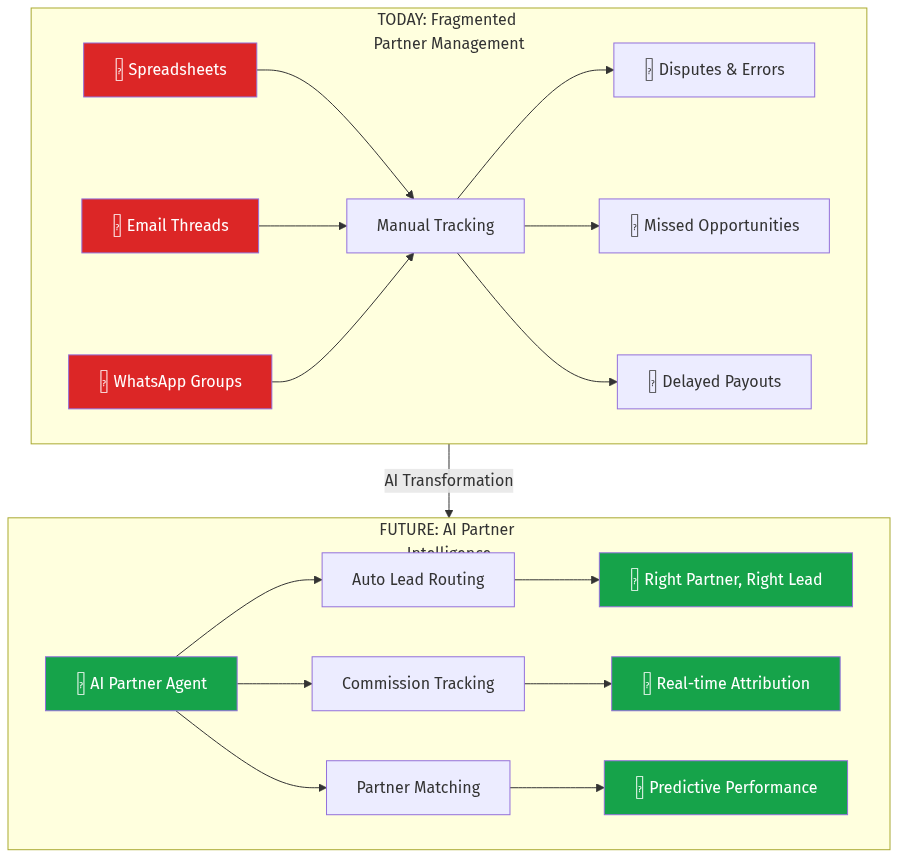
Instead of partners logging into a portal:
7.
Product Concept
Core Product: PartnerOS
An AI-native operating system for B2B partnerships that works where partners already are.
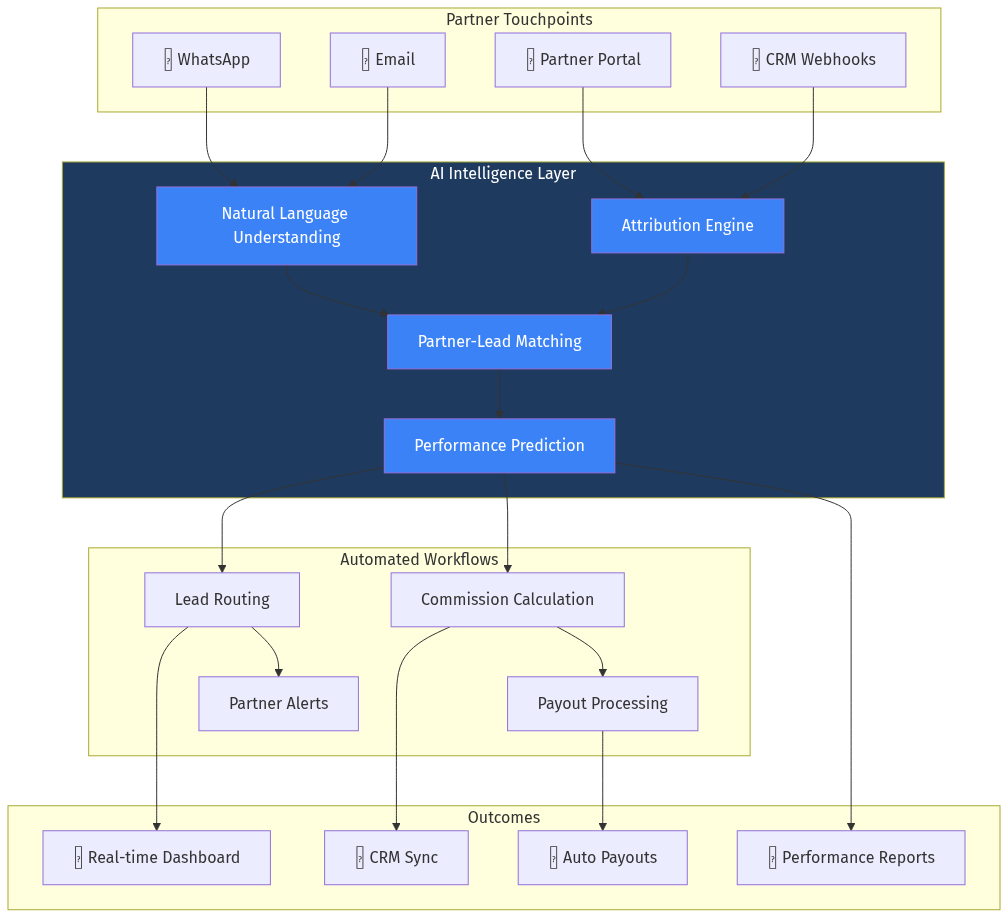
Key Features
1. Omnichannel Partner Agent- WhatsApp, Slack, email, and web — one AI agent handles all partner interactions
- Natural language processing for deal registration, status queries, and commission checks
- No portal login required for 80% of partner workflows
- Multi-touch attribution across all partner touchpoints
- Influence tracking (partners who educated the buyer but didn't close)
- Real-time, auditable attribution that partners can verify
- Partner health score based on engagement, deal velocity, and communication patterns
- Churn prediction with proactive intervention alerts
- Resource allocation recommendations (which partners deserve more support)
- Real-time commission calculation as deals progress
- Automated payout processing via Stripe/PayPal
- Dispute flagging and resolution workflows
- Which partners are performing, which are struggling
- Competitive intelligence from partner conversations
- Market feedback aggregation from partner interactions
8.
Development Plan
| Phase | Timeline | Deliverables |
|---|---|---|
| MVP | 8 weeks | WhatsApp agent for deal registration, basic attribution, commission tracking |
| V1 | 12 weeks | Multi-channel support (email, Slack), predictive partner scoring, automated payouts |
| V2 | 16 weeks | AI dispute resolution, multi-partner deal tracking, CRM integrations (Salesforce, HubSpot) |
| V3 | 24 weeks | Partner marketplace, benchmarking, white-label for agencies |
Technical Architecture
- LLM: Claude 3.5 for conversation understanding, deal extraction
- Integration: WhatsApp Business API, Slack API, Gmail API
- Database: PostgreSQL + vector store for semantic search
- Payments: Stripe Connect for partner payouts
- CRM Sync: Native integrations + Zapier/Make for long-tail
9.
Go-To-Market Strategy
Phase 1: Land (Months 1-3)
Target: B2B SaaS companies with 10-50 partners, primarily in India and SEA where WhatsApp is dominant. Channel:Phase 2: Expand (Months 4-8)
Target: Mid-market companies with 50-200 partners, global footprint. Channel:Phase 3: Enterprise (Months 9-12)
Target: Enterprises with 200+ partners looking to modernize legacy PRM. Channel:10.
Revenue Model
Primary Revenue Streams
| Stream | Pricing | Target Contribution |
|---|---|---|
| SaaS Subscription | $299-3,000+/month | 70% |
| Payment Processing Fee | 1% of commissions processed | 15% |
| Professional Services | $5,000+ setup for enterprise | 10% |
| API Access | $0.01/API call after free tier | 5% |
Unit Economics (Target)
- CAC: $1,500 (SMB), $15,000 (Enterprise)
- LTV: $15,000 (SMB), $150,000 (Enterprise)
- LTV/CAC: 10:1
- Payback: 6 months (SMB), 12 months (Enterprise)
11.
Data Moat Potential
What Accumulates
Defensibility Timeline
- Year 1: Product moat (AI-native vs portal-first)
- Year 2: Data moat (attribution patterns, benchmarks)
- Year 3: Network moat (partner network effects)
12.
Why This Fits AIM Ecosystem
Perfect AIM Vertical: PartnerOS becomes the "structured discovery" layer for B2B partnerships.
Integration Points:
Enterprise sales cycles too long. Companies take 6-12 months to switch PRM. Startup runway doesn't survive.
- Mitigation: Focus on SMB initially, move upmarket with traction.
WhatsApp doesn't scale. Enterprises won't let critical deal data flow through WhatsApp.
- Mitigation: WhatsApp for SMB, multi-channel for enterprise from V1.
Attribution is unsolvable. Disputes happen regardless of data quality.
- Mitigation: Transparent audit trails reduce disputes even if they don't eliminate them.
Incumbents copy AI features.
- Mitigation: AI-native architecture is hard to retrofit. Impartner adding "AI" is different from building AI-first.
- AIM.in directory: List partners by capability, geography, performance score
- AI-first matching: "Find me implementation partners in Bangalore with HubSpot expertise and >90% satisfaction scores"
- Workflow automation: Partner onboarding flows integrated with AIM supplier verification
- partneros.in (available)
- channels.in (premium, worth acquiring)
- ecosystem.in (available)
- Companies using PartnerOS also need supplier management → AIM.in core
- Partners discovered via AIM can be onboarded to PartnerOS
- Single data layer for all B2B relationships
## Verdict
Applying Falsification: Pre-Mortem
Assume this fails. Why?Opportunity Score: 8/10
Why 8:- Clear pain point validated by market size and Reddit-level frustration
- AI disruption angle is genuine, not incremental
- SMB segment is wide open
- Fits AIM ecosystem perfectly
- Enterprise sales cycles are real obstacles
- Incumbents have distribution advantages
- Commission processing requires fintech compliance
Recommendation
BUILD IT. Start with WhatsApp-first MVP targeting India SaaS companies with 10-30 partners. Prove AI-native attribution, then expand to multi-channel and upmarket.## Sources
- Impartner — Enterprise PRM leader
- PartnerStack — B2B affiliate/partner network
- Channeltivity — Mid-market PRM
- TrustMRR — Revenue-sharing SaaS leaderboard
- Grand View Research — PRM Market Size Report 2025
- Reddit r/startups — Commission dispute case study
❧