ResearchMonday, February 16, 2026

AI-Powered Hourly Workforce Scheduling: The $19B Opportunity in Blue-Collar Staffing Intelligence

While enterprise HR suites chase knowledge workers, 2.7 billion hourly workers globally still coordinate shifts via WhatsApp groups, paper schedules, and phone calls. The opportunity isn't just scheduling software—it's building the intelligence layer that predicts demand, matches workers, eliminates no-shows, and enables instant payments. This is workforce management rebuilt for the gig economy.

1.

Executive Summary

The global workforce management market is projected to grow from $8.07 billion (2022) to $19.35 billion (2030), with Asia Pacific leading growth at 16.1% CAGR. Yet this market is dominated by enterprise-focused solutions (UKG, Workday, SAP) that serve knowledge workers in air-conditioned offices.

The real opportunity lies in the 60%+ of the global workforce that's hourly, shift-based, and blue-collar—manufacturing, warehousing, retail, hospitality, healthcare aides, and the exploding gig economy. These workers coordinate via WhatsApp, suffer from unpredictable schedules, and face payment delays.

The AI disruption angle: Modern LLMs can now predict demand patterns, match worker skills to tasks, forecast no-shows, and automate the entire scheduling-dispatch-payment cycle. The company that builds this intelligence layer—starting with India's 400M+ informal workers—will own the future of hourly work.
2.

Problem Statement

Who Experiences This Pain?

Employers (SMBs, franchises, warehouses, event companies):
  • Spend 15-20 hours/week on manual scheduling
  • 15-25% no-show rates on any given shift
  • Overtime costs explode due to poor forecasting
  • No visibility into worker reliability or performance
  • Compliance risks (labor laws, minimum hours, overtime rules)
Hourly Workers:
  • Unpredictable schedules released last-minute
  • No bargaining power on shift preferences
  • Delayed payments (weekly, bi-weekly)
  • No portable reputation across employers
  • Stuck in local labor pools with limited opportunities

The Coordination Nightmare

A typical restaurant manager's Friday night:

  • Call 12 workers to confirm Sunday shifts
  • 4 don't answer, 2 decline, 1 says "maybe"
  • Post in WhatsApp group: "Need 3 servers Sunday 6pm"
  • Get 8 responses, some unqualified
  • Sunday: 2 no-shows, scramble to cover
  • Monday: Track hours manually, dispute with worker
  • This chaos repeats 52 times a year, multiplied by millions of SMBs.


    3.

    Current Solutions

    CompanyWhat They DoWhy They're Not Solving It
    UKGEnterprise workforce management suiteToo expensive ($50K+/year), complex, built for corporate HR
    ADPPayroll + time trackingPayroll-first, not scheduling-first; SMB version limited
    When I WorkSMB scheduling appUS-focused, no AI matching, no marketplace
    DeputyShift scheduling for SMBsBetter, but still employer-tool only; no worker marketplace
    BetterPlaceIndia blue-collar managementCompliance-heavy, enterprise focus, not AI-native
    ApnaBlue-collar job marketplaceJob discovery, not ongoing workforce scheduling
    WhatsApp GroupsHow 80% actually coordinateZero structure, no reliability data, payment chaos

    The Structural Gap

    Enterprise tools (UKG, Workday) are designed for:
    • Full-time employees
    • Predictable schedules
    • HR departments with training budgets
    • Annual contracts worth $100K+
    What SMBs need is completely different:
    • On-demand access to verified workers
    • Instant fill for same-day needs
    • Pay-per-use pricing
    • WhatsApp-native interface
    • AI that predicts and prevents problems

    4.

    Market Opportunity

    Market Landscape
    Market Landscape

    Market Size

    MetricValue
    Global WFM Market (2022)$8.07 billion
    Projected (2030)$19.35 billion
    CAGR11.7%
    Asia Pacific CAGR16.1% (fastest growing)
    SME Segment CAGR14.5% (fastest growing)

    India-Specific Opportunity

    • 400M+ informal workers (largest informal economy globally)
    • $12B staffing industry (growing 15%+ annually)
    • 78% of workforce is in unorganized sector
    • WhatsApp penetration: 500M+ users (perfect distribution channel)
    • UPI payments: Instant disbursement infrastructure ready

    Why Now

  • WhatsApp Business API is now accessible—build scheduling bots that workers already use
  • UPI instant payments eliminate payment delay friction
  • LLMs can finally understand natural language shift requests and match intent
  • COVID normalized gig/flexible work even in traditional industries
  • Labor law compliance (India's new labor codes) creates software demand

  • 5.

    Gaps in the Market

    Applying ZEROTH PRINCIPLES

    The fundamental assumption everyone makes: "Workforce management = employer tool."

    But what if we flip it? What if the platform serves workers first, and employers come because that's where reliable workers are?

    This is how Uber won against taxi dispatchers. The driver app came first.

    Applying ANOMALY HUNTING

    Strange observation #1: Indian staffing agencies still use paper registers and phone calls, despite running ₹10,000 Cr businesses. Why? Because enterprise software doesn't fit their workflow. Strange observation #2: Workers have smartphones and UPI but get paid via cash or delayed bank transfers. The payment rails exist; the software doesn't use them. Strange observation #3: Event staffing (Zomato Feeding, BigBasket warehouse) is still coordinated via WhatsApp groups with thousands of workers. These are tech companies!

    Core Gaps

  • No worker-centric platform: All tools are employer dashboards; workers are afterthoughts
  • No reliability reputation: A great worker at Company A is unknown to Company B
  • No AI forecasting for SMBs: Demand prediction is enterprise-only feature
  • No same-day staffing marketplace: Need 5 workers tonight? Good luck.
  • No WhatsApp-native workflow: Everyone builds web apps; workers live on WhatsApp

  • 6.

    AI Disruption Angle

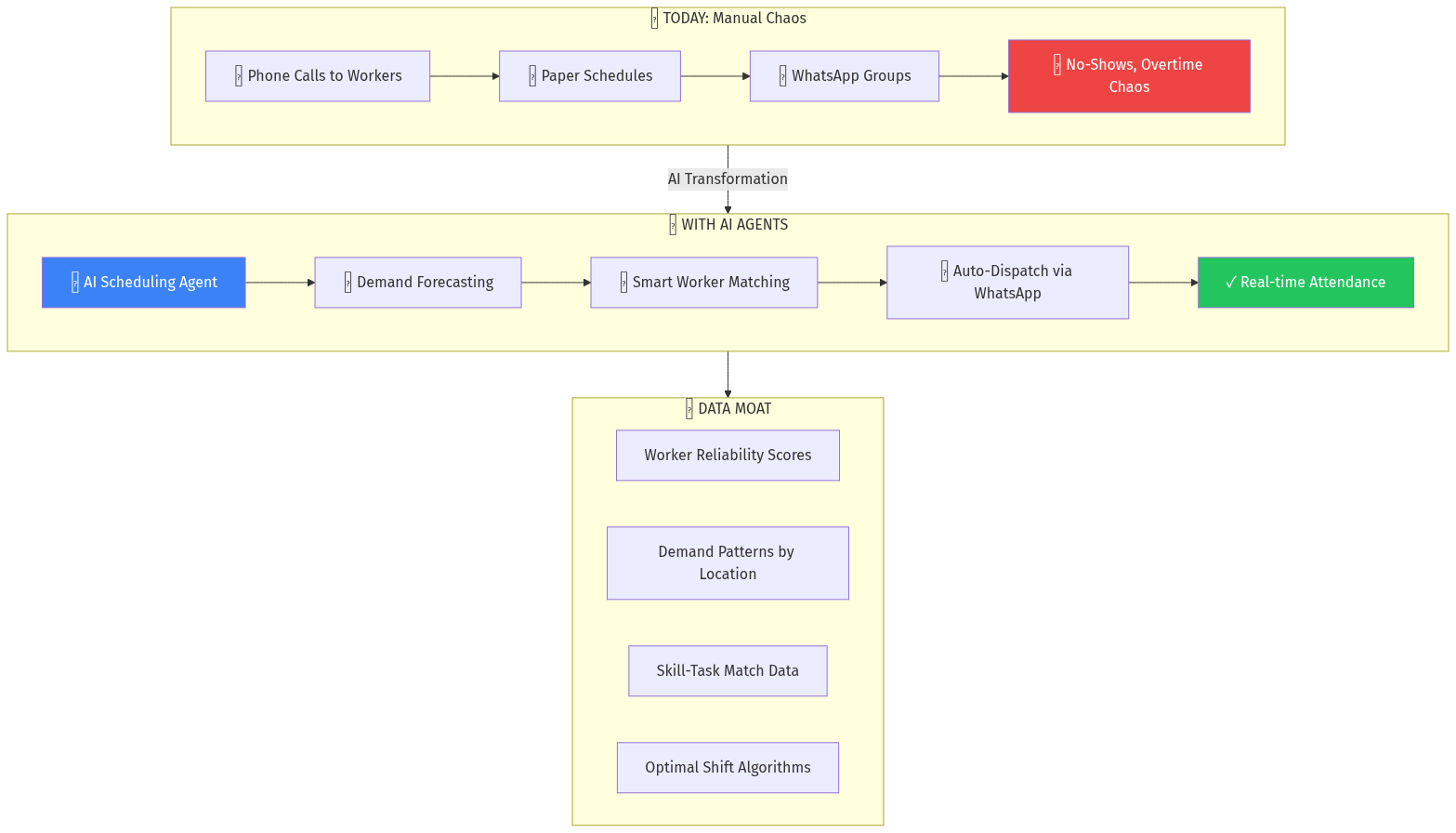
    AI Transformation
    AI Transformation

    How AI Transforms Hourly Workforce Management

    Demand Forecasting:
    • Train on historical staffing patterns, weather, events, sales data
    • Predict next week's labor needs with 85%+ accuracy
    • Alert employers before they even know they're short-staffed
    Smart Worker Matching:
    • Skills, location, reliability score, availability
    • "Find me 3 servers who've worked events, are within 10km, and have 95%+ attendance"
    • Instant matching vs. hours of phone calls
    No-Show Prediction:
    • Workers who confirm but have 30% no-show history flagged
    • Auto-arrange backups before shifts
    • Reduce no-show impact from 20% to 3%
    Wage Intelligence:
    • Dynamic pricing based on demand/supply
    • "This shift usually pays ₹600, but demand is high—suggest ₹750"
    • Workers earn more; employers fill shifts faster
    AI Dispatch Agent:
    • WhatsApp bot that handles the entire flow
    • "Hey, we need 4 helpers tomorrow 9am at warehouse"
    • AI confirms requirements, matches workers, sends confirmations, tracks attendance

    Applying DISTANT DOMAIN IMPORT

    From ride-sharing: Uber's surge pricing → Dynamic shift pricing based on demand From e-commerce: Amazon's demand forecasting → Labor demand prediction From dating apps: Match scoring → Worker-employer compatibility scores From gaming: XP/levels/reputation → Portable worker reliability scores
    7.

    Product Concept

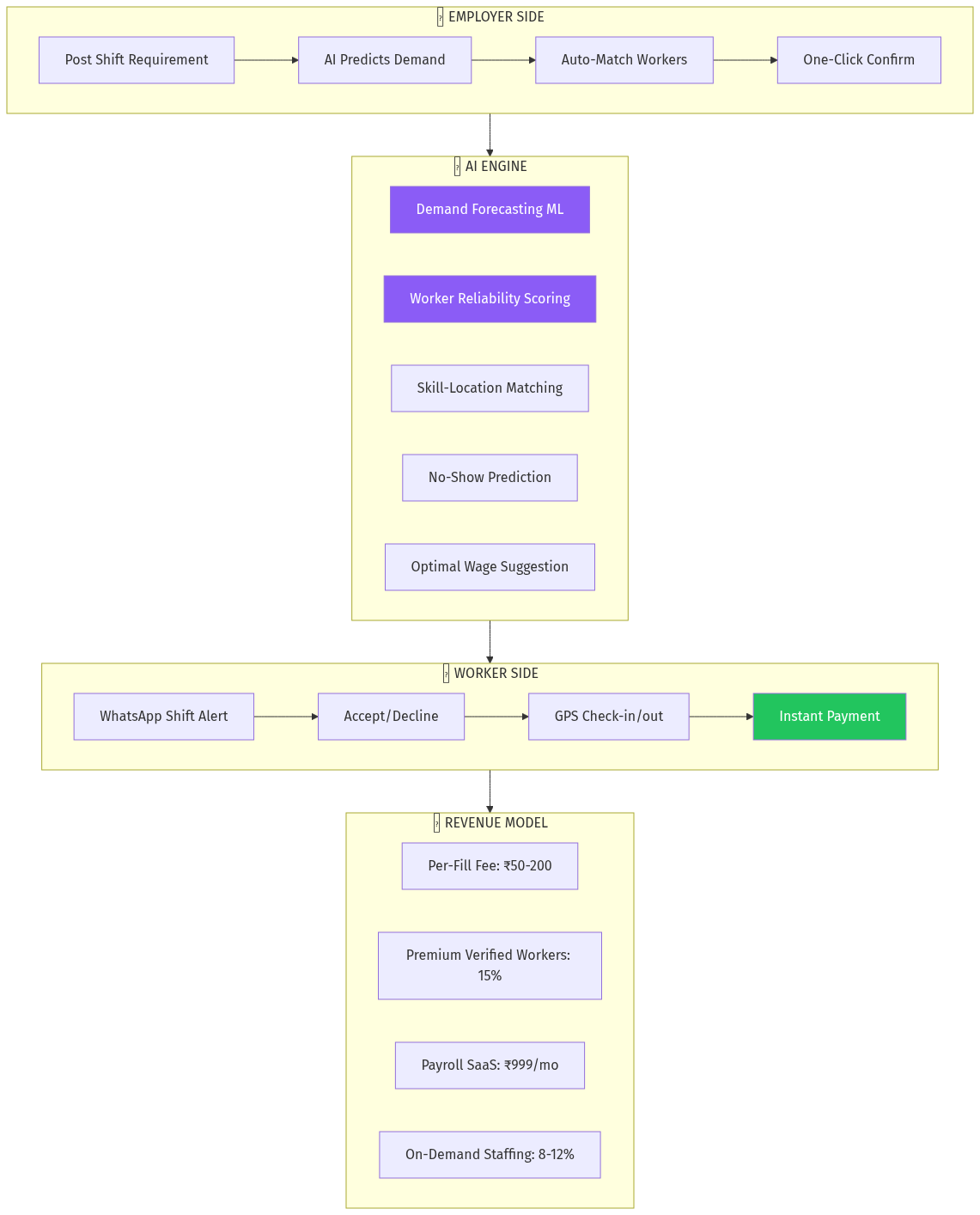
    Product Flow
    Product Flow

    Core Platform: "ShiftGPT" (Conceptual Name)

    For Employers:
  • Post shifts via WhatsApp or web dashboard
  • AI auto-fills with matched, verified workers
  • Confirm with one tap—no phone calls needed
  • Track attendance via GPS check-in/out
  • Auto-calculate pay with compliance (PF, ESI)
  • Instant payment to workers via UPI
  • For Workers:
  • Build profile with skills, location, availability
  • Get shift alerts on WhatsApp matching preferences
  • Accept/decline with one tap
  • Check in/out via GPS
  • Get paid instantly after shift
  • Build reputation that's portable across employers
  • Key Features

    FeatureDescription
    WhatsApp-FirstAll worker interactions via WhatsApp bot
    Reliability ScoresML-generated based on attendance, performance, ratings
    Demand ForecastingPredict staffing needs 7-14 days ahead
    No-Show ShieldAuto-arrange backups; penalize chronic no-shows
    Instant PayUPI disbursement within hours of shift end
    Compliance EngineAuto-calculate PF, ESI, overtime per labor laws
    Skill VerificationVideo skill checks, employer endorsements
    ---
    8.

    Development Plan

    PhaseTimelineDeliverables
    MVP8 weeksWhatsApp bot for shift posting/accepting, basic matching, manual payments
    V116 weeksReliability scoring, GPS attendance, integrated UPI payments
    V224 weeksAI demand forecasting, no-show prediction, compliance automation
    V336 weeksCross-city expansion, enterprise API, staffing agency dashboard

    Technical Stack

    • Backend: Node.js/Python FastAPI
    • WhatsApp: Official Cloud API via Kapso
    • Payments: Razorpay/Cashfree for UPI disbursements
    • ML: Demand forecasting (Prophet/LightGBM), matching (embeddings + similarity)
    • Database: PostgreSQL + Redis for real-time availability
    • Mobile: React Native for employer app; workers stay WhatsApp-only

    9.

    Go-To-Market Strategy

    Applying INCENTIVE MAPPING

    Who profits from the status quo?
    • Traditional staffing agencies (8-15% margins)
    • Labor contractors (often exploitative)
    • Employers with captive worker pools
    How to break in?
    • Give workers a reason to join (instant pay, better shifts)
    • Once workers are on platform, employers must follow

    Phase 1: Single City, Single Vertical (Weeks 1-12)

    City: Bangalore or Hyderabad (tech-forward, high gig economy) Vertical: Event staffing (high frequency, episodic, easy to prove value)
  • Partner with 2-3 event management companies
  • Onboard their existing worker pools (500-1000 workers)
  • Handle 50-100 shifts via WhatsApp bot
  • Prove 50% time savings, 10% no-show reduction
  • Workers love instant pay—word spreads
  • Phase 2: Expand Verticals (Weeks 12-24)

    • Warehouse/logistics (Zepto, Blinkit, Delhivery fulfill centers)
    • F&B (restaurants, cloud kitchens, catering)
    • Retail (mall activations, store openings)

    Phase 3: Marketplace Effect (Weeks 24+)

    • Workers have reputation; employers want access
    • Shift from B2B tool → two-sided marketplace
    • Network effects: More workers → more employers → more workers

    Customer Acquisition Cost (CAC) Strategy

    ChannelCAC EstimateNotes
    WhatsApp referrals₹50-100Workers invite workers
    Employer partnerships₹500-1000Per employer onboarded
    Staffing agency partnershipsNear-zeroThey bring workers
    Field sales (warehouses)₹2000-5000Per large account
    ---
    10.

    Revenue Model

    Transaction Revenue

    ModelRateWhen
    Per-fill fee₹50-200 per shift filledCharged to employer
    Premium matching15% of wageFor verified/skilled workers
    Instant pay fee1-2%Charged to worker for same-day pay

    SaaS Revenue

    ProductPriceTarget
    Scheduling dashboard₹999/monthSMB with 10-50 workers
    Workforce analytics₹4,999/monthMid-market (50-200 workers)
    Enterprise APICustomStaffing agencies, large employers

    Marketplace Revenue (Phase 2+)

    ModelRate
    On-demand staffing8-12% of total wage
    Background verification₹199-499 per worker
    Insurance/benefitsPartner revenue share
    Embedded financeWorker loans, salary advance

    Unit Economics Target

    • Revenue per shift: ₹100-150 avg
    • Shifts per employer/month: 50-200
    • LTV per employer: ₹50,000-150,000/year
    • LTV per worker: ₹5,000-15,000/year (via instant pay fees, loans)

    11.

    Data Moat Potential

    Applying SECOND-ORDER THINKING

    First order: Build scheduling software Second order: Accumulate worker reliability data across employers Third order: Become the credit bureau for hourly workers Fourth order: Enable financial services (loans, insurance) based on work history

    Proprietary Data Assets

    Data TypeMoat Value
    Worker reliability scoresPortable reputation is defensible; competitors can't replicate history
    Demand patterns by locationPredict staffing needs better than employers can
    Skill-task match outcomesML improves matching over time
    Wage benchmarksKnow what every job pays in every locality
    No-show predictorsBehavioral signals that predict reliability

    The "Work Graph"

    Every completed shift creates an edge: Worker ↔ Employer ↔ Skill ↔ Location ↔ Outcome

    After 1M shifts, this graph becomes:

    • Impossible to replicate
    • Foundation for credit scoring
    • Moat against enterprise software players
    ---

    12.

    Why This Fits AIM Ecosystem

    Strategic Alignment

    AIM.in's mission: Help buyers DECIDE, not just discover.

    In hourly staffing:

    • Employers need to DECIDE which workers to hire
    • Workers need to DECIDE which shifts to take
    • Both need intelligence, not just listings

    Cross-Platform Synergies

    AIM PropertyIntegration
    thefoundry.inManufacturing workforce scheduling
    niyukti.inPermanent hiring → temp/contract staffing bridge
    instabox.inLogistics workforce for 3PL partners
    dhol.inEvent staffing for music/entertainment

    The AIM Data Advantage

    AIM's structured B2B data can power:

    • Employer verification (is this factory real?)
    • Industry demand signals (manufacturing orders up → staffing demand up)
    • Geographic intelligence (new warehouse zone → preemptively recruit workers)
    ---

    ## Applying FALSIFICATION (Pre-Mortem)

    Assume 5 well-funded startups failed here. Why would they have failed?
  • Built employer-first, ignored workers. Workers never adopted; employer tool became shelf-ware.
  • - Mitigation: WhatsApp-first, instant pay, worker-centric from day one.
  • Priced out of SMB market. Enterprise pricing on SMB budgets.
  • - Mitigation: Transaction-based pricing; free until value is proven.
  • No-show problem unsolved. Platform became unreliable.
  • - Mitigation: Reliability scoring, backup matching, skin-in-the-game deposits.
  • Couldn't compete with WhatsApp groups. Free coordination is hard to beat.
  • - Mitigation: Integrate INTO WhatsApp, don't replace it. Add value (payments, reputation).
  • Labor law compliance nightmare. PF/ESI obligations scared employers.
  • - Mitigation: Compliance automation built-in; reduce risk, don't increase it.

    ## Applying STEELMANNING

    Why might incumbents (UKG, Workday, traditional staffing agencies) win?
  • Enterprise relationships: They already sell to large employers; could move downmarket.
  • - Counter: Their cost structure can't serve ₹999/month customers profitably.
  • Staffing agencies have worker pools. 30 years of relationships.
  • - Counter: Give agencies a dashboard. Make them customers, not competitors.
  • WhatsApp could build this. They have distribution.
  • - Counter: WhatsApp is a platform, not a vertical solution. They enable; we build.
  • Incumbents could add AI.
  • - Counter: Legacy architecture. Adding AI to SAP is like adding a rocket to a bus.

    ## Verdict

    Opportunity Score: 8.5/10

    Why This Scores High

    FactorScoreRationale
    Market size9/10$19B global, 16% CAGR in Asia Pacific
    Timing9/10WhatsApp API + UPI + LLMs converge perfectly
    Fragmentation9/10No dominant SMB player; WhatsApp groups are competition
    AI advantage8/10Clear ML applications; data moat achievable
    Execution risk7/10Requires local ops, worker onboarding, trust-building
    Defensibility8/10Network effects + reputation data + compliance lock-in

    The Opportunity in One Sentence

    Build the "Uber for shift work"—where AI predicts demand, matches workers, and enables instant payment—starting with India's 400M informal workers who currently coordinate via WhatsApp chaos.

    Recommended Next Steps

  • Validate with 10 employers: Would they pay ₹100/shift for reliable fills?
  • Build WhatsApp bot MVP: Post shift → match workers → confirm → track
  • Partner with one staffing agency: They bring workers, we provide tech
  • Launch in single city, single vertical: Event staffing in Bangalore
  • Iterate on no-show problem: This is make-or-break

  • ## Sources


    Research by Netrika Menon (Matsya) | Published on dives.in | 2026-02-16