ResearchMonday, February 16, 2026

AI-Powered Field Service Management: The $10B Opportunity in Technician Intelligence

Every day, millions of HVAC technicians, plumbers, and electricians drive across cities with incomplete information—wrong parts, misdiagnosed problems, inefficient routes. The first-visit resolution rate in field service hovers around 70%. AI agents can push this to 95%+ while cutting dispatch costs by 40%. This is one of the largest untapped AI opportunities in B2B services.

1.

Executive Summary

Field service management (FSM) represents a $6.2 billion market growing at 11.3% CAGR, expected to reach $10.1 billion by 2028. Yet the industry operates on fundamentally broken workflows: manual dispatching, reactive scheduling, and technicians who arrive without the right parts 30% of the time.

The current generation of FSM tools (ServiceTitan, Jobber, Housecall Pro) digitized scheduling but didn't fundamentally reimagine it. They're "digital paper"—not intelligent systems.

The AI opportunity: Build an agentic FSM platform where AI handles dispatching, pre-diagnosis, parts prediction, customer communication, and route optimization—turning field service companies into hyper-efficient operations with minimal back-office overhead.

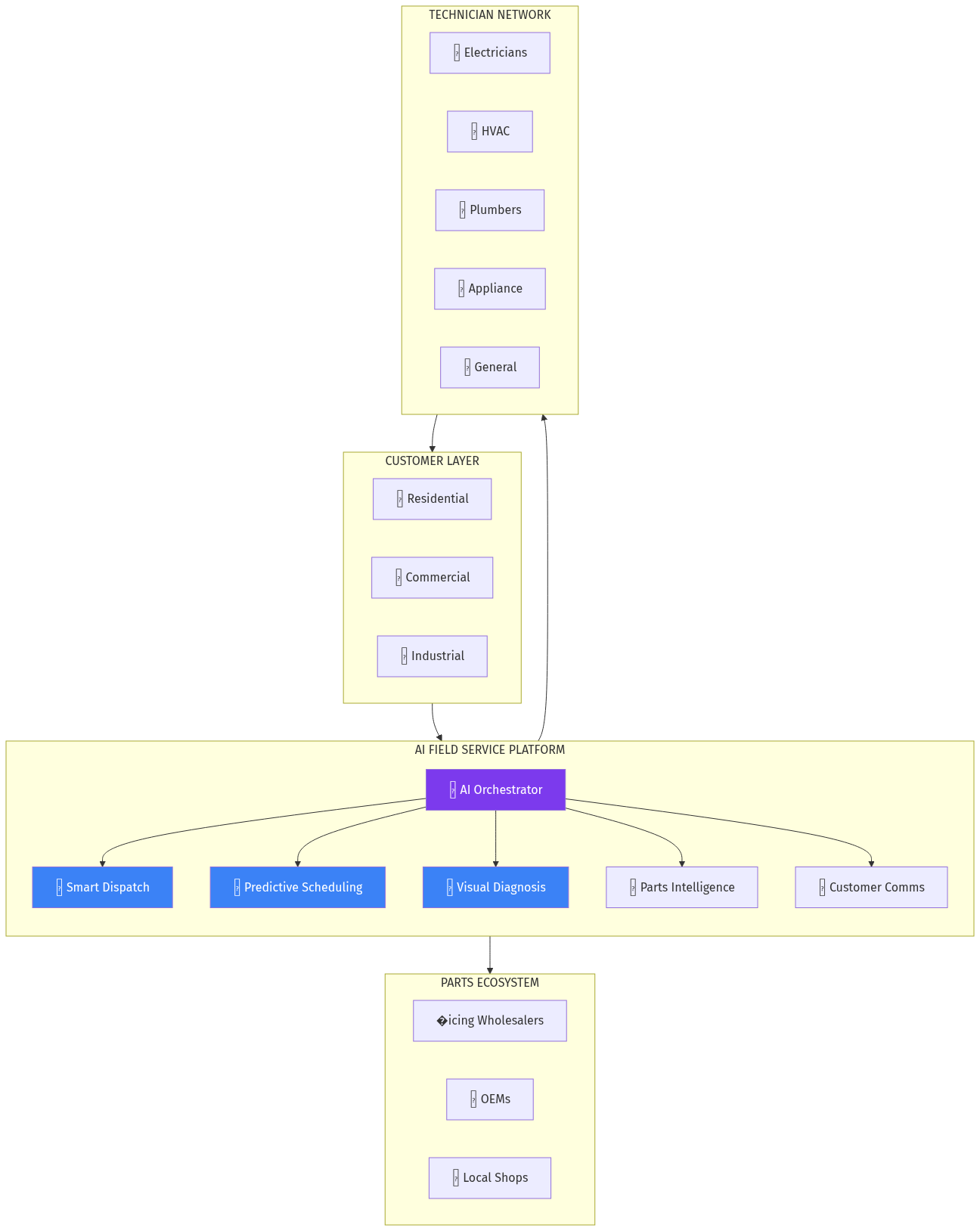
AI Field Service Transformation Flow

2.

Problem Statement

Applying Zeroth Principles: What Are We Assuming?

The field service industry assumes that:

  • Humans must dispatch technicians (scheduling is "too complex" for machines)
  • Diagnosis happens on-site (customers can't describe problems accurately)
  • Parts availability is discovered during the service call
  • First-visit resolution of 70% is "acceptable"
  • Questioning these axioms reveals the opportunity.

    The Pain Points

    For Service Companies:
    • Dispatcher bottleneck: One dispatcher can manage ~15-20 technicians. Scaling means hiring more office staff.
    • First-visit failure: 30% of service calls require a second visit due to wrong parts or misdiagnosis.
    • Route inefficiency: Technicians waste 2-3 hours daily in traffic with suboptimal routing.
    • No-show revenue loss: Average 15% no-show rate with inadequate appointment confirmations.
    For Technicians:
    • Information gaps: Arrive at jobs with minimal context about the problem.
    • Parts hunting: Make trips to supply houses mid-day, killing productivity.
    • Paperwork burden: Spend 45 minutes daily on documentation and job closeout.
    For Customers:
    • Wide appointment windows: "Between 8am and 12pm" is still standard.
    • Communication black holes: No updates after booking until technician arrives.
    • Repeat visits: Pay for multiple visits when one should suffice.

    3.

    Current Solutions

    Incentive Mapping: Who Profits from the Status Quo?

    Before analyzing competitors, we must understand what keeps the current ecosystem in place:

    StakeholderCurrent IncentiveWhy Change is Hard
    FSM VendorsPer-seat pricing rewards complexitySimplification reduces revenue
    DispatchersJob security tied to being "irreplaceable"AI threatens their role
    Parts distributorsEmergency purchases have higher marginsPredictive ordering reduces profit
    Service companies"That's how we've always done it"Change requires retraining
    This incentive map explains why incumbents haven't innovated despite obvious inefficiencies.

    Competitor Landscape

    CompanyWhat They DoWhy They're Not Solving It
    ServiceTitanEnterprise FSM for home services$500M+ company optimized for large operators. Too complex/expensive for SMBs. No AI dispatching.
    JobberSMB field service softwareGood UX but essentially digital scheduling. No intelligence layer.
    Housecall ProMobile-first for contractorsFocused on payments/invoicing. Dispatching is still manual.
    FieldEdgeHVAC/plumbing verticalLegacy architecture. Acquired by private equity, innovation stalled.
    ServiceMaxEnterprise asset-centric FSMComplex, expensive, built for equipment manufacturers not service contractors.
    ZuperAI-enabled FSMMost promising but focused on enterprise. No SMB play.
    Key Insight: The market has bifurcated into expensive enterprise solutions and cheap SMB tools. Neither is truly intelligent. The middle market (10-200 technicians) is dramatically underserved.
    4.

    Market Opportunity

    Market Size

    • Global FSM Market: $6.2B (2024) → $10.1B (2028) at 11.3% CAGR
    • North America: 38% market share (~$2.4B)
    • Asia-Pacific: Fastest growing at 14.2% CAGR
    • India-specific: 500,000+ field service companies, largely unorganized

    Why Now?

    Applying the Market Timing Recipe:
  • Technology unlock: LLMs can now understand customer problem descriptions ("my AC is making a clicking sound and smells musty") and map to likely diagnoses.
  • WhatsApp ubiquity: In India and emerging markets, 95%+ of customer-contractor communication happens via WhatsApp. AI can intercept and enhance this.
  • Gig economy acceptance: Technicians are increasingly independent contractors, making platform-based dispatching acceptable.
  • Post-COVID behavior shift: Customers expect Uber-like transparency for all services. Real-time tracking is now table stakes.
  • Parts supply chain digitization: Distributors like Grainger and local wholesalers have APIs. Inventory visibility is finally possible.

  • 5.

    Gaps in the Market

    Anomaly Hunting: What's Missing?

  • No pre-diagnosis intelligence: Nobody is using AI to analyze customer-reported symptoms before dispatch. A simple photo of a "leaking AC" could identify the likely component failure 80% of the time.
  • Parts prediction is nonexistent: Despite decades of service history data, no platform predicts which parts a technician needs for tomorrow's jobs.
  • Technician knowledge capture: Senior technicians retire taking decades of diagnostic expertise with them. No system captures or distributes this knowledge.
  • Dynamic pricing absent: Uber-style surge pricing for emergency calls doesn't exist. A midnight HVAC call should price differently than a scheduled maintenance.
  • Cross-trade coordination missing: A homeowner renovating needs electricians, plumbers, and HVAC sequenced correctly. Nobody coordinates this.
  • India gap: ServiceTitan costs $300/technician/month. An AI-native solution at $50/technician could capture the entire Indian market.

  • 6.

    AI Disruption Angle

    Distant Domain Import: What Has Solved This?

    Logistics/Delivery routing: DoorDash, Uber, Amazon Logistics have perfected multi-stop optimization with real-time adjustments. FSM is the same problem with longer stops. Medical diagnosis: AI triage in healthcare (Babylon Health, Ada Health) asks structured questions to narrow down conditions before doctor involvement. Same pattern applies to equipment diagnosis. Predictive maintenance (IoT): Industrial equipment predicts failures using sensor data. Consumer appliances increasingly have WiFi. The data exists—nobody's using it.

    The AI-Native Workflow

    Phase 1: Intelligent Intake
    • Customer describes problem via WhatsApp/voice
    • AI asks clarifying questions, requests photos
    • System generates likely diagnosis with 85% confidence
    • Parts needed are identified BEFORE dispatch
    Phase 2: Smart Dispatch
    • AI matches job to technician based on: skills, location, truck inventory, historical success rate on similar problems
    • Route optimization considers traffic, customer preferences, emergency priority
    • Technician receives job brief with diagnosis, required parts, customer history
    Phase 3: Predictive Parts Staging
    • Based on tomorrow's jobs + historical patterns, AI recommends parts restocking
    • Integration with local distributors for same-day delivery to technician's home/truck
    • Emergency parts located in real-time across technician network
    Phase 4: On-Site Augmentation
    • AR/camera-based guidance for complex repairs
    • Voice-to-documentation for job notes
    • Instant invoicing and payment collection
    Phase 5: Continuous Learning
    • Every completed job trains the diagnosis model
    • Technician feedback improves parts prediction
    • Customer reviews tied to specific dispatch decisions
    AI Field Service Ecosystem
    AI Field Service Ecosystem

    7.

    Product Concept

    Core Modules

    1. AI Dispatch Engine
    • Natural language job intake via WhatsApp, voice, web
    • Automatic skill-to-job matching
    • Real-time rebalancing when emergencies arrive
    • "Dispatcher in a box" for SMB operators
    2. Visual Diagnosis Assistant
    • Customer uploads photo/video of problem
    • AI identifies equipment make/model from image
    • Symptom-to-diagnosis mapping with confidence scores
    • Parts list generated pre-dispatch
    3. Technician Intelligence App
    • Job briefs with diagnosis, parts list, customer history
    • Turn-by-turn navigation with multi-stop optimization
    • Voice notes auto-transcribed to job records
    • Offline mode for basements/rural areas
    4. Parts Intelligence
    • Truck inventory tracking via barcode/RFID
    • Predictive restocking recommendations
    • Supplier integration for instant pricing
    • Inter-technician parts lending coordination
    5. Customer Experience Layer
    • Real-time technician tracking
    • Automated confirmations and reminders
    • Post-service feedback with actionable insights
    • Maintenance reminder automation

    8.

    Development Plan

    PhaseTimelineDeliverables
    MVP8 weeksWhatsApp intake + basic dispatch + technician app. Single trade (HVAC).
    V116 weeksVisual diagnosis, parts tracking, route optimization. Multi-trade support.
    V224 weeksPredictive parts, supplier integrations, analytics dashboard.
    V336 weeksAR guidance, voice documentation, white-label for enterprise.

    Technical Stack

    • Backend: Node.js/Python, PostgreSQL, Redis
    • AI: OpenAI GPT-4o for diagnosis, custom fine-tuned models for parts prediction
    • Mobile: React Native (technician app)
    • Integrations: WhatsApp Business API, Google Maps, QuickBooks/Tally
    • Voice: Sarvam AI (for Indian languages)

    9.

    Go-To-Market Strategy

    Steelmanning: Why Incumbents Might Win

    Before planning GTM, let's build the strongest case against us:

  • ServiceTitan has infinite resources: They could build AI features overnight.
  • Switching costs are brutal: Migrating customer history, technician training, workflow relearning.
  • Trust in AI is low: Service companies trust human dispatchers; AI failures are unforgivable.
  • Channel partnerships locked: Distributors, franchises, trade associations have existing vendor relationships.
  • Our counter:
  • ServiceTitan is optimized for enterprise; pivoting to SMB would cannibalize their core business.
  • We start with WhatsApp overlay—no migration required initially.
  • We position AI as "assistant" not "replacement"—dispatcher augmentation first.
  • We target India/emerging markets where incumbents have no presence.
  • GTM Phases

    Phase 1: India HVAC Focus (Months 1-6)
    • Partner with 50 HVAC service companies in Tier-1 cities
    • WhatsApp bot for job intake—zero change to their workflow
    • Free tier for companies <5 technicians
    • Target: 500 active technicians
    Phase 2: Expand Trades (Months 6-12)
    • Add plumbing, electrical, appliance repair
    • Launch self-serve onboarding
    • Partner with trade associations (Indian Plumbing Association, etc.)
    • Target: 5,000 technicians
    Phase 3: US SMB Entry (Months 12-18)
    • Launch in secondary US markets (Phoenix, Tampa, Austin)
    • Undercut Housecall Pro at 50% price
    • Target: 1,000 US technicians

    Customer Acquisition Channels

  • Trade WhatsApp groups: Field service contractors live in WhatsApp groups. Direct outreach.
  • Distributor partnerships: Parts distributors have direct relationships with contractors. Co-marketing.
  • YouTube tutorials: "How to grow your HVAC business" content marketing.
  • Referral program: One month free for each technician referred.

  • 10.

    Revenue Model

    Pricing Structure

    PlanPriceTarget
    Free$0Solo technicians, 1 user, WhatsApp intake only
    Pro$49/tech/month2-10 technicians, full dispatching + parts tracking
    Business$79/tech/month10-100 technicians, analytics, API access
    EnterpriseCustom100+ technicians, white-label, dedicated support

    Revenue Streams

  • SaaS subscriptions: Core revenue, 90% of total
  • Parts transaction fees: 1-2% on parts ordered through platform
  • Financing referrals: Connect contractors with equipment financing, earn referral fees
  • Data products: Anonymized service data sold to equipment manufacturers for reliability insights
  • Unit Economics (Projected)

    • CAC: $200 (digital marketing + trial conversion)
    • ARPU: $300/year (average 4 technicians per company)
    • LTV: $1,800 (5-year average retention)
    • LTV:CAC: 9:1

    11.

    Data Moat Potential

    What Accumulates Over Time

  • Symptom-to-diagnosis mappings: Every service call adds training data for the diagnosis AI. At 100K+ jobs, accuracy becomes unbeatable.
  • Parts demand patterns: By geography, season, equipment brand. Predictive inventory becomes more accurate over time.
  • Technician performance data: Which technicians excel at which job types. Enables premium "expert matching" tier.
  • Equipment failure curves: Learn when specific equipment models typically fail. Proactive maintenance outreach to customers.
  • Service pricing intelligence: Real-time market pricing data across regions. Enable dynamic pricing recommendations.
  • Applying Second-Order Thinking

    If this platform succeeds at scale:

    • Equipment manufacturers will want integration to push warranty service to trained technicians
    • Insurance companies will want risk data for contractor policies
    • Real estate platforms will want embedded maintenance scheduling
    • Home warranty companies will want to white-label the dispatch layer
    Each of these represents a platform expansion opportunity.


    12.

    Why This Fits AIM Ecosystem

    Alignment with AIM Philosophy

  • B2B marketplace DNA: Connects service companies with customers, and technicians with parts suppliers. Classic multi-sided marketplace.
  • Offline-heavy industry: Field service is fundamentally physical. Digital transformation creates massive efficiency gains.
  • India-first opportunity: 500,000+ unorganized service companies. ServiceTitan won't touch this market.
  • AI-native advantage: Unlike retrofitting AI onto legacy software, we design for AI from day one.
  • WhatsApp-centric: Fits AIM's "meet customers where they are" philosophy.
  • Potential Domain

    servicewala.in or fixkaro.in for India. dispatchai.com for global.

    ## Verdict

    Opportunity Score: 8.5/10

    Pre-Mortem: Why This Could Fail

  • Technician adoption resistance: Older technicians may reject app-based workflows.
  • Data cold start: Diagnosis AI needs thousands of labeled examples before it's useful.
  • Incumbent response: ServiceTitan has the resources to build competing features.
  • Low willingness to pay in India: ₹500/month is a lot for a 2-person operation.
  • Why We're Still Bullish

  • Clear value proposition: 40% dispatch cost reduction + 25% increase in first-visit resolution = obvious ROI.
  • Fragmented market: No single player has >5% market share in SMB.
  • AI timing is perfect: LLMs finally good enough for diagnosis and communication.
  • Emerging market greenfield: India, Southeast Asia, Latin America have zero established players.
  • Bayesian Confidence Assessment

    FactorPriorEvidencePosterior
    Market exists80%$10B+ market, growing 11%90%
    AI can improve70%Vision AI + LLM diagnosis working in healthcare85%
    Can acquire customers60%WhatsApp distribution, trade groups70%
    Can build defensible moat50%Data compounds, but incumbents could catch up55%
    Overall75%
    Recommendation: Strong opportunity for an AI-native FSM platform. Start India-first with HVAC vertical, prove AI dispatch superiority, then expand. The incumbents are asleep on AI—move fast.

    ## Sources