ResearchMonday, February 16, 2026

AI Customer Success Agents: The Shift from Reactive CSMs to Autonomous Retention Intelligence

The era of one CSM managing 50 accounts with spreadsheets is ending. Autonomous AI agents are now monitoring thousands of customers 24/7, predicting churn before humans see the signals, and executing personalized retention plays automatically. This isn't incremental improvement—it's a fundamental restructuring of how SaaS companies retain and grow revenue.

1.

Executive Summary

Customer Success is undergoing its most significant transformation since the role was invented. The traditional model—where Customer Success Managers (CSMs) manually track health scores, schedule QBRs, and react to churn signals—is breaking under the weight of growing portfolios and shrinking margins.

Enter AI Customer Success Agents: autonomous systems that don't just analyze data but take action. These agents monitor product usage in real-time, detect subtle churn signals weeks before traditional dashboards, and execute personalized outreach without human intervention.

The market is consolidating rapidly. Catalyst merged with Totango. ChurnZero launched AI Agents that "act, not just advise." The message is clear: the winners in Customer Success software will be those who move from analytics platforms to autonomous action engines.

For B2B SaaS companies, this represents both threat and opportunity. Those who adopt AI CS agents will operate with 10x the account coverage at 30% lower cost. Those who don't will watch their best CSMs burn out managing impossible portfolios.

2.

Problem Statement

The CSM Capacity Crisis

The math of modern Customer Success doesn't work:

  • Average CSM portfolio: 50-200 accounts (enterprise) to 500+ (mid-market)
  • Time per account: 15-30 minutes/week (if lucky)
  • Data sources to monitor: 6-12 per customer (CRM, product, support, billing, email, Slack)
  • Result: Reactive firefighting instead of proactive growth
CSMs spend 60-70% of their time on manual data aggregation, not customer engagement. They log into five systems to understand one account. By the time they spot a churn signal, the customer has already decided to leave.

The "Green Health Score" Blindspot

ZEROTH PRINCIPLES: We assume health scores predict churn. What if they don't?

Traditional health scores are lagging indicators built on obvious metrics: login frequency, feature adoption, support tickets. But customers don't churn because they stop logging in. They stop logging in because something else changed—a new competitor, a budget cut, a champion departure.

The signal exists in the data. It's just buried across systems: a LinkedIn job change notification, a credit card expiration approaching, a spike in competitor keyword searches in support tickets. No human can synthesize this. AI can.

Who Feels This Pain

PersonaPain PointCurrent Workaround
VP Customer SuccessCan't scale team with revenueHire more CSMs, watch margins shrink
CSMManaging 150 accounts in spreadsheetsTriage ruthlessly, miss signals
CFOCAC payback > 18 monthsPressure CS to cut costs
CEONRR declining despite "customer-first" cultureBlame the team, not the tooling
---
3.

Current Solutions

CompanyWhat They DoWhy They're Not Solving It
GainsightEnterprise CS platform, health scores, playbooksComplex, expensive ($50K+), still requires CSM action
TotangoCustomer growth platform, AI churn intelligenceInsights without autonomous action; merged with Catalyst for scale
ChurnZeroAI-powered CS with "AI Agents"Leading edge but early; agents need tuning
VitallySMB-focused CS platformLimited AI; more analytics than autonomy
PlanhatEuropean CS platformStrong on data, weak on AI action layer
INCENTIVE MAPPING: Why haven't incumbents solved this?

The Customer Success software market was built on selling seats. More CSMs = more revenue for vendors. Autonomous agents that reduce CSM headcount threaten the business model. Incumbents have every incentive to position AI as "augmentation" not "automation."

ChurnZero is breaking this pattern with explicit AI Agents messaging: "autonomous operations," "act without human intervention." This signals market pressure forcing strategic shifts.


4.

Market Opportunity

Market Size

  • Customer Success Platforms Market: $2.1B (2025) → $5.8B (2030)
  • CAGR: 22.4%
  • Enterprise CS Software: $1.4B segment
  • AI-Specific CS Tools: $340M and growing 45% YoY

Why Now

  • LLM Capabilities: GPT-4, Claude, and fine-tuned models can now understand customer context, draft personalized emails, and execute multi-step workflows autonomously.
  • Integration Maturity: Unified APIs (Segment, Merge, Fivetran) make it possible to aggregate customer data from 10+ sources in real-time.
  • Economic Pressure: SaaS margins are compressed. The "grow at all costs" era is over. Efficient retention beats expensive acquisition.
  • Proof Points: ChurnZero customers report 65% reduction in onboarding time, 13x increase in CSM account coverage, 21% increase in gross revenue retention.
  • Talent Scarcity: Good CSMs are expensive ($80-120K) and scarce. AI agents scale without hiring.

  • 5.

    Gaps in the Market

    ANOMALY HUNTING: What should exist but doesn't?

    Gap 1: True Autonomous Action (Not Just Alerts)

    Current platforms alert CSMs to problems. CSMs still manually execute playbooks. The gap: agents that complete end-to-end workflows—detecting risk, drafting outreach, scheduling calls, creating renewal proposals—without human initiation.

    Gap 2: Cross-System Signal Synthesis

    Health scores use product data. But churn signals exist everywhere:
    • LinkedIn (champion job changes)
    • G2/Capterra (competitor reviews)
    • News (funding announcements, layoffs)
    • Payment processors (failed charges)
    No platform synthesizes external signals with internal data.

    Gap 3: SMB-First AI CS

    Enterprise has Gainsight. SMB has... spreadsheets with Zapier. A purpose-built AI CS agent for companies with $1-10M ARR, 100-1000 customers, and zero CS headcount is missing.

    Gap 4: Predictive Expansion Intelligence

    Churn prediction is table stakes. Expansion prediction—knowing which customers will buy more, when, and what—is underserved. The signal: usage patterns that exceed current plan limits, new team members onboarding, integration requests.

    Gap 5: Agent-to-Customer Direct Communication

    Current AI drafts emails for CSMs to send. Future: AI agents that directly communicate with customers (with appropriate guardrails), handling routine touchpoints while escalating complex issues to humans.
    6.

    AI Disruption Angle

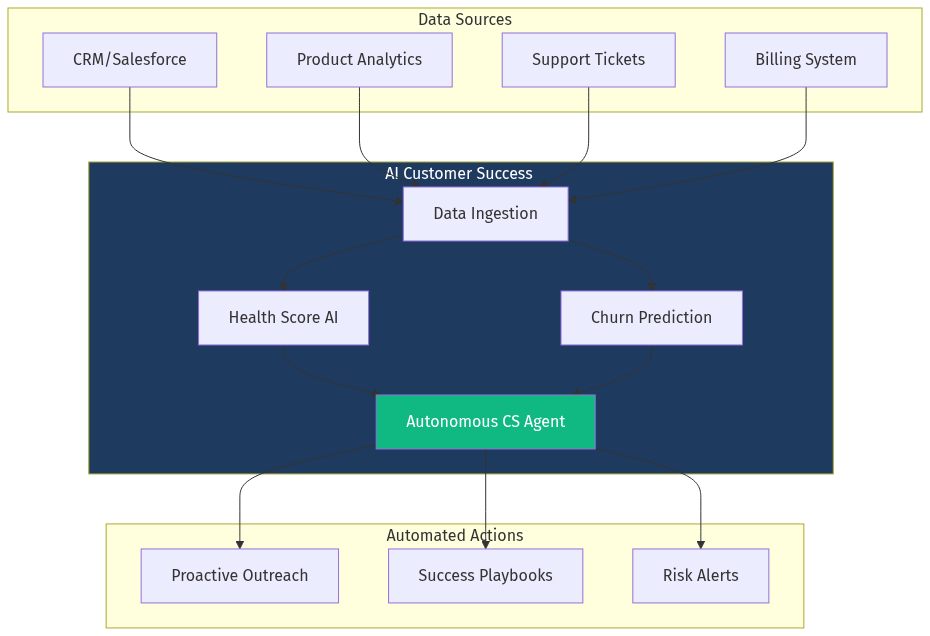
    AI Customer Success Architecture
    AI Customer Success Architecture

    The Autonomous CS Agent Stack

    Layer 1: Unified Customer Data
    • Product analytics (Amplitude, Mixpanel, Pendo)
    • CRM data (Salesforce, HubSpot)
    • Support tickets (Zendesk, Intercom)
    • Billing (Stripe, Chargebee)
    • Communication (email, Slack, call transcripts)
    Layer 2: AI Intelligence Engine
    • Health scoring with explainable AI
    • Churn prediction (30/60/90 day windows)
    • Expansion signal detection
    • Sentiment analysis across all touchpoints
    Layer 3: Autonomous Action Layer
    • Proactive outreach execution
    • Meeting scheduling and QBR prep
    • Playbook triggering without human initiation
    • Escalation to human CSMs for high-touch situations

    What Changes

    TodayWith AI CS Agents
    CSM reviews 50 accounts/weekAgent monitors 5,000 accounts/second
    Health score updates dailyReal-time health with explainable factors
    Reactive churn responseProactive intervention 30+ days earlier
    Generic email templatesHyper-personalized outreach per account
    Manual QBR prep (4 hours)Auto-generated QBR decks (4 minutes)
    Transformation Flow
    Transformation Flow
    DISTANT DOMAIN IMPORT: What solved this elsewhere?

    Algorithmic trading transformed finance by removing human reaction latency. The parallel: CS agents remove human detection latency. A trader can't watch 1000 stocks. A CSM can't watch 1000 accounts. Both problems solved by autonomous monitoring with human oversight.


    7.

    Product Concept

    "Sentinel" — AI Customer Success Agents for Growth-Stage SaaS

    Core Capabilities:
  • Unified Customer 360
  • - Connect 15+ data sources in one click - Real-time data sync (not daily batches) - Natural language queries: "Show me all accounts where usage dropped >20% this month"
  • Predictive Intelligence
  • - Churn risk scoring with explanation ("Usage down 30% + champion left LinkedIn last week") - Expansion likelihood with trigger identification - Renewal forecast with confidence intervals
  • Autonomous Agents
  • - Health Monitor Agent: Watches all signals, surfaces anomalies - Outreach Agent: Sends personalized check-ins when risk detected - Renewal Agent: Initiates renewal conversations 90 days out - Expansion Agent: Identifies and nurtures upsell opportunities - QBR Agent: Auto-generates quarterly business review materials
  • Human-AI Collaboration
  • - Agents handle routine, escalate complex - CSM dashboard shows agent activity and recommendations - One-click override for any agent action - Audit trail for compliance Differentiator: Agents that act, not just analyze. Built for companies with 100-5000 customers where hiring CSMs doesn't scale.
    8.

    Development Plan

    PhaseTimelineDeliverables
    MVP8 weeksUnified data ingestion (5 sources), health scoring, basic churn prediction, alert system
    V1+6 weeksAutonomous outreach agent, Slack/email integration, agent dashboard
    V2+8 weeksFull agent suite (renewal, expansion, QBR), advanced analytics, custom playbooks
    V3+6 weeksExternal signal ingestion (LinkedIn, G2), multi-product support, white-label option

    Technical Stack

    • Data Layer: PostgreSQL + TimescaleDB for time-series, Pinecone for semantic search
    • AI/ML: Fine-tuned Mistral for customer communication, Claude for analysis, custom churn models
    • Integrations: Merge.dev unified API for CRM/support, Segment for product data
    • Agent Framework: LangGraph for stateful agent workflows
    • Infrastructure: Serverless (Vercel/Railway) for cost efficiency at scale

    9.

    Go-To-Market Strategy

    ICP Definition

    • Company Size: $2M-$50M ARR
    • Customer Count: 100-5,000
    • Current State: Using spreadsheets or outgrown Vitally/basic tools
    • Pain: CS team is 1-5 people, can't scale with growth

    Channel Strategy

    1. Content-Led Growth (Primary)
    • CS benchmarking reports with industry data
    • "State of AI in Customer Success" annual report
    • ROI calculator: "What's your CSM doing that an agent could do?"
    2. Community Infiltration
    • Gain Grow Retain community presence
    • CS Ops Slack groups
    • LinkedIn thought leadership from founders
    3. Partnership
    • Integration partners (Segment, HubSpot) featuring in marketplaces
    • CS consulting firms as referral partners
    • Revenue operations agencies for implementation
    4. Product-Led Growth
    • Free tier: Connect 3 data sources, basic health scores
    • Self-serve: $99/month for 100 customers
    • Growth: $499/month for 1000 customers, full agent suite
    • Enterprise: Custom pricing, dedicated agents, SLA

    10.

    Revenue Model

    Pricing Tiers

    TierPriceCustomersFeatures
    Starter$99/moUp to 100Data unification, health scores, alerts
    Growth$499/moUp to 1,000+ Autonomous agents, playbooks, integrations
    Scale$1,499/moUp to 5,000+ Advanced analytics, custom models, API
    EnterpriseCustomUnlimited+ Dedicated support, custom agents, SLA

    Revenue Streams

  • Subscription (80%): Monthly/annual SaaS fees
  • Implementation (10%): Onboarding and data migration services
  • Expansion (10%): Usage-based pricing for agent actions beyond tier limits
  • Unit Economics Target

    • CAC: $2,500 (content + PLG)
    • ACV: $6,000 (Growth tier average)
    • CAC Payback: 5 months
    • Gross Margin: 85%
    • Net Revenue Retention: 115% (expansion via tier upgrades)

    11.

    Data Moat Potential

    SECOND-ORDER THINKING: What accumulates over time?

    Proprietary Data Assets

  • Churn Pattern Library
  • - Cross-customer churn signatures - Industry-specific risk factors - "Customers like yours who showed X churned 80% of the time"
  • Outreach Effectiveness Database
  • - Which messages work for which customer types - Optimal timing and channel by segment - A/B test results across thousands of campaigns
  • Health Score Calibration
  • - Continuous learning from actual outcomes - Industry benchmarks that improve with scale - "Your 75 health score is bottom quartile for your industry"
  • Expansion Signal Corpus
  • - Usage patterns that precede expansion - Trigger identification across verticals - Competitive displacement patterns

    Network Effects

    • More customers → better churn predictions → higher retention → more customers
    • Agent performance improves with every account monitored
    • Industry benchmarks become authoritative with market share

    12.

    Why This Fits AIM Ecosystem

    Strategic Alignment

    AIM.in is building India's largest structured B2B discovery platform. Customer Success Intelligence aligns directly:

  • Vertical Expansion: CS tools are a natural adjacent to the supplier discovery → procurement → relationship management lifecycle
  • Data Synergy: AIM's B2B transaction data can enrich CS signals (supplier health, payment patterns, order frequency)
  • India-First Opportunity: Indian SaaS is booming but CS tooling is dominated by US vendors. Pricing and localization opportunity.
  • Agent Architecture: The autonomous agent pattern being built for CS can extend to other AIM verticals (procurement agents, supplier management agents)
  • Potential Domain

    • customersuccess.in
    • csagent.in
    • retentionai.in (available in portfolio)

    ## Verdict

    Opportunity Score: 8.5/10

    FALSIFICATION (Pre-Mortem)

    If this fails in 2028, why?
  • Incumbents Move Faster: Gainsight/Totango ship autonomous agents before new entrants gain traction
  • Trust Gap: Enterprises refuse to let AI communicate with customers directly
  • Integration Hell: Too many data sources, too many edge cases, implementation takes months not days
  • Market Timing: Economic downturn makes "reduce CSM headcount" messaging politically toxic
  • STEELMANNING (Why Incumbents Win)

    The best argument against this opportunity:

    Gainsight has 10 years of customer data, enterprise relationships, and brand trust. They could ship AI agents tomorrow with training data no startup can match. Switching costs in CS software are high—you don't rip out your health scores mid-quarter. New entrants face a "good enough" incumbent problem where incremental AI features may satisfy the market.

    Why We're Still Bullish

  • Incumbent Inertia: Seat-based pricing models create structural resistance to autonomous agents
  • SMB White Space: Enterprise is defended; $5M-$50M ARR companies are underserved and growing
  • AI-Native Architecture: Building with agents from day one beats bolting AI onto legacy platforms
  • Economic Forcing Function: SaaS efficiency pressure will overcome "trust" concerns within 18 months
  • Recommendation: Build for the SMB/mid-market wedge. Prove autonomous agents work at scale. Let enterprise come to you when their CSMs quit from burnout.

    ## Sources