ResearchSunday, February 15, 2026

AI-Powered B2B Credit Intelligence: Unlocking $500B in SME Trade Finance

India's 63 million SMEs face a $500 billion credit gap — not because they're uncreditworthy, but because traditional underwriting can't see them. AI agents analyzing GST filings, bank statements, and trade relationships in real-time are about to make manual credit assessment obsolete.

9
Opportunity
Score out of 10
1.

Executive Summary

The Indian SME lending market represents one of the largest AI transformation opportunities globally. With 63 million MSMEs contributing 30% of GDP but receiving less than 16% of formal credit, the gap isn't a lack of money — it's a lack of intelligence.

Traditional credit assessment relies on audited financials, collateral, and relationship banking — systems that structurally exclude small businesses. But three converging forces have created a perfect storm:

  • GST digitization — Every B2B transaction now leaves a digital trail
  • Account Aggregator framework — Consent-based data sharing is now legal infrastructure
  • LLM reasoning — AI can now synthesize unstructured data into credit decisions
  • The opportunity: Build the "credit bureau for the informal economy" — AI infrastructure that converts transaction patterns, payment behaviors, and supply chain relationships into bankable creditworthiness signals.

    slug: "credit" ---
    2.

    Problem Statement

    The Credit Paradox

    India's MSMEs generate ₹150 lakh crore ($1.8 trillion) in annual output but can only access ₹25 lakh crore ($300B) in formal credit. The remaining ₹40 lakh crore ($500B) gap is filled by:

    • Informal moneylenders charging 24-60% annually
    • Supplier credit with punishing terms
    • Personal savings and family loans
    • Simply not growing

    Why Traditional Underwriting Fails

    Zeroth Principles Analysis: The fundamental axiom of traditional credit — "past audited performance predicts future repayment" — assumes businesses maintain Western-style books. This axiom is categorically false for 95% of Indian SMEs.
    Traditional SignalSME Reality
    Audited financialsCash-based, informal books
    3-year track recordNew businesses are credit-invisible
    CollateralAssets are often personal/family-owned
    Bank statementsMultiple accounts, cash deposits
    Credit scoreCIBIL doesn't capture B2B behavior
    The real creditworthiness signals exist — they're just invisible to legacy systems:
    • GST filing patterns (consistency, growth, buyer concentration)
    • Bank statement velocity (inflow/outflow ratios, seasonal patterns)
    • Supplier payment behavior (from other businesses)
    • Purchase order pipelines (forward-looking revenue)
    • Industry and geography risk factors

    Who Experiences This Pain?

  • SME owners — Rejected despite profitable operations
  • NBFCs — Want to lend but can't underwrite efficiently
  • Large corporates — Need healthy supply chains but suppliers can't grow
  • Banks — Regulatory pressure to meet PSL targets, no tools to do it safely

  • 3.

    Current Solutions

    CompanyWhat They DoWhy They're Not Solving It
    PerfiosBank statement analysis, GST parsingData extraction, not credit intelligence; sells to lenders who still decide manually
    KarzaKYC, bureau data, GST verificationVerification layer only; doesn't synthesize into creditworthiness
    CredAvenue/YubiDebt marketplace connecting lenders-borrowersDistribution, not underwriting; still requires manual assessment
    Aye FinanceDirect MSME lending with alt-dataLender, not infrastructure; keeps intelligence proprietary
    LendingkartWorking capital loans for SMEsDirect lending with some automation; doesn't serve ecosystem
    OpenBusiness banking with creditNeo-bank with lending; limited to own customers

    Incentive Mapping: Why Status Quo Persists

    Who profits from the current system?
  • Informal lenders — $100B+ annual interest income at risk
  • Large banks — PSL shortfall penalties are cheaper than fixing underwriting
  • Auditing firms — Manual assessment creates consulting revenue
  • Relationship managers — Their value comes from "judgment calls" AI would automate
  • Feedback loops maintaining status quo:
    • Banks that underwrite manually have slow turnaround → SMEs go informal → Banks say "SMEs are unreliable" → More manual screening
    • NBFCs without good data have high NPAs → Tighten criteria → Reject good borrowers → Selection bias toward risky "desperate" applicants

    4.

    Market Opportunity

    Market Size

    SegmentSizeGrowth
    Indian MSME lending market$300B outstanding12% CAGR
    Addressable credit gap$500B unmet demandGrowing with formalization
    Trade finance (factoring, invoice discounting)$50B25% CAGR
    Credit decisioning software (India)$200M35% CAGR
    Account Aggregator ecosystem$5B projected by 2027100%+ CAGR

    Why Now: The Perfect Storm

  • GST Maturity (2017→2026): 9 years of transaction data now exists for 14 million GST-registered businesses. Pattern recognition is finally possible.
  • Account Aggregator Live: RBI's AA framework went live in 2021. 1.8 billion accounts are now consentable. Financial data is no longer locked in silos.
  • OCEN 2.0: Open Credit Enablement Network standardizes loan APIs. Any app can become a lending touchpoint.
  • LLM Reasoning: For the first time, AI can read unstructured data (invoices, WhatsApp conversations, supplier reviews) and synthesize credit signals.
  • Regulatory Push: RBI's co-lending framework + PSL requirements are forcing banks to find MSME borrowers.

  • 5.

    Gaps in the Market

    Applying Anomaly Hunting

    What's surprising about this market?
  • The data exists but nobody synthesizes it. Perfios extracts bank statements. Karza verifies GST. Bureau pulls CIBIL. But no one combines these into a unified creditworthiness score with explainable reasoning.
  • Trade finance is still paper-based. Invoice discounting requires physical verification of invoices that already exist digitally in GST systems. This is absurd in 2026.
  • Supply chain credit doesn't flow. Large corporates know which suppliers are reliable. This knowledge never reaches lenders.
  • Payment behavior is invisible across businesses. If a supplier consistently pays their vendors on time, that's a credit signal — but it's locked in those vendors' books.
  • The Five Gaps

    GapDescriptionOpportunity
    Synthesis GapData exists in silos; no unified intelligence layerBuild the credit reasoning engine
    Explainability GapML models are black boxes; lenders can't defend decisionsLLM-generated credit narratives
    Real-time GapCredit assessment is point-in-time; risk changes dailyContinuous monitoring + alerts
    Network GapB2B relationships are invisible to credit systemsMap trade graphs, derive network scores
    Forward-looking GapHistorical data only; no PO/contract-based lendingUnderwrite future cash flows
    ---
    6.

    AI Disruption Angle

    How AI Agents Transform Credit Assessment

    Current State: Human analyst reviews documents → requests clarifications → makes judgment call → 5-15 day turnaround → 60% rejection rate AI-Native State:
    1. SME connects Account Aggregator + GST credentials (2 minutes)
    2. AI agent pulls 24 months of bank statements + GST filings
    3. Agent analyzes: revenue consistency, buyer concentration, 
       seasonal patterns, payment cycles, growth trajectory
    4. Agent cross-references with bureau data, public filings, 
       industry benchmarks
    5. Agent generates credit report with:
       - Recommended limit
       - Risk factors
       - Mitigating factors  
       - Suggested covenants
    6. Total time: <15 minutes
    7. Explainable reasoning in natural language

    Distant Domain Import: What Other Fields Solved This?

    Insurance Underwriting: InsurTech companies like Lemonade and Root transformed insurance by replacing actuarial judgment with ML models + instant decisions. The same pattern applies to credit. E-commerce Seller Financing: Amazon, Flipkart, and PayPal have been doing "invisible underwriting" for years — extending credit to sellers based on platform transaction data. This proves the model works; it just needs to escape walled gardens. Supply Chain Visibility (Logistics): Project44 and FourKites built "control towers" that synthesize fragmented logistics data. Credit needs the same — a "credit control tower" synthesizing fragmented financial data.

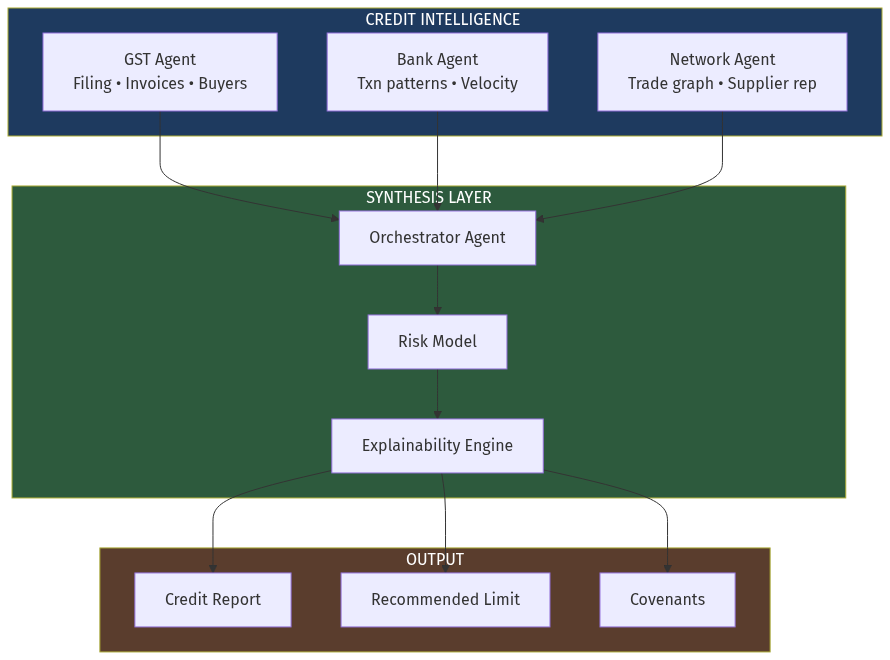
    The AI Agent Architecture

    Credit Intelligence Architecture
    Credit Intelligence Architecture

    7.

    Product Concept

    Core Platform: CreditMind (Working Name)

    What it does: AI-powered credit intelligence infrastructure that transforms raw financial data into bankable creditworthiness signals with explainable reasoning.

    Key Features

    #### For Lenders (NBFCs, Banks, Fintechs)

  • Instant Credit Bureau 2.0
  • - Connect borrower via AA consent - Receive comprehensive credit report in <15 minutes - Explainable AI narratives (not just scores) - Suggested terms and covenants
  • Portfolio Monitoring
  • - Real-time alerts on borrower health changes - Early warning signals before defaults - Automated covenant monitoring
  • Underwriting Co-pilot
  • - AI reviews applications, flags concerns - Generates questions for human review - Learns from lender's approval/rejection patterns

    #### For Corporates (Supply Chain Finance)

  • Supplier Credit Scoring
  • - Score your suppliers' creditworthiness - Identify which suppliers need financing - Enable supply chain lending programs
  • Payment Behavior Network
  • - Contribute your payment data (anonymized) - Access network-wide payment reliability scores - Build "payment reputation" for your suppliers

    #### For Embedded Finance (Apps, Platforms)

  • Credit-as-a-Service API
  • - Single API for credit decisions - White-label integration - OCEN-compatible
    8.

    Development Plan

    PhaseTimelineDeliverables
    Phase 1: Data FoundationWeeks 1-8AA integration, GST parsing engine, bank statement analyzer
    Phase 2: Intelligence LayerWeeks 9-16Credit scoring model, LLM reasoning engine, explainability module
    Phase 3: Lender MVPWeeks 17-24Dashboard, API, pilot with 2-3 NBFCs
    Phase 4: Network EffectsWeeks 25-36Supplier payment network, trade graph, portfolio monitoring
    Phase 5: Embedded DistributionWeeks 37-52OCEN integration, white-label SDK, marketplace connectors

    Technical Architecture

    • Data Layer: Account Aggregator APIs, GST APIs, Bureau APIs
    • Processing: Apache Spark for transaction analysis, TimescaleDB for time-series
    • AI/ML: LLM (Claude/GPT-4) for reasoning + traditional ML for scoring
    • API: REST + GraphQL, OCEN-compliant
    • Compliance: RBI data localization, consent management, audit trails

    9.

    Go-To-Market Strategy

    Phase 1: NBFC Penetration (Months 1-12)

  • Target: Mid-size NBFCs ($100M-$1B AUM) with MSME focus
  • Value prop: "Reduce underwriting time from 5 days to 15 minutes, cut NPAs by 20%"
  • Model: Pilot free, charge per credit decision
  • Goal: 5 paying NBFCs, 10,000 decisions/month
  • Phase 2: Corporate Supply Chain (Months 6-18)

  • Target: Large manufacturers with 500+ suppliers
  • Value prop: "Unlock supply chain financing for your vendors"
  • Model: SaaS platform fee + success fee on financing enabled
  • Goal: 3 enterprise clients, 5,000 suppliers scored
  • Phase 3: Embedded Distribution (Months 12-24)

  • Target: B2B marketplaces, accounting software, neo-banks
  • Value prop: "Add instant credit to your platform"
  • Model: API calls + revenue share on loans originated
  • Goal: 10 embedded partners, 100,000 decisions/month
  • Distribution Insight

    Steelmanning the opposition: Why might direct sales to NBFCs fail?
    • NBFCs have internal risk teams with job security concerns
    • Regulatory requirements may demand human-in-loop
    • Legacy tech stacks resist API integration
    Counter-strategy:
    • Position as "co-pilot" not replacement
    • Start with overflow/rejection pile (low political risk)
    • Offer on-prem deployment for regulated entities

    10.

    Revenue Model

    Revenue StreamPricingYear 1 Target
    Credit Decision API₹50-200 per decision₹2 Cr ($250K)
    Portfolio Monitoring₹5,000/month per ₹10Cr AUM₹1 Cr ($125K)
    Enterprise SaaS₹2-5 lakh/month₹1.5 Cr ($185K)
    Embedded APIRevenue share (0.5-1% of loan)₹50 lakh ($60K)
    Data NetworkSubscription for aggregated insights₹50 lakh ($60K)
    Year 1 Revenue Target: ₹5.5 Cr (~$680K) Year 3 Revenue Target: ₹50 Cr (~$6M) Unit Economics:
    • Cost per credit decision: ₹15-30 (API costs + compute)
    • Price per decision: ₹50-200
    • Gross margin: 70-85%

    11.

    Data Moat Potential

    Compounding Data Advantages

  • Performance Data Loop
  • - Every credit decision creates outcome data - Loan performance improves model accuracy - Accuracy attracts more lenders - More decisions = more data = better accuracy
  • Trade Network Graph
  • - Every supplier relationship mapped - Payment behavior data across the ecosystem - Network effects: more participants = more valuable scores - Becomes the "social graph" of B2B creditworthiness
  • Industry Benchmarks
  • - Aggregate anonymized data by sector, geography, size - Proprietary benchmarks no competitor can replicate - Lenders need benchmarks to calibrate risk
  • Rejection Intelligence
  • - Rejected applications often default elsewhere - Track rejection-to-default correlation - Build "negative signal" database

    Pre-Mortem: Why This Data Moat Might Fail

  • Large banks could build internally — But they haven't in 10 years; organizational antibodies are strong
  • Account Aggregator data isn't proprietary — True, but synthesis + reasoning IS defensible
  • Bureaus (CIBIL, Experian) could expand — They're focused on consumer; B2B is different
  • Network cold-start problem — Solve via corporate supply chains (instant 500+ nodes)

  • 12.

    Why This Fits AIM Ecosystem

    Strategic Alignment

  • B2B Infrastructure Play
  • AIM.in is building B2B discovery infrastructure. Credit intelligence is adjacent infrastructure — discovery leads to transactions, transactions need financing.
  • Data Synergy
  • AIM's supplier directories could feed creditworthiness signals. A supplier's profile completeness, inquiry patterns, and transaction history on AIM become credit inputs.
  • Platform Extension
  • "Find a supplier on AIM → Check their creditworthiness → Finance the purchase order" — complete procurement-to-payment journey.
  • India-First, Global Potential
  • India's AA framework is the most advanced consent infrastructure globally. Build here, export to markets adopting similar frameworks (UK, Australia, Singapore).

    Integration Points

    AIM ComponentCredit Integration
    Supplier Discovery"This supplier has a CreditMind score of 82"
    RFQ System"Pre-qualify vendors by credit limit"
    Transaction HistoryFeed purchase behavior into credit models
    Verified SuppliersVerified badge = credit data shared
    ---

    ## Verdict

    Opportunity Score: 9/10

    Scoring Breakdown

    DimensionScoreReasoning
    Market Size10/10$500B credit gap is massive
    Timing9/10AA live, GST mature, LLMs ready
    Competition7/10Data players exist, but no synthesis layer
    AI Leverage10/10LLMs + network effects create defensibility
    Execution Difficulty7/10Regulatory complexity, enterprise sales cycles
    AIM Fit9/10Natural extension of B2B infrastructure

    Why This Will Succeed

  • Infrastructure timing is perfect: AA + GST + OCEN have created the pipes; now we need the intelligence layer.
  • Incentives are aligned: Lenders want to lend, SMEs want credit, regulators want financial inclusion. Nobody loses.
  • AI is the unlock: Previous attempts failed because synthesis required human judgment. LLMs can now read unstructured data and generate explainable decisions.
  • Network effects are strong: Every participant makes the network more valuable. Winner-take-most dynamics favor the first mover.
  • Key Risk: Regulatory Overhang

    RBI's approach to AI in credit decisions is evolving. Require explainability by design, maintain human-in-loop for high-value decisions, and engage proactively with regulators.

    Recommended Next Steps

  • Validate with 3 NBFCs: Understand their specific pain points and willingness to adopt AI underwriting
  • Build GST analysis prototype: Demonstrate value with synthetic data
  • Partner with AA TSP: Ensure seamless data access
  • Recruit FinTech regulatory expert: Compliance is existential

  • ## Sources